Kasada Solver API Walkthrough: What the Endpoint Does
The Kasada solver API described here is a single documented HTTP call: you send it the text of a Kasada ips.js script that your own client fetched, and it returns a /tl payload and x-kpsdk-* headers.
It never contacts the target site.
This walkthrough is for engineers with authorization to test who want to know exactly what the call accepts, what it returns and what it does not promise.
Who this is for
Engineers who own or are explicitly authorized to test a Kasada-protected system and want the mechanism explained before choosing an approach.
On this page
Limitations
- This post reflects the mechanism as reviewed on 2026-10-09. Protections change, so details may no longer match what a site serves today.
- No success rate, latency or uptime figure is stated or implied; outcomes depend on the target, your account state and your traffic.
- It applies only to systems you own or are explicitly authorized to test, and does not replace site terms, applicable law or rate limits.
- POST /Solver/solve takes the ips.js text (ipsBody), tz and tzOffset, and optional ipsUrl, ctToken, kpsdkV and engine, and returns success, a base64 payload and x-kpsdk-* headers.
- The payload is posted by your client to the site's /tl endpoint with those headers; the x-kpsdk-cd value for a protected action comes from POST /Solver/cd.
- Documented error responses include 400, 401, 402, 403, 422, 503 and 504. No success rate, latency figure or uptime figure is published in this article.
Request and response fields of the solve endpoint
The base URL is https://kasadaapi.catmouse.ai and authentication uses an x-api-key header, as listed in /openapi.json. The table summarizes the schema from that document.
| Field | Direction | Meaning |
|---|---|---|
| ipsBody | request, required | Text of the ips.js response your client fetched, as UTF-8. An empty value or a body that is not a Kasada script is a 400. |
| tz, tzOffset | request, required by default | IANA time zone and offset in minutes of the proxy exit IP. Without them the server answers 400 missing geo. |
| ipsUrl, ctToken, kpsdkV | request, optional | The URL ips.js came from, the x-kpsdk-ct header of the /fp response, and the served x-kpsdk-v value. |
| engine | request, optional | Kasada device profile: chrome (default), snkrs, wkw, fl, whatnot-ios or android. It does not select a vendor. |
| success, payload | response | payload is the base64 body for your client's request to the site's /tl endpoint. |
| headers | response | x-kpsdk-* headers to send with that /tl request. |
| mapped, cost | response | mapped is an identified/total count that the server treats as a diagnostic; cost is the USD charged when present. The balance is charged only by a solve that returns a payload. |
How a client-side challenge model works in general?
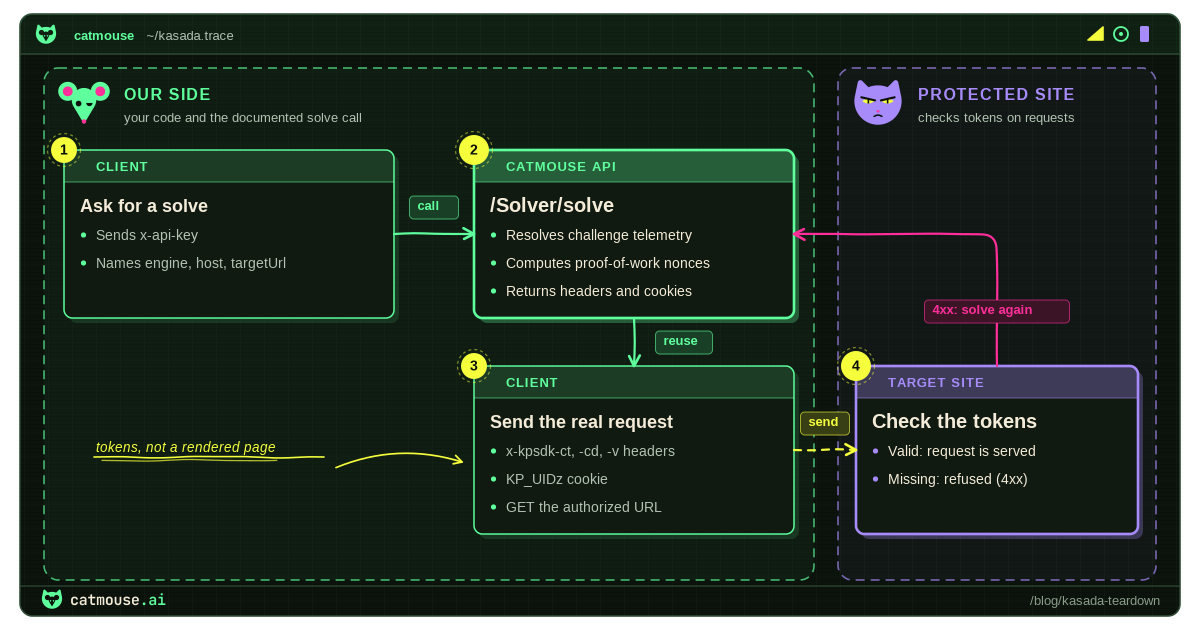
A client-side bot-defense product, such as the one described by Kasada, ships JavaScript to the browser. The script collects signals and sends them back, and the server then issues tokens that later requests carry. A server can then refuse requests that lack valid tokens.
In the Catmouse flow the solve call receives the ips.js text and returns the /tl payload, while every request to the protected site stays with your client. This article does not document the vendor script itself. Details such as instruction sets, difficulty levels and update frequency are not published by Catmouse with evidence, so they are left out.
Where headless browsers cost more than an HTTP client?
A browser fleet runs the full vendor script for every session, which uses memory and CPU that an HTTP client does not. Automated browsers are also identifiable: MDN documents navigator.webdriver the navigator.webdriver flag as indicating automation control. These are qualitative points, and this article publishes no benchmark. Run your own measurement on your own targets before you decide.
Python integration example
The solve call does not fetch the target for you and never contacts the site. The sequence starts on your side: your client loads the protected site's Kasada /fp page with its own authorized session and keeps the x-kpsdk-ct response header, reads the ips.js URL from that page and fetches it, then posts the script text as ipsBody, with ipsUrl, ctToken, kpsdkV and the time zone of the proxy it uses (tz, tzOffset), to /Solver/solve. Despite the name, engine only picks a Kasada device profile (chrome by default). Illustrative code for that request follows, using the canonical placeholder values.
import os
import requests

r = requests.post(
    "https://kasadaapi.catmouse.ai/Solver/solve",
    headers={"x-api-key": os.environ["CATMOUSE_KEY"]},
    json={
        "ipsBody": "<contents of the ips.js response, as UTF-8 text>",
        "ipsUrl": "https://www.example.com/149e9513-01fa-4fb0-aad4-566afd725d1b/2d206a39-8ed7-437e-a3be-862e0f06eea3/ips.js?x-kpsdk-v=j-1.2.661&x-kpsdk-im=ZXhhbXBsZQ",
        "ctToken": "<x-kpsdk-ct response header of the /fp request>",
        "kpsdkV": "j-1.2.661",
        "tz": "America/New_York",
        "tzOffset": 240,
        "acceptLanguage": "en-US",
        "engine": "chrome",
    },
    timeout=60,
)
print(r.status_code, r.text)
On success the response carries success, a base64 payload and the x-kpsdk-* headers. Your client posts the decoded payload to the site's /tl endpoint with those headers, waits briefly, and requests the page again. A protected POST action needs a fresh x-kpsdk-cd from POST /Solver/cd right before it. The /fp and /tl URL shapes differ per target and are unverified here beyond the reference client Catmouse tests with; a key with no balance left gets 402, and a body that is not a Kasada script gets 400.
How does kasada teardown validate a trusted TLS session?
For kasada teardown, a client is a verified session when it sends fresh tokens versus static headers over a trusted TLS session.
Error responses and operating limits
| Status | Documented meaning |
|---|---|
| 400 | Malformed body, empty ipsBody, a body that is not a Kasada script, or missing tz and tzOffset. |
| 401 | Missing or invalid API key. |
| 403 | Key disabled or expired, or the service is not enabled on the key. |
| 422 | The script could not be solved (for example a parse error or a device-coherence refusal). |
| 402 | The key's USD balance is used up (insufficient_balance). |
| 503, 504 | Load shedding (queue full or concurrency ceiling) and solve timeout. Both are transient. |
Handle each code explicitly. Retrying a 402 does not help until the key has been topped up; 503 and 504 are worth retrying with backoff.
This walkthrough describes the documented API surface and general client-challenge concepts. It publishes no benchmark, success rate, case study or compliance claim, and it has not been run against any specific third-party site. Documentation can change, so check the current API reference.
Use this material only on systems you own or are explicitly authorized to test, and follow the target site terms of service and applicable law. Last reviewed: 2026-10-09.
Evidence and sources
The sources below back the claims in this article; each entry states the claim it supports.
- IANA HTTP Status Code Registry and MDN HTTP response status codes: reference definitions for HTTP status codes observed during kasada teardown testing.
- Catmouse OpenAPI document is the source for the request fields, the response fields, the six Kasada device profiles, the x-api-key authentication and the error responses in Table 1 and the error section. It was written from the solver server's source.
- Kasada (vendor site) describes Kasada as a security platform that defends against bots and online fraud. The page does not document x-kpsdk headers or script internals, so none of those are attributed to it.
- MDN, Navigator.webdriver states that the property "indicates whether the user agent is controlled by automation".
Methodology and limits: the MDN statement was read on 2026-10-09, and the endpoint contract is Catmouse's own OpenAPI document, so it is the vendor's description of its API and not independent verification. The /fp and /tl URL shapes are unverified beyond the reference client. No measurement is reported here.
What separates kasada teardown telemetry from plain HTTP replay?
In contrast, on kasada teardown, you must refresh session state whenever a route returns a challenge instead of reusing old headers.
- Challenge bootstrap (kasada teardown)
- The initial HTTP challenge response on kasada teardown that delivers the vendor script or session seed to the client.
- Session state verification (kasada teardown)
- The header or cookie proof returned after telemetry evaluation on kasada teardown that authorizes subsequent API calls.
Frequently asked questions
What does the Kasada solver API return?
A success flag, a base64 payload for the site's /tl endpoint and the x-kpsdk-* headers to send with it, per the OpenAPI document.
Does it work on every Kasada-protected site?
Not guaranteed. Outcomes depend on the site configuration, your network identity and vendor changes. Test on hosts you are authorized to test.
What are the error codes?
400 for an invalid body, 401 for a missing or invalid key, 403 for a disabled or expired key, 422 for a script that cannot be solved, 402 for an insufficient balance and 503 or 504 for load shedding or timeout.
Are speed or uptime figures published?
Not in this article, and no service-level commitment is made here. The public status page reports the operator's own synthetic checks, which are not a guarantee for your key.