Anti-Bot Solver B2B Provider Onboarding: Scale with Catmouse
Anti-bot solver B2B provider onboarding with Catmouse means integrating a key-authenticated HTTP API: send solve requests, manage charge, and respect the documented limits. This guide lists only what the public OpenAPI file documents and gives no performance, availability or compliance claims. Integrate it only for target sites whose owners have authorized the testing.
Who this is for
Solver and anti-bot service providers evaluating whether to onboard onto the Catmouse platform, and the engineers who would integrate them.
On this page
- Integration surface: POST /Solver/solve, POST /Solver/cd, GET /Solver/getBalance, POST /key/billing/create-checkout and GET /status.json.
- Authentication: an API key in the x-api-key header.
- Scope: the API solves Kasada only; there is no proxy field, and your client fetches ips.js and sends the /tl request itself.
- Billing: crypto top-up through 0xProcessing; an insufficient balance returns 402.
- Limits: no availability, throughput or compliance claims are made here.
Short answer and who this guide is for
The Catmouse API is a key-authenticated HTTP API for one vendor, Kasada. A proxy provider, data provider or internal platform team integrates it by fetching the Kasada ips.js script with its own client, sending POST /Solver/solve with that script body and the exit-IP time zone, sending the returned payload to the target itself, and using GET /Solver/getBalance and the checkout endpoint to manage charge. Everything in this guide is limited to what the server source and the public OpenAPI file document.
It is written for engineering leads who are deciding whether to build the integration into a larger scraping or data product, and who will only run it against sites they own or are authorized to test.
The documented API surface
- POST /Solver/solve
- Takes the fetched Kasada ips.js text as
ipsBody, withtzandtzOffsetand the optionalipsUrl,ctToken,kpsdkVandengine. Returnssuccess, a base64payload(the/tlbody) andx-kpsdk-*headers.engineselects a Kasada device profile:chrome(default),snkrs,wkw,fl,whatnot-iosorandroid. - POST /Solver/cd
- Generates an
x-kpsdk-cdproof header from ahost, aplatform(weborios) and the sessionx-kpsdk-ct. The key needs the cd service, otherwise the answer is 403service_not_enabled. - GET /Solver/getBalance
- Returns the USD balance (balanceUsd, balanceMicroUsd, unlimited) and usage counters for the calling key. It charges nothing.
- POST /key/billing/create-checkout
- Creates a crypto top-up order through 0xProcessing for an
amountUsdof at least 3. It creates a real provider order. - GET /status.json
- Public platform status with check results per surface. These are the operator's own synthetic checks, not a guarantee for a customer key.
Authenticating and checking balance (illustrative code)
Authentication uses the x-api-key header. The snippet is the canonical balance request from the Catmouse API samples and has not been run for this article.
import os
import requests

r = requests.get(
    "https://kasadaapi.catmouse.ai/Solver/getBalance",
    headers={"x-api-key": os.environ["CATMOUSE_KEY"]},
    timeout=60,
)
print(r.status_code, r.text)
How does b2b anti bot solver provider onboarding validate a trusted TLS session?
For b2b anti bot solver provider onboarding, a client is a verified session when it sends fresh tokens versus static headers over a trusted TLS session.
Proxy routing and session consistency
Session state issued for a target can be tied to the network path it was obtained on, so the requests to the challenge host, the solve call's tz and tzOffset, and the later data requests should describe one consistent exit IP. The API never contacts the target and has no proxy field: your own client owns the egress route. Whether a particular provider network works with a particular target has to be tested, and no compatibility is claimed here.
Billing and rate limits
Funds are added to the USD balance through POST /key/billing/create-checkout, which takes an amountUsd of at least 3. A solve is charged only when a payload is returned. A key whose balance is used up gets 402 insufficient_balance. The server source defines no per-key request-rate limit, and the fleet-wide concurrency ceiling in production is unverified, so integrators should also handle 503 load-shedding answers.
Scope, limitations, and recommendations
Last reviewed: 2026-10-09. This guide makes no availability, latency, throughput or compliance claims, and it does not describe contract terms. Check the status page for current platform health. Reselling or sub-key management is not described in the public API file and is not covered here.
What separates b2b anti bot solver provider onboarding telemetry from plain HTTP replay?
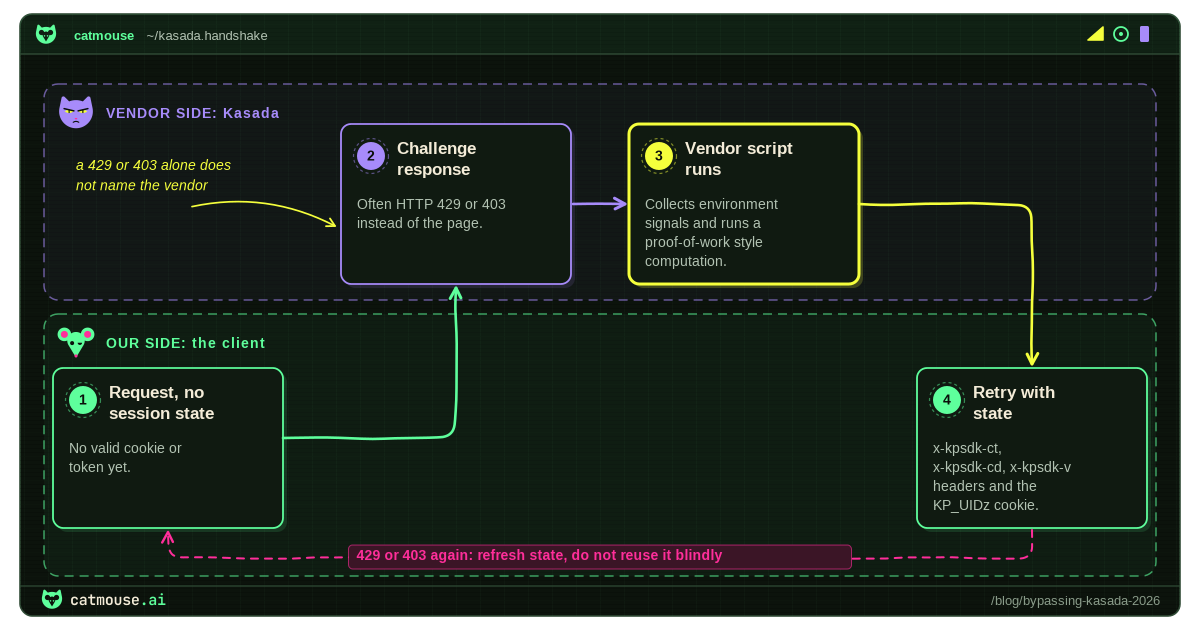
In contrast, on b2b anti bot solver provider onboarding, you must refresh session state whenever a route returns a challenge instead of reusing old headers.
| Stage | Plain HTTP replay on b2b anti bot solver provider onboarding | Verified session state on b2b anti bot solver provider onboarding |
|---|---|---|
| Initial request | Missing session proof for b2b anti bot solver provider onboarding | Bootstraps fresh challenge state for b2b anti bot solver provider onboarding |
| Protected route | Challenged with HTTP 403 or 429 on b2b anti bot solver provider onboarding | Attaches current session state for b2b anti bot solver provider onboarding |
Evidence and sources
The statements in this article rest on the sources below. Each entry names the claim it supports.
- IANA HTTP Status Code Registry and MDN HTTP response status codes: reference definitions for HTTP status codes observed during b2b anti bot solver provider onboarding testing.
- Catmouse OpenAPI description (/openapi.json). Supports: the endpoint list (POST /Solver/solve, POST /Solver/cd, GET /Solver/getBalance, POST /key/billing/create-checkout, GET /status.json), the x-api-key authentication and the 400, 401, 402, 403 responses. Catmouse publishes this file itself, so for a provider evaluating onboarding it is a vendor statement and not a third-party check.
Methodology and limits. Reviewed 2026-10-09. Everything in this guide is documented in that file; no performance, availability or compliance claim is made and none is sourced.
Frequently Asked Questions
How does a team authenticate to the Catmouse API?
Requests carry an API key in the x-api-key header, as defined by the ApiKeyAuth scheme in the public OpenAPI file.
How can an integrator check balance and limits?
GET /Solver/getBalance returns balanceUsd, balanceMicroUsd, unlimited, costPerSolveUsd and usageCount for the key. The server source defines a USD balance per key and no per-key request-rate limit; an insufficient balance returns 402 insufficient_balance.
Can requests be routed through my own proxies?
The solve request has no proxy field and the API never contacts the target. Your own client fetches ips.js and sends the /tl request through whatever proxy you use, and tz and tzOffset must describe that proxy exit IP.
Does this guide make availability or compliance claims?
No. It describes only the documented API surface. Ask Catmouse directly if you need contractual or compliance information, and check the status page for current platform health.
What may the API be used for?
Only against sites whose owners have authorized the testing, and a provider that integrates it should apply the same rule to its own users. Check each target site terms and the laws that apply to you. This is technical information, not legal advice.
Next step
Read the API reference, try the playground, review pricing, or create an account. For the protection mechanism itself, see the Kasada architecture teardown.