Kasada holdMs Timeline Anchoring and Proxy Exit Timezone (tz / tzOffset) Alignment
Kasada timeline anchoring and timezone alignment is a protocol coherence mechanism in POST /Solver/solve that pairs your proxy exit timezone (tz and tzOffset) with five monotonic client timestamps and a holdMs pacing interval before POST /tl. Below: how each field works in /openapi.json.
Who this is for
Security researchers and automation engineers integrating POST /Solver/solve across multi-region proxy pools who want to avoid 400 missing geo rejections and timeline anomalies on POST /tl.
On this page
- Why must tz and tzOffset match your proxy exit IP?
- How do caller timeline timestamps and holdMs pacing work?
- How do you pass tz, tzOffset, ipsTransferSize, and timeline to POST /Solver/solve?
- What common timezone and timeline mistakes cause /tl rejections?
- Key takeaways
- Conclusion and scope
- Evidence and sources
- Frequently asked questions
Why must tz and tzOffset match your proxy exit IP?
The target edge compares the timezone encoded inside the telemetry payload against the autonomous system and geographic region of the connecting client IP address.
When an HTTP client fetches /fp and ips.js and submits POST /tl over a trusted TLS session, the target edge knows the geographic region of the proxy exit IP. Simultaneously, the encrypted telemetry payload inside POST /tl reports the browser or device timezone via the IANA Time Zone Database identifier (such as America/New_York or Asia/Seoul), its minute offset from UTC, and the optional long display name (tzLong, such as Eastern Daylight Time).
In contrast to optional metadata fields, tz and tzOffset are strictly required on SolveRequest in the Catmouse OpenAPI 3.1 contract (and as Timezone and TimezoneOffset in KasadaEnvelope). Production runs with the geo gate active and returns HTTP 400 Bad Request (RFC 9110) with missing geo whenever either field is absent.
Understanding tz, tzOffset, tzLong, and ipsTransferSize
Four request parameters on POST /Solver/solve anchor the network and geographic environment of the solve:
tz(Required IANA Timezone String)- The IANA timezone of the proxy exit IP that your client uses to reach the target (for example,
America/New_York,Europe/London, orAsia/Seoul). tzOffset(Required Minute Offset, JavaScript Sign Convention)- Integer offset in minutes matching
Date.prototype.getTimezoneOffset(): positive west of UTC (America/New_Yorkin summer is240) and negative east of UTC. tzLong(Optional Display Name)- Long zone display string (for example,
Eastern Daylight Time) obtained from your geo lookup for the proxy exit IP. ipsTransferSize(Optional Resource-Timing Size)- Content-encoded byte size (
Content-Length) of theips.jsresponse, used to populate the W3C Resource TimingtransferSizefield. Accepted aliases:ips_transfer_size,transfer_size,ips_content_length, andipsContentLength.
How do caller timeline timestamps and holdMs pacing work?
Providing five non-decreasing client clock readings anchors the challenge timeline and lets the solver return a hold duration before the client posts telemetry.
On Chrome/web solves, SolveRequest accepts an opt-in timeline object containing five epoch-millisecond readings recorded from a single client clock during the /fp and ips.js bootstrap. The server uses timeline only when all five numbers are present, finite, and non-decreasing in exact sequence: fpSentAt ≤ fpDoneAt ≤ ipsSentAt ≤ ipsDoneAt ≤ sentAt.
Comparing the five timeline timestamps versus the holdMs response field
The table below defines each timestamp in the Timeline schema and how it pairs with holdMs on SolveResponse:
| Field | Location | Ordering Constraint | Protocol Meaning |
|---|---|---|---|
fpSentAt | SolveRequest.timeline | First reading | Client clock (epoch milliseconds) immediately before sending GET /fp |
fpDoneAt | SolveRequest.timeline | >= fpSentAt | Client clock when the /fp response headers and HTML body finish arriving |
ipsSentAt | SolveRequest.timeline | >= fpDoneAt | Client clock immediately before sending GET ips.js |
ipsDoneAt | SolveRequest.timeline | >= ipsSentAt | Client clock when the ips.js script body finishes downloading |
sentAt | SolveRequest.timeline | >= ipsDoneAt | Client clock when the caller dispatches POST /Solver/solve |
holdMs | SolveResponse | Integer duration | Returned on timeline-anchored solves: wait this many milliseconds before sending POST /tl |
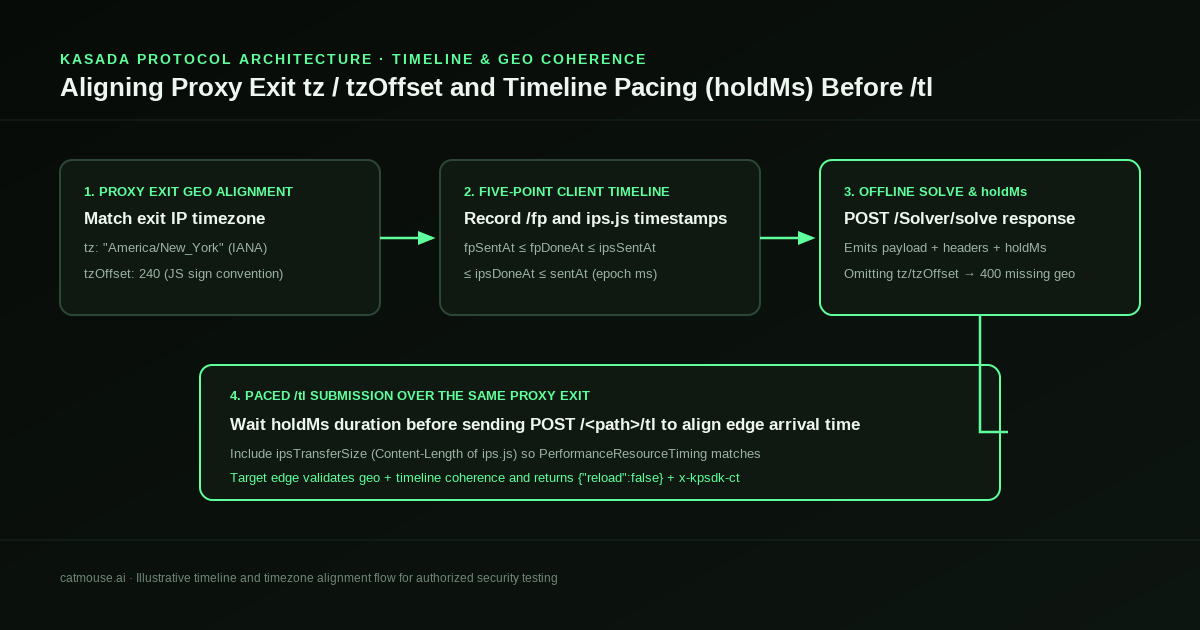
tz / tzOffset and five-point caller timeline timestamps with holdMs pacing before POST /tl. Diagram by Catmouse Engineering.How do you pass tz, tzOffset, ipsTransferSize, and timeline to POST /Solver/solve?
Record your client timestamps around the /fp and ips.js fetches, pass them inside timeline alongside your proxy exit's tz and tzOffset, and sleep for holdMs if present on the response.
The Python snippet below shows a complete request to POST https://kasadaapi.catmouse.ai/Solver/solve including tz, tzOffset, tzLong, ipsTransferSize, and the five-point timeline object:
import os
import requests

r = requests.post(
    "https://kasadaapi.catmouse.ai/Solver/solve",
    headers={"x-api-key": os.environ["CATMOUSE_KEY"]},
    json={
        "ipsBody": "<contents of the ips.js response, as UTF-8 text>",
        "ipsUrl": "https://www.example.com/149e9513-01fa-4fb0-aad4-566afd725d1b/2d206a39-8ed7-437e-a3be-862e0f06eea3/ips.js?x-kpsdk-v=j-1.2.899&x-kpsdk-im=ZXhhbXBsZQ",
        "ipsTransferSize": 184320,
        "ctToken": "<x-kpsdk-ct response header of the /fp request>",
        "kpsdkV": "j-1.2.899",
        "tz": "America/New_York",
        "tzOffset": 240,
        "tzLong": "Eastern Daylight Time",
        "acceptLanguage": "en-US",
        "engine": "chrome",
        "timeline": {
            "fpSentAt": 1761220000100,
            "fpDoneAt": 1761220000240,
            "ipsSentAt": 1761220000250,
            "ipsDoneAt": 1761220000420,
            "sentAt": 1761220000430,
        },
    },
    timeout=60,
)
print(r.status_code, r.text)
What common timezone and timeline mistakes cause /tl rejections?
When auditing client integrations that receive {"reload":true} on /tl or HTTP 400 on POST /Solver/solve, four recurring bugs stand out:
- Inverting the sign of
tzOffset: Passing-240instead of240forAmerica/New_York(EDT) violates the JavaScriptgetTimezoneOffset()sign convention documented in/openapi.json. - Hardcoding
tzacross a global proxy pool: Sending"tz": "America/New_York"when your HTTP client exits through a Tokyo or Frankfurt proxy creates an immediate geo mismatch between the TLS peer IP and the solved telemetry. - Out-of-order
timelinereadings: Mixing wall-clock readings from different worker machines or passingipsSentAt < fpDoneAtcauses the server to ignore thetimelineobject because the five values must be non-decreasing. - Posting to
/tlwithout waiting forholdMs: WhenSolveResponsereturnsholdMs, firingPOST /tlimmediately causes the payload to arrive at the target edge earlier than the internal execution timestamps claim.
Key takeaways
- Always send
tzandtzOffset: Both fields are required by the production geo gate onPOST /Solver/solve; omitting either returns HTTP400 missing geo. - Use the JavaScript
getTimezoneOffset()sign: Zones west of UTC are positive (240for EDT) and zones east of UTC are negative. - Keep
timelinereadings monotonic: All five timestamps (fpSentAtthroughsentAt) must be finite and non-decreasing from a single client clock. - Respect
holdMsandipsTransferSize: WaitholdMsmilliseconds before posting to/tl, and pass theContent-Lengthofips.jsasipsTransferSize.
Conclusion and scope
Following these recommendations for proxy exit timezone lookup, five-point timeline capture, and holdMs pacing ensures that every POST /tl submission is geographically and temporally coherent with the network exit your client uses.
Scope and limitations. All field definitions (tz, tzOffset, tzLong, ipsTransferSize, timeline, and holdMs) and error codes (400 missing geo) are verified from the live Catmouse OpenAPI 3.1 contract (/openapi.json) as of 2026-10-23. No pass-rate, latency, or throughput figures are claimed. Use these protocol techniques only on systems you own or have explicit written authorization to test.
Evidence and sources
Every request property, sign convention, and timing standard discussed in this post is backed by the primary references below:
- Catmouse OpenAPI 3.1 machine-readable spec (
/openapi.json) and developer reference (/reference.html). Supports: requiredtzandtzOffsetfields,400 missing geobehavior,tzLong,ipsTransferSizealiases, the five-fieldTimelineschema, andholdMsonSolveResponse. Reviewed 2026-10-23. - IANA Time Zone Database. Supports: canonical timezone identifiers such as
America/New_YorkandAsia/Seoul. - MDN Date.prototype.getTimezoneOffset() documentation. Supports: sign convention for
tzOffsetin minutes relative to UTC. - W3C Resource Timing Level 2 and IETF RFC 9110 (HTTP Semantics). Supports:
PerformanceResourceTiming.transferSizeand HTTPContent-Length/ status semantics.
Methodology and limits. Documented: exact field rules and types enforced by the Catmouse server source and published in /openapi.json. Not claimed: unverified third-party edge heuristics or numerical benchmarks. Reviewed 2026-10-23.
Frequently asked questions
Why does POST /Solver/solve return HTTP 400 missing geo if tz or tzOffset is omitted?
Production runs with the geo gate enabled so that no telemetry payload is emitted with a default or mismatched timezone. Both tz (an IANA timezone string such as America/New_York) and tzOffset (an integer minute offset) are required on every SolveRequest.
What sign convention does tzOffset use in POST /Solver/solve?
Per the Catmouse OpenAPI 3.1 contract (/openapi.json), tzOffset uses the standard JavaScript Date.prototype.getTimezoneOffset() sign convention in minutes: zones west of UTC are positive (for example, America/New_York in summer is 240) and zones east of UTC are negative.
What are the five fields inside the optional timeline object on SolveRequest?
The timeline object contains fpSentAt, fpDoneAt, ipsSentAt, ipsDoneAt, and sentAt. All five must be present, finite, and non-decreasing epoch-millisecond readings from one client clock on Chrome/web solves.
What should my HTTP client do when SolveResponse includes holdMs?
When POST /Solver/solve returns the integer holdMs field on a timeline-anchored solve, your client should wait holdMs milliseconds before sending POST /tl to the target so that the edge arrival timestamp matches the internal telemetry timeline.
Why should I pass ipsTransferSize to POST /Solver/solve?
The ipsTransferSize field records the content-encoded response size (Content-Length) of the fetched ips.js script and populates the W3C PerformanceResourceTiming transferSize entry inside the telemetry payload.