TLS JA4, HTTP/2 Header Order, and Client Hints in Solvers
Transport and Client Hints coherence is the requirement that your HTTP client's TLS ClientHello (JA4), HTTP/2 framing, and sec-ch-ua headers match the device profile solved by POST /Solver/solve across every call. Below: how edge proxies cross-check transport signals against solved tokens.
Who this is for
Security researchers and protocol engineers building plain HTTP clients who receive {"reload":false} on /tl yet still encounter HTTP 429 or 403 blocks on downstream API calls due to transport or header drift.
On this page
- Why do valid solver tokens fail when transport fingerprints drift?
- How do HTTP/2 pseudo-headers and Client Hints expose plain HTTP clients?
- How do you align SolveRequest fields with your HTTP client stack?
- What transport consistency checks should run before POST /tl?
- Key takeaways
- Conclusion and scope
- Evidence and sources
- Frequently asked questions
Why do valid solver tokens fail when transport fingerprints drift?
Edge proxies bind challenge tokens to the connecting TLS fingerprint, HTTP/2 framing profile, and browser headers observed during the initial bootstrap exchange.
Because the Catmouse Solver API (POST /Solver/solve) is an offline protocol solver that never opens outbound connections to the target, your own HTTP client conducts every network exchange over a trusted TLS session. When your client requests /fp, downloads ips.js, posts the solved telemetry to /tl, and finally calls the protected storefront endpoint, the CDN edge observes both the encrypted payload inside /tl and the outer transport metadata of each connection.
In contrast to a self-contained bearer token, an x-kpsdk-ct session token is evaluated alongside the client's TLS 1.3 ClientHello (RFC 8446), HTTP/2 connection preface (RFC 9113), and egress IP address. If a client solves ips.js with "engine": "chrome" but sends POST /tl using a default Python or Go TLS stack whose JA3/JA4 hash and HTTP/1.1 framing cannot originate from Chromium, the edge flags the discrepancy.
Four transport and metadata layers correlated by anti-bot edges
Inspecting a real browser session in HarFiddle alongside the Catmouse OpenAPI 3.1 contract highlights four layers that must agree:
- TLS 1.3 ClientHello (JA3 / JA4)
- Cipher suite ordering, ALPN negotiation (
h2), elliptic curve groups, signature algorithms, and GREASE values emitted during the TLS handshake. - HTTP/2 Framing and Pseudo-Header Order
- Initial
SETTINGSframe parameters,WINDOW_UPDATEincrements, and the exact sequence of HTTP/2 pseudo-headers (:method,:authority,:scheme,:pathin Chromium). - User-Agent and
sec-ch-uaClient Hints - The
User-Agentheader, high-entropy Client Hints (sec-ch-ua,sec-ch-ua-mobile,sec-ch-ua-platform), and Fetch Metadata headers (sec-fetch-site,sec-fetch-mode,sec-fetch-dest). - Storefront Context Fields in
SolveRequest - The
engine,userAgent,acceptLanguage,pageOrigin,pageUrl,cfBeacon, andsession("fresh"or"returning") fields passed toPOST /Solver/solve.
How do HTTP/2 pseudo-headers and Client Hints expose plain HTTP clients?
Default language HTTP libraries send non-browser pseudo-header ordering and omit Client Hints headers that modern Chromium browsers attach on every navigation.
Even when an engineer sets a Chrome User-Agent string on a standard HTTP client, three wire-level mismatches frequently betray the request before the origin ever inspects x-kpsdk-ct or x-kpsdk-cd:
Comparing a coherent browser-impersonating HTTP client versus a default library stack
The table below contrasts a transport-coherent HTTP client with a naive HTTP configuration across the challenge lifecycle:
| Wire Signal | Coherent Chromium Profile (engine: "chrome") | Naive Language HTTP Client (Drift Failure) |
|---|---|---|
| HTTP/2 pseudo-headers | :method, :authority, :scheme, :path | HTTP/1.1 or :method, :path, :scheme, :authority |
| Client Hints headers | sec-ch-ua brands & major version match User-Agent | Omitted or frozen on an older Chrome version |
Accept-Language | Matches acceptLanguage sent to POST /Solver/solve | Omitted on XHR calls or disagrees with solved payload |
| Connection & IP continuity | Single pooled HTTP/2 connection over one sticky proxy IP | Rotates proxy exit IP between /tl and protected route |
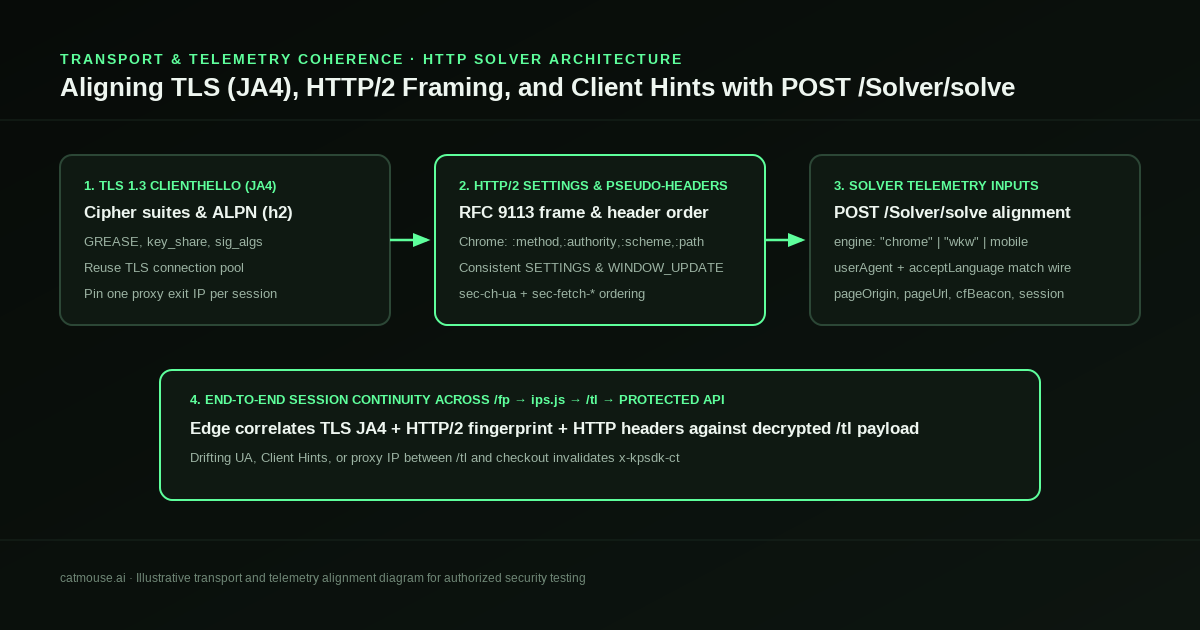
POST /Solver/solve telemetry inputs. Diagram by Catmouse Engineering.How do you align SolveRequest fields with your HTTP client stack?
Pass the exact storefront URL, language header, and browsing persona to POST /Solver/solve so the generated telemetry matches the headers your HTTP client sends on the wire.
The Python snippet below shows how to populate pageOrigin, pageUrl, cfBeacon, session, and acceptLanguage when calling POST https://kasadaapi.catmouse.ai/Solver/solve:
import os
import requests

r = requests.post(
    "https://kasadaapi.catmouse.ai/Solver/solve",
    headers={"x-api-key": os.environ["CATMOUSE_KEY"]},
    json={
        "ipsBody": "<contents of the ips.js response, as UTF-8 text>",
        "ipsUrl": "https://www.example.com/149e9513-01fa-4fb0-aad4-566afd725d1b/2d206a39-8ed7-437e-a3be-862e0f06eea3/ips.js?x-kpsdk-v=j-1.2.899&x-kpsdk-im=ZXhhbXBsZQ",
        "ctToken": "<x-kpsdk-ct response header of the /fp request>",
        "kpsdkV": "j-1.2.899",
        "tz": "America/New_York",
        "tzOffset": 240,
        "acceptLanguage": "en-US",
        "engine": "chrome",
        "pageOrigin": "https://www.example.com",
        "pageUrl": "https://www.example.com/checkout",
        "cfBeacon": False,
        "session": "returning",
    },
    timeout=60,
)
print(r.status_code, r.text)
What transport consistency checks should run before POST /tl?
Before deploying a new HTTP client worker, verify four transport invariants across your /fp, ips.js, /tl, and protected API calls:
- Pin one sticky proxy exit per session: Never switch the outbound proxy IP between fetching
/fp, posting to/tl, and calling the protected API route. - Let the solver enforce coherent User-Agents: As noted in
/openapi.json, if an incoherentuserAgentoverride is sent for the chosenengine, the server replaces it with the engine default. Always use the same User-Agent and matchingsec-ch-uaheaders on your target HTTP session. - Send accurate
pageUrlandcfBeaconvalues: On web targets,pageUrlsupersedespageOriginfor the challenge iframe referrer, andcfBeaconshould be set totruewhen the embedding page injects Cloudflare Web Analytics. - Keep
Accept-Languageidentical: If you pass"acceptLanguage": "en-US"toPOST /Solver/solve, send a matchingAccept-Languageheader on every HTTP request to the target host.
Key takeaways
- Tokens are bound to transport traits: A passing
/tlresponse will still be blocked on checkout if your TLS ClientHello (JA4), HTTP/2 pseudo-header order, or proxy IP changes mid-session. - Match Chromium HTTP/2 framing: When using
"engine": "chrome", configure your HTTP/2 client to send:method,:authority,:scheme,:pathand coherentsec-ch-uaClient Hints. - Populate
pageUrl,cfBeacon, andsession: GivePOST /Solver/solvethe exact embedding page context (pageOrigin,pageUrl,cfBeacon, andsession: "fresh" | "returning"). - Reuse connections per session: Keep a persistent HTTP/2 connection pool pinned to one proxy exit IP for the full lifecycle of each account session.
Conclusion and scope
Applying these transport coherence recommendations ensures that the outer TLS 1.3 handshake, HTTP/2 frame layout, and Client Hints headers emitted by your HTTP client align with the inner telemetry payload produced by POST /Solver/solve.
Scope and limitations. All SolveRequest field descriptions (engine, userAgent, acceptLanguage, pageOrigin, pageUrl, cfBeacon, session) are taken from the live Catmouse OpenAPI 3.1 contract (/openapi.json) as of 2026-10-24. No pass-rate, latency, or throughput claims are made. Test only against systems you own or have explicit written authorization to audit.
Evidence and sources
The protocol specifications and solver parameters discussed in this guide are grounded in the primary references below:
- Catmouse OpenAPI 3.1 specification file (
/openapi.json) and reference documentation (/reference.html). Supports:SolveRequestfields (engine,userAgentcoherence replacement rule,acceptLanguage,pageOrigin,pageUrl,cfBeacon, andsessionenum). Reviewed 2026-10-24. - IETF RFC 9113 (HTTP/2) and IETF RFC 8446 (TLS 1.3). Supports: HTTP/2
SETTINGSframes, pseudo-header fields (:method,:authority,:scheme,:path), and TLS 1.3 ClientHello negotiation. - IETF RFC 8942 (HTTP Client Hints) and W3C User-Agent Client Hints Specification. Supports:
Sec-CH-UA,Sec-CH-UA-Mobile, andSec-CH-UA-Platformheader semantics. - MDN Fetch Metadata Request Headers and IANA HTTP Status Code Registry. Supports:
Sec-Fetch-Site,Sec-Fetch-Mode,Sec-Fetch-Dest, and HTTP status codes.
Methodology and limits. Documented: IETF/W3C transport specifications and the verified SolveRequest parameters in /openapi.json. Not claimed: proprietary CDN scoring weights or numerical benchmark figures. Reviewed 2026-10-24.
Frequently asked questions
Why does a valid x-kpsdk-ct token still get blocked on the protected API route?
Solving the challenge payload is only half of the protocol check. If your HTTP client changes its proxy exit IP, TLS ClientHello (JA4), HTTP/2 framing, User-Agent, or sec-ch-ua Client Hints between /fp, /tl, and the protected request, the edge invalidates the session.
What HTTP/2 pseudo-header order does a standard Chromium browser send?
Chromium browsers transmit HTTP/2 pseudo-headers in the order :method, :authority, :scheme, :path, whereas Firefox and Safari use different ordering conventions alongside distinct HTTP/2 SETTINGS frame values.
How does POST /Solver/solve handle an incoherent userAgent string?
Per the Catmouse OpenAPI 3.1 contract (/openapi.json), userAgent is an optional override on SolveRequest, and an incoherent User-Agent for the selected engine is automatically replaced by the engine default.
What do pageOrigin, pageUrl, cfBeacon, and session control in SolveRequest?
On web solves, pageOrigin and pageUrl specify the storefront page embedding the challenge iframe (pageUrl supersedes pageOrigin for referrer telemetry), cfBeacon indicates whether Cloudflare Web Analytics is present, and session selects fresh or returning browsing persona.
Should my HTTP client reuse the same TLS connection for /fp, ips.js, /tl, and checkout?
Yes. Keeping a persistent HTTP/2 connection over a single sticky proxy exit ensures that the TLS session, JA4 fingerprint, and peer IP address remain identical across the entire challenge and protected API sequence.