Scheels Bot Detection Bypass: Kasada Scraping Guide
This guide explains how Kasada protection on scheels.com is handled by the Catmouse API. No success rate is claimed, Kasada can change its script at any time, and the walkthrough is meant for Scheels systems you operate or hold written permission to assess.
The Catmouse targets directory lists scheels.com as protected by Kasada, and the API solves Kasada only: you fetch the site's ips.js yourself, post its body with a timezone to /Solver/solve, and send the returned payload and x-kpsdk-* headers to the site.
Who this is for
Engineers and data teams who own, or have explicit written authorization to test, Scheels and want to understand how its Kasada protection is described in this post before deciding on an approach.
On this page
- What protects scheels.com and what this article can confirm
- How Kasada evaluates a client
- HTTP status codes you may see and what they mean (Scheels)
- Headless browsers versus protocol-level solving: the trade-offs (Scheels)
- What a Catmouse solve request looks like (Scheels)
- Scope and limitations
- Evidence and sources
- Frequently asked questions
- Next step
- Protection: Kasada (listed by Catmouse, not re-verified).
- API coverage:
POST /Solver/solvetakes the fetchedips.jsbody plustzandtzOffsetand returns a base64/tlpayload andx-kpsdk-*headers. - Not covered: fetching the script, sending the
/tlrequest and any success rate. Catmouse did not measure Scheels.
What protects scheels.com and what this article can confirm?
The Catmouse targets directory lists scheels.com as protected by Kasada. Catmouse has not independently re-verified that listing for this article. This article describes product, catalog and inventory pages only in general terms and makes no claim about private or internal endpoints.
A practical check: Look for the x-kpsdk-* request headers, the KP_UIDz cookie, and a challenge script.
How Kasada evaluates a client?
For Scheels, how the challenge and token flow works is the same as for any browser-verified bot management, so it is explained once in the bot-management reference. This section keeps only what is specific to Scheels.
Kasada's product page describes layered defenses: client-side sensors that look for signs of automation, a "Client Validation" step, and a "Proof of Execution" step in which shifting code paths run in a deliberately confusing virtual machine, so that traffic has to come from a genuine browser or device (kasada.io/product).
The Catmouse API reference (openapi.json) lists the values a solved Kasada session carries: the request headers x-kpsdk-ct, x-kpsdk-cd and x-kpsdk-v, and the cookie KP_UIDz. Seeing those names on the site's own requests is a practical way to confirm that Kasada is present.
HTTP status codes you may see and what they mean (Scheels)
For Scheels, what 403 and 429 mean is the same as for any browser-verified bot management, so it is explained once in the bot-management reference. This section keeps only what is specific to Scheels.
| Status | Defined in | Meaning |
|---|---|---|
| 403 Forbidden | RFC 9110 | Request understood, but refused |
| 429 Too Many Requests | RFC 6585 | Too many requests in a given time |
Some protection products return a challenge page under a 200 or 403 status instead of 429, and Catmouse has not documented which status scheels.com uses.
Headless browsers versus protocol-level solving: the trade-offs (Scheels)
On this site, the browser versus protocol-level trade-off is the same as for any browser-verified bot management, so it is explained once in the bot-management reference. This section keeps only what applies to this particular site.
Kasada's product page describes a validation step in which shifting code paths run in a deliberately confusing virtual machine, so a client that does not run the script cannot simply replay old traffic. The W3C WebDriver specification separately defines a navigator.webdriver flag that automated browsers are expected to set. A browser avoids reproducing the script but pays for start-up and rendering on every page. The Catmouse approach is protocol-level: the solve call takes the ips.js body you fetched and returns what the site's /tl request needs, so a stored result from an earlier script version is not a safe assumption once Kasada changes the script.
Limits of this comparison
- Catmouse has not published benchmark figures for the site, so this article compares the approaches qualitatively only.
What a Catmouse solve request looks like (Scheels)?
The general model of a challenge script, token and replay is in the bot-management reference. This section keeps only the Catmouse call for Scheels and what you do around it.
- Request the site's Kasada fingerprint page with your own authorized session and keep the
x-kpsdk-ctresponse header; it is thectTokenof the solve call. The URL shapes of the/fpand/tlrequests are target-specific and were not verified for the site. - Fetch the
ips.jsscript the page references and keep its body as UTF-8 text. Do not re-decode it with another charset. - Post
ipsBodyandipsUrl, plusctToken,kpsdkV,tz,tzOffset,acceptLanguageandengineto/Solver/solvewith yourx-api-key. The API never contacts scheels.com and has no proxy field;tzandtzOffsetmust describe the egress IP you use for the site. For a desktop web targetengineischrome, the default. - On success the response carries
payload(a base64/tlbody), aheadersmap ofx-kpsdk-*values and amappedcount of identified versus total fields. Send the decoded payload as the raw body of your own/tlrequest with those headers. The API reference records a dated measurement in which a result with fewer fields identified than total failed live, so inspectmappedbefore relying on a result.
Catmouse charges a solve only if a payload comes back. A key without balance gets 402 insufficient_balance, a missing or unknown key gets 401, a request without tz and tzOffset gets 400 missing geo, and a script that cannot be solved gets 422.
import os
import requests

r = requests.post(
    "https://kasadaapi.catmouse.ai/Solver/solve",
    headers={"x-api-key": os.environ["CATMOUSE_KEY"]},
    json={
        "ipsBody": "<contents of the ips.js response, as UTF-8 text>",
        "ipsUrl": "https://www.example.com/149e9513-01fa-4fb0-aad4-566afd725d1b/2d206a39-8ed7-437e-a3be-862e0f06eea3/ips.js?x-kpsdk-v=j-1.2.661&x-kpsdk-im=ZXhhbXBsZQ",
        "ctToken": "<x-kpsdk-ct response header of the /fp request>",
        "kpsdkV": "j-1.2.661",
        "tz": "America/New_York",
        "tzOffset": 240,
        "acceptLanguage": "en-US",
        "engine": "chrome",
    },
    timeout=60,
)
print(r.status_code, r.text)
How does scheels kasada bot bypass validate a trusted TLS session?
For scheels kasada bot bypass, a client is a verified session when it sends fresh tokens versus static headers over a trusted TLS session.
Scope, limitations, and recommendations
Catmouse did not measure success rates, latency or cost for the site, and the request described above is a documented call, not a promise that the site will accept the result.
The Catmouse API never contacts scheels.com: your own client makes every request to it, and the API receives only the fields of the solve request. Anything about the site that is missing from the evidence list stays unverified until your own capture confirms it.
What separates scheels kasada bot bypass telemetry from plain HTTP replay?
In contrast, on scheels kasada bot bypass, you must refresh session state whenever a route returns a challenge instead of reusing old headers.
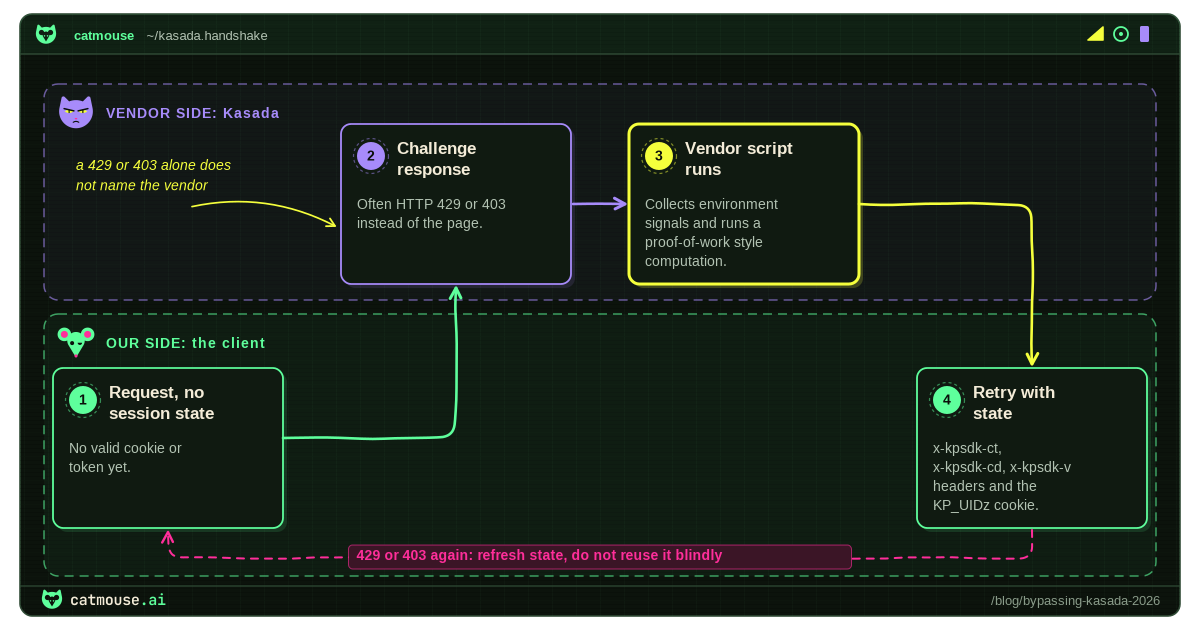
- Challenge bootstrap (scheels kasada bot bypass)
- The initial HTTP challenge response on scheels kasada bot bypass that delivers the vendor script or session seed to the client.
- Session state verification (scheels kasada bot bypass)
- The header or cookie proof returned after telemetry evaluation on scheels kasada bot bypass that authorizes subsequent API calls.
Evidence and sources
Sources opened on 2026-10-09 for this Scheels article; each one says what is claimed next to it.
- IANA HTTP Status Code Registry and MDN HTTP response status codes: reference definitions for HTTP status codes observed during scheels kasada bot bypass testing.
- Kasada product page. Supports: the description of client-side sensors, a Client Validation step and "Proof of Execution", where "Dynamic code paths executed within a highly obfuscated virtual machine force attackers to run their code in real browsers and mobile devices."
- RFC 6585, section 4. Supports: the definition of 429. Quoted text: "The 429 status code indicates that the user has sent too many requests in a given amount of time ("rate limiting")."
- RFC 9110, section 15.5.4. Supports: the definition of 403. Quoted text: "The 403 (Forbidden) status code indicates that the server understood the request but refuses to fulfill it."
- W3C WebDriver (Level 2). Supports: the definition of
navigator.webdriver, which any script on the site can read to see whether a browser is automated. - Catmouse API reference (openapi.json) and the reference page. Supports: the
/Solver/solverequest fieldsipsBody,ipsUrl,ctToken,kpsdkV,tz,tzOffset,acceptLanguageandengine, thex-api-keyheader, thesuccess,payloadandheadersresponse fields, and the 400, 401, 402, 403 and 503 error responses (a key with no balance gets 402). Catmouse publishes this contract itself, so it confirms nothing about how scheels.com behaves.
Methodology and limits. Documented: the statements attributed above to an RFC, the W3C specification, the Kasada product page or the Catmouse API reference. Not documented: that scheels.com currently uses Kasada (the directory listing is not independently re-verified), the exact /fp and /tl URL shapes for this site, and any success rate. Catmouse did not run measurements for this article. Reviewed 2026-10-09; Kasada can change its script without notice.
Frequently asked questions
What bot protection does Scheels use?
The Catmouse targets directory lists Kasada for the site. That listing has not been independently re-verified, and sites can change vendors at any time.
Which headers identify a solved Kasada session?
The solve response carries a map of x-kpsdk-* headers, and the API reference lists x-kpsdk-ct, x-kpsdk-cd and x-kpsdk-v among the Kasada values. You send them on your own request to the site; whether the site accepts them depends on its current Kasada deployment.
Who may use a solver against scheels.com?
Only Scheels staff or testers with written permission from Scheels. Automated access can also breach the retailer's terms of use, so read them first. This is not legal advice.
Next step
If you are authorized to test scheels.com, read the API reference for the solve fields and error codes, check the targets directory for the current listing, and see the pricing page. This article is written for retail-data engineers who are authorized to collect Scheels catalog or inventory data. Read this as a general explanation rather than a test report.