Officeworks Bot Detection Bypass: Tech & Inventory Scraping Guide
Catmouse lists Officeworks (officeworks.com.au) under Kasada bot-management protection. This guide explains how that kind of protection treats a client with no session state, what a protocol-level solver API call looks like, and where the approach stops working. Use it only for officeworks.com.au catalog, pricing and stock requests you are authorized to make.
Key points
- Short answer: a Kasada challenge is answered by running its ips.js script and sending the resulting /tl request. Your client fetches the script from officeworks.com.au itself, posts it to Catmouse's POST /Solver/solve, and gets back the /tl payload and the x-kpsdk-* headers to send.
- Who it is for: engineers with permission to collect catalog, pricing and store stock data from officeworks.com.au, such as the site owner, a partner, or an authorized tester.
- Vendor label: taken from the Catmouse targets directory and not re-verified against a dated capture. Confirm it in your own authorized traffic.
- Not covered: no benchmark is published on this page. Live service data is on the status page.
Who this is for
Engineers and data teams who own, or have explicit written authorization to test, Officeworks and want to understand how its Kasada protection is described in this post before deciding on an approach.
On this page
- Which protection officeworks.com.au uses and what this guide covers
- How a Kasada-protected site treats a client with no session state
- Why headless browser fleets are costly to run against protected sites
- Example Python call to the Catmouse solve endpoint (illustrative)
- Scope, limitations and authorized use
- Evidence and sources
- Frequently asked questions
Which protection officeworks.com.au uses and what this guide covers?
The Catmouse targets directory lists officeworks.com.au as protected by Kasada, and the directory describes the target as commercial technology pricing, local warehouse stock levels, and trade catalog feeds. This page treats that label as a working assumption. It was not re-verified against a dated capture, so confirm it before you build on it.
You can check the vendor yourself on traffic you are authorized to inspect: Kasada-protected sites exchange x-kpsdk-* headers (for example x-kpsdk-ct and x-kpsdk-v) with the client. The Catmouse OpenAPI file returns values of that family from POST /Solver/solve. Seeing them on requests to officeworks.com.au is consistent with the directory label, but it is an inference, not vendor confirmation. Their absence means the label may be wrong or out of date, and in that case the solver API does not apply, because it covers Kasada only.
How a Kasada-protected site treats a client with no session state?
In Catmouse's experience, not vendor documentation, a client with no valid session state is typically sent a challenge instead of the catalog content. Once a client passes it, later requests carry the x-kpsdk-* values shown above. The server is expected to check them before it answers. Catmouse's own analysis of the mechanism is in the Kasada teardown, which is Catmouse research and not vendor documentation.
A rejected or challenged request can come back as HTTP 429. RFC 6585, section 4 defines that status as meaning the user has sent too many requests in a given amount of time (rate limiting). Bot-management products can also use 429 for a challenge, so read the response body and headers before you decide whether you hit a rate limit or a challenge.
- Rate limit: slowing down or spacing requests changes the outcome.
- Challenge: the body carries challenge content and slowing down alone does not change the outcome.
Why headless browser fleets are costly to run against protected sites?
A headless browser fleet runs a full browser per worker, so memory and CPU use is expected to grow with concurrency. This is a general expectation that Catmouse has not measured here. Automated browsers also expose signals. The W3C WebDriver specification defines navigator.webdriver as returning true when the user agent is under remote control (source: that specification, section 4). Stealth plugins try to hide that and similar signals, which is Catmouse's observation rather than a documented fact.
Catmouse has not published a measured browser-versus-solver comparison for officeworks.com.au. If cost matters to your decision, measure it: run your intended number of browser contexts on your own hardware, record resident memory and success rate over a day, and compare that with a protocol client that uses solver output.
Example Python call to the Catmouse solve endpoint (illustrative)
The solve endpoint never contacts officeworks.com.au. Your own client, with your own authorized session and egress IP, first requests the site's /fp challenge page to get the x-kpsdk-ct response header and the ips.js URL (with its x-kpsdk-im value), then downloads ips.js. You post that script body as ipsBody, together with ipsUrl, ctToken, kpsdkV, tz and tzOffset, to POST /Solver/solve. The engine field selects a Kasada device profile (chrome in this example), not a vendor.
import base64, os, requests

# Steps 1-3 run in YOUR client against YOUR target (authorized use only); the solver API never contacts the target.
# ips_body: UTF-8 text of the ips.js you fetched; ips_url: where you fetched it; ct_token: x-kpsdk-ct of the /fp response;
# kpsdk_v: the x-kpsdk-v the served script declares.
r = requests.post("https://kasadaapi.catmouse.ai/Solver/solve",
    headers={"x-api-key": os.environ["CATMOUSE_KEY"]},
    json={
        "ipsBody": ips_body,
        "ipsUrl": ips_url,
        "ctToken": ct_token,
        "kpsdkV": kpsdk_v,
        "tz": "America/New_York",
        "tzOffset": 240,
        "acceptLanguage": "en-US",
        "engine": "chrome",
    },
    timeout=60)
out = r.json()
if not out.get("success"):
    raise RuntimeError(f"{r.status_code} {out.get('error')}")   # 4xx/5xx are not charged
# Step 5 (your own client): POST base64.b64decode(out["payload"]) as the raw body to the target's /tl URL
# with the headers in out["headers"].
The response carries a base64 payload and a headers map. Your client posts the decoded payload as the raw body to the site's /tl URL with those x-kpsdk-* headers. The fetches in steps 1 to 3 and the /tl request are target-specific and are shown only as comments: Catmouse has not verified the exact /fp and /tl URL shapes or header order for officeworks.com.au, and has no measured result for this site. tz and tzOffset are required in production and must describe the egress IP your client really uses. A solve is charged only when a payload is returned, and a key with no balance left gets HTTP 402 insufficient_balance. Whether officeworks.com.au also checks TLS fingerprint, IP address or other client attributes against the issued values depends on its current configuration. Test only on endpoints you are authorized to use and treat any single result as a point-in-time observation.
How does officeworks kasada scraping bypass validate a trusted TLS session?
For officeworks kasada scraping bypass, a client is a verified session when it sends fresh tokens versus static headers over a trusted TLS session.
Scope, limitations and authorized use
Last reviewed: 2026-10-09.
Next step: read the API reference, try a request in the playground, or compare plans on the pricing page.
What separates officeworks kasada scraping bypass telemetry from plain HTTP replay?
In contrast, on officeworks kasada scraping bypass, you must refresh session state whenever a route returns a challenge instead of reusing old headers.
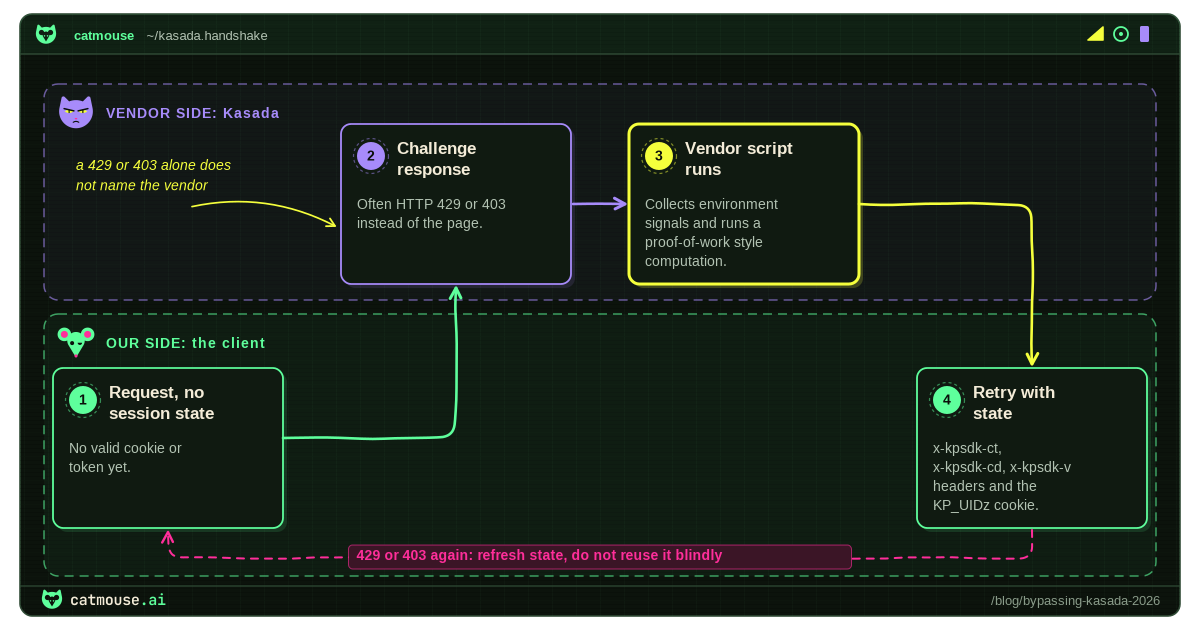
- Challenge bootstrap (officeworks kasada scraping bypass)
- The initial HTTP challenge response on officeworks kasada scraping bypass that delivers the vendor script or session seed to the client.
- Session state verification (officeworks kasada scraping bypass)
- The header or cookie proof returned after telemetry evaluation on officeworks kasada scraping bypass that authorizes subsequent API calls.
| Stage | Plain HTTP replay on officeworks kasada scraping bypass | Verified session state on officeworks kasada scraping bypass |
|---|---|---|
| Initial request | Missing session proof for officeworks kasada scraping bypass | Bootstraps fresh challenge state for officeworks kasada scraping bypass |
| Protected route | Challenged with HTTP 403 or 429 on officeworks kasada scraping bypass | Attaches current session state for officeworks kasada scraping bypass |
Evidence and sources
The statements in this article rest on the sources below. Each entry names the claim it supports.
- IANA HTTP Status Code Registry and MDN HTTP response status codes: reference definitions for HTTP status codes observed during officeworks kasada scraping bypass testing.
- RFC 6585, section 4: supports the meaning of HTTP 429. Source text: "The 429 status code indicates that the user has sent too many requests in a given amount of time ("rate limiting")." Fetched 2026-10-09.
- W3C WebDriver, section 4: supports the statement about
navigator.webdriver. Source text: "Returns true if webdriver-active flag is set, false otherwise." and "The webdriver-active flag is set to true when the user agent is under remote control." Fetched 2026-10-09. - Catmouse OpenAPI file: supports the
POST /Solver/solvefields used in the Officeworks example (ipsBody,ipsUrl,ctToken,kpsdkV,tz,tzOffset,acceptLanguage,engine), the response fieldssuccess,payloadandheaders, and the 401, 403 and 429 status meanings. The file was derived from the server source by Catmouse; it is first-party and does not show that officeworks.com.au accepts a solve. - Catmouse API reference: supports the description of the
x-kpsdk-*headers returned by a solve (first-party documentation). - Catmouse targets directory: the source of the vendor label for this site. It is a Catmouse list and was not independently re-verified.
Methodology and limits. Documented: the meaning of 429, the navigator.webdriver definition, and the solve endpoint fields and status codes (all from the sources above). Observation or inference: that a fresh client is challenged, that stealth plugins hide automation signals, and the vendor label for officeworks.com.au; these are Catmouse inferences and are labelled as such in the text. Reviewed 2026-10-09.
Frequently asked questions
Which bot protection does officeworks.com.au use?
The Catmouse targets directory lists officeworks.com.au as Kasada. That label was not re-verified, so check it in your own authorized traffic by looking for x-kpsdk-* headers.
Do I need a headless browser to request officeworks.com.au?
Not necessarily. A protocol-level HTTP client can fetch the challenge script itself, post it to the solver and send the returned /tl payload and headers. Whether that works on a given officeworks.com.au endpoint depends on its current configuration, which Catmouse has not measured, so test on endpoints you are authorized to use.
What does an HTTP 429 from officeworks.com.au mean?
RFC 6585 defines 429 as the user having sent too many requests in a given amount of time. Bot-management products can also return it for a challenge, so inspect the response body and headers to tell the two apart.
Am I allowed to collect catalog, pricing and store stock data from officeworks.com.au?
Only with permission from whoever operates officeworks.com.au. Review its terms of use and robots.txt, and get written permission where the terms restrict automated access.
How do I add balance to a Catmouse key?
The OpenAPI file documents POST /key/billing/create-checkout and POST /key/billing/binance-pay for topping up a key. See the pricing page for current terms.