Sportsbet Bot Detection: How Odds Pages Are Protected
Sportsbet bot detection on sportsbet.com.au is handled by bot-management protection (vendor not re-verified). This guide explains how that class of protection works, how to identify the product on a host you are authorized to test, and why the Catmouse solver API, which documents Kasada only, is not an option for a host listed as Akamai-protected.
Who this is for
Engineers and data teams who own, or have explicit written authorization to test, Sportsbet and want to understand how its bot protection is described in this post before deciding on an approach.
On this page
- What protects sportsbet.com.au and why the vendor is not named here
- How client-side bot management works in general
- How to identify the protection product on a host you are authorized to test
- Why headless browsers are a poor fit for high-rate odds collection
- What the Catmouse API covers for sportsbet.com.au
- Scope and limitations
- Evidence and sources
- Frequently asked questions
- Next step
- Vendor: the Catmouse targets page lists Akamai Bot Manager for sportsbet.com.au, and that listing has not been re-verified here, so this article uses the neutral label bot-management protection (vendor not re-verified).
- Who it is for: engineers who have permission to collect odds data and need to understand why plain HTTP clients are challenged or blocked.
- Mechanism: a script on the page collects browser signals, and the server accepts follow-up requests only when they carry a token or cookie issued after that check.
- Limits: this article contains no benchmark numbers, and nothing here promises access to any site.
What protects sportsbet.com.au and why the vendor is not named here?
Sportsbet serves odds and racing markets behind bot-management protection (vendor not re-verified). The Catmouse targets page records the host as Akamai Bot Manager, and no source cited here settles the question. The label therefore stays neutral until someone confirms it from live traffic on the host.
Odds are commercial data. Many operators restrict automated collection in their terms of service, and licensed data feeds exist in some markets. Check the site's terms and ask whether a licensed feed covers your use case before you build a collector.
How client-side bot management works in general?
Client-side bot management follows one pattern. The page loads a script, the script collects signals about the browser and its behavior, and the server issues a cookie or token only when the result looks acceptable. Later requests must carry that token. The Akamai Bot Manager product page describes this model: a small script added to each monitored page sets up client-side behavioral anomaly detection.
A request without a valid token usually gets a challenge page or an error status. A 429 means rate limiting (RFC 6585 section 4), and a 403 means the server refuses to serve the request (RFC 9110). Neither status proves that a bot-management product is involved, so read the surrounding cookies and scripts as well.
How to identify the protection product on a host you are authorized to test?
Open your browser developer tools on a page you are permitted to test and record the status codes, cookie names, request headers and script hosts. Compare them with the table below. No single row is proof, and the cookie and header names come from public community write-ups rather than vendor documentation.
| Observed signal | What it can indicate | Evidence level |
|---|---|---|
| HTTP 429 with a Retry-After header | Rate limiting. RFC 6585 defines 429 as "too many requests in a given amount of time". It does not say which product issued it. | Standard |
| HTTP 403 | The server refuses the request. Causes include WAF rules, geography, or bot management. See RFC 9110. | Standard |
| Cookies named _abck or bm_sz | Commonly associated with Akamai Bot Manager in public technical write-ups. | Community observation, not vendor documentation |
| Request headers starting with x-kpsdk- | Commonly associated with Kasada in public technical write-ups. | Community observation, not vendor documentation |
| A cookie named datadome | Commonly associated with DataDome. | Community observation, not vendor documentation |
Why headless browsers are a poor fit for high-rate odds collection?
Browser automation is a reasonable way to test one page. It becomes costly for continuous odds collection because every session runs a full browser. Automated browsers also expose themselves: the W3C WebDriver specification defines a webdriver-active flag that is set to true when the user agent is under remote control, and stealth patches that hide it are a moving target.
A protocol-level approach avoids the browser, but it replaces that cost with its own risks. It depends on a third-party solver for the vendor in question, it breaks when the vendor changes its challenge, and it still has to respect the site's rules. This article makes no performance claims for either approach.
What separates sportsbet betr odds scraping bypass telemetry from plain HTTP replay?
In contrast, on sportsbet betr odds scraping bypass, you must refresh session state whenever a route returns a challenge instead of reusing old headers.
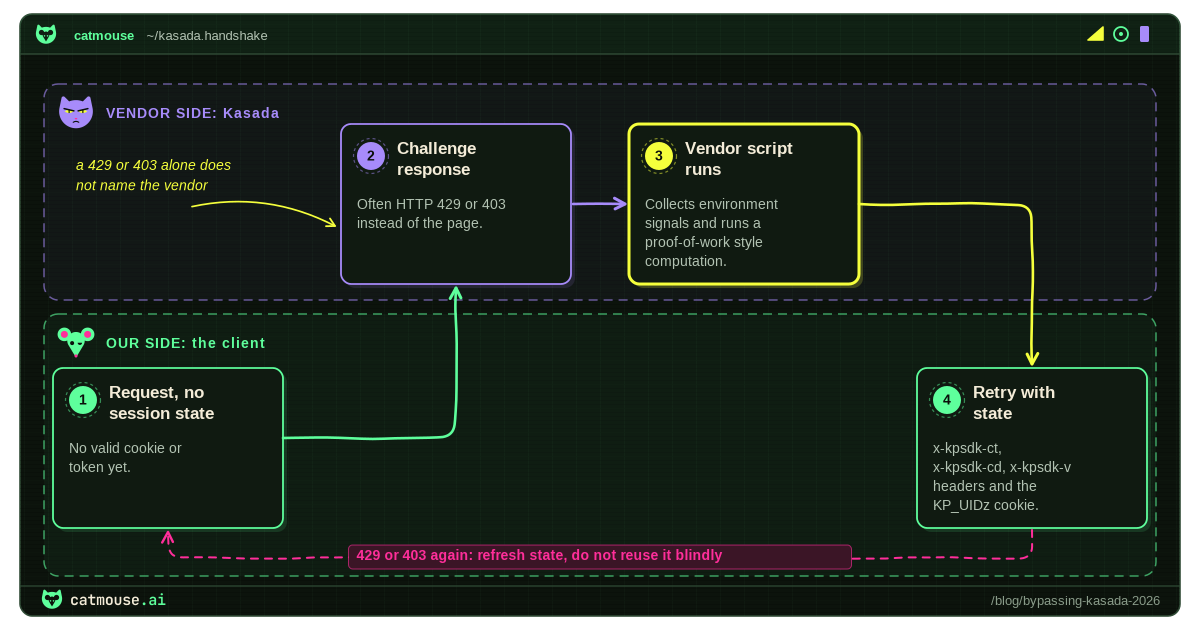
- Challenge bootstrap (sportsbet betr odds scraping bypass)
- The initial HTTP challenge response on sportsbet betr odds scraping bypass that delivers the vendor script or session seed to the client.
- Session state verification (sportsbet betr odds scraping bypass)
- The header or cookie proof returned after telemetry evaluation on sportsbet betr odds scraping bypass that authorizes subsequent API calls.
What the Catmouse API covers for sportsbet.com.au?
This article is a research write-up on sportsbet.com.au's protection, not an integration guide. For sportsbet.com.au, the Catmouse solver API documented in the OpenAPI document solves Kasada only: its engine field selects a Kasada device profile (chrome, snkrs, wkw, fl, whatnot-ios or android), not a vendor. It documents no Akamai Bot Manager engine, so no request for this host is shown and none is implied.
If a Kasada-protected host sits in your authorized scope instead of sportsbet.com.au, the request flow is described in the bot-management reference and the API reference.
Scope, limitations, and recommendations
This article describes how bot-management products behave in general and how to identify them on a host you are allowed to test. It contains no measured pass rates, latencies or costs for any named site. Live-odds WebSocket connections were not tested for this article. Vendors change their products without notice, so treat every product label here as a starting hypothesis and confirm it against live traffic.
Authorized use: Test odds pages only with the operator's written permission or under a licensed data agreement, and follow the site's terms of service and applicable law. See the acceptable use policy.
Last reviewed: 2026-10-09.
Evidence and sources
- IANA HTTP Status Code Registry and MDN HTTP response status codes: reference definitions for HTTP status codes observed during sportsbet betr odds scraping bypass testing.
- Akamai Bot Manager product page: Behavior anomaly detection "is configured automatically by injecting a simple script into each monitored page", and the product detects bot traffic and mitigates malicious bots at the edge.
- RFC 6585 section 4: the 429 status code "indicates that the user has sent too many requests in a given amount of time ("rate limiting")".
- RFC 9110 section 15.5.4: the 403 (Forbidden) status code "indicates that the server understood the request but refuses to fulfill it".
- W3C WebDriver specification: the webdriver-active flag is "set to true when the user agent is under remote control", and
navigator.webdriverreturns its value. - Catmouse API: the
/Solver/solveendpoint (authenticated with thex-api-keyheader) and its Kasada device-profileenginevalues are defined in the Catmouse OpenAPI document and described in the API reference. - Catmouse targets page: which vendor Catmouse lists for this host is a Catmouse directory entry, not a vendor statement, and it has not been re-verified
Methodology and limits
Live-odds WebSocket behavior was not tested.
How does sportsbet betr odds scraping bypass validate a trusted TLS session?
For sportsbet betr odds scraping bypass, a client is a verified session when it sends fresh tokens versus static headers over a trusted TLS session.
Frequently asked questions
Which bot-management vendor protects Sportsbet?
It has not been re-verified. The Catmouse targets page lists Akamai Bot Manager, and that listing has not been re-verified. Confirm it from live traffic on a page you are allowed to test.
Does the Catmouse API help with live-odds WebSockets?
No. The documented API solves Kasada scripts and returns x-kpsdk headers for HTTP requests. It has no Akamai engine, and WebSocket handshakes on sportsbet.com.au were not tested for this article.
Does the solve request take a proxy?
No. The server does not read a proxy field. Your client sends the Kasada requests itself through its own proxy, and the solve request carries only the time zone of that proxy exit.
Is collecting odds data allowed?
It depends on the site terms, your licence and local law. Ask for permission or a licensed feed first. This is not legal advice.
Next step
Next step: read the bot-management reference for the shared mechanics, then check the targets list and the API reference for what the solver API covers today.