Eventim Bot Detection Bypass: European Concert Ticket Guide
Eventim bot detection bypass comes down to how eventim.de verifies browser-side signals and issues the tokens later requests carry. A plain HTTP client lacks those tokens, so a request built without running the page's script can be refused, challenged or queued. The shared reference covers the rest.
Akamai Bot Manager is the vendor named for eventim.de and fansale.de, but the Catmouse solver API has no Akamai engine, so this is a research note and not an integration guide.
Who this is for
Engineers and data teams who own, or have explicit written authorization to test, Eventim and want to understand how its bot protection is described in this post before deciding on an approach.
On this page
- Protection: Akamai Bot Manager (per the Catmouse target list, not re-verified).
- Audience: engineers with authorization to test or collect data from eventim.de.
Which protection sits in front of eventim.de?
For Eventim, how the challenge and token flow works is the same as for any browser-verified bot management, so it is explained once in the bot-management reference. This section keeps only what is specific to Eventim.
Eventim (eventim.de) is listed as protected by Akamai Bot Manager, a bot-management product that checks clients with browser-side verification before serving protected requests.
Akamai Bot Manager is the vendor named for the site in the Catmouse target list. That attribution was not re-verified on 2026-10-09. The pages in scope typically include event listings and FanSALE resale listings (eventim.de and fansale.de).
Who it is for: engineers with written authorization to test or collect data from the site, for example an authorized security assessment, a contracted data feed, or a property they operate.
How browser-side verification works (Eventim)?
On this site, how the challenge and token flow works is the same as for any browser-verified bot management, so it is explained once in the bot-management reference. This section keeps only what applies to this particular site.
- Edge request analysis: Akamai lists browser fingerprinting as a detection method (see Evidence and sources). Which connection or header characteristics a deployment compares is not documented publicly, so this guide does not list them.
- Sensor data submission: Akamai says it injects a script into monitored pages. In this guide, the term sensor data is a general description of the signals such a script may submit, an observation rather than vendor documentation.
- Cookie issuance: Cookies such as _abck and bm_sz have been observed on some Akamai-protected sites. This is an observation, not vendor documentation, and cookie behaviour varies by deployment.
- Scoring: The site may evaluate the submitted signals against its own configured policy. Thresholds are not public.
- Enforcement: Requests that fail can be refused with an error status, challenged, or placed in a queue, so a failure on the site does not by itself show which of the three happened.
Browser automation compared with protocol-level solving (Eventim)
On this site, the browser versus protocol-level trade-off is the same as for any browser-verified bot management, so it is explained once in the bot-management reference. This section keeps only what applies to this particular site.
What the Catmouse API covers (Eventim)?
Here, the shape of a solver request and token reuse is the same as for any browser-verified bot management, so it is explained once in the bot-management reference. This section keeps only what applies to this particular site.
The Catmouse solver API handles one vendor, Kasada. POST /Solver/solve takes the ips.js body your own client fetched and returns a base64 /tl payload plus x-kpsdk-* headers; the engine field only picks a Kasada device profile. There is no Akamai Bot Manager engine, so nothing in this article is an API recipe for the site or fansale.de.
If your own authorized capture of the site shows a Kasada script, the request flow is the one in the Flight Centre guide; otherwise treat this article as research on the mechanism only.
Scope, limitations and authorized use
This guide for Eventim is a general explanation, not a test report. It contains no measured pass rates, latency, cost or uptime figures for the site, and it does not promise that any request will be accepted.
What separates eventim fansale akamai bot bypass telemetry from plain HTTP replay?
In contrast, on eventim fansale akamai bot bypass, you must refresh session state whenever a route returns a challenge instead of reusing old headers.
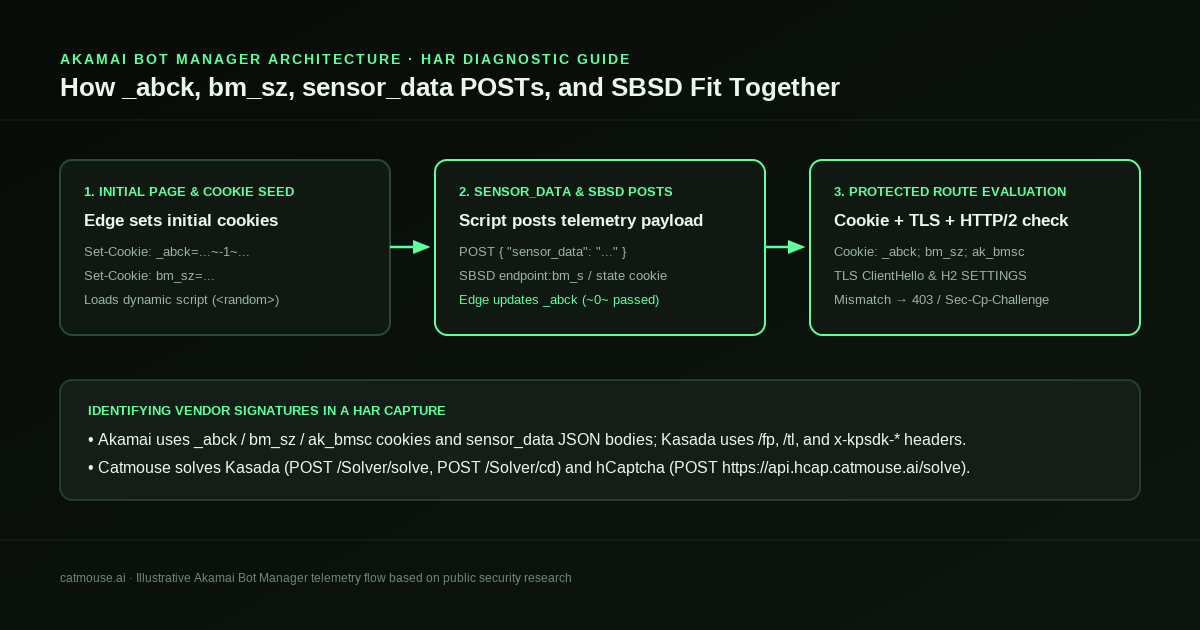
- Challenge bootstrap (eventim fansale akamai bot bypass)
- The initial HTTP challenge response on eventim fansale akamai bot bypass that delivers the vendor script or session seed to the client.
- Session state verification (eventim fansale akamai bot bypass)
- The header or cookie proof returned after telemetry evaluation on eventim fansale akamai bot bypass that authorizes subsequent API calls.
| Stage | Plain HTTP replay on eventim fansale akamai bot bypass | Verified session state on eventim fansale akamai bot bypass |
|---|---|---|
| Initial request | Missing session proof for eventim fansale akamai bot bypass | Bootstraps fresh challenge state for eventim fansale akamai bot bypass |
| Protected route | Challenged with HTTP 403 or 429 on eventim fansale akamai bot bypass | Attaches current session state for eventim fansale akamai bot bypass |
Next step
To continue with Eventim, read the API reference and check the targets directory for the current label. Run requests against eventim.de or fansale.de only with the operator's written permission.
How does eventim fansale akamai bot bypass validate a trusted TLS session?
For eventim fansale akamai bot bypass, a client is a verified session when it sends fresh tokens versus static headers over a trusted TLS session.
Evidence and sources
Sources are listed below, each one with the claim it supports.
- IANA HTTP Status Code Registry and MDN HTTP response status codes: reference definitions for HTTP status codes observed during eventim fansale akamai bot bypass testing.
- RFC 9110, section 15.5.4 (403 Forbidden). Supports: the generic meaning of the 403 status code. It says nothing about how any particular site decides to return it.
- RFC 6585, section 4 (429 Too Many Requests). Supports: "The 429 status code indicates that the user has sent too many requests in a given amount of time (“rate limiting”)."
- W3C WebDriver. Supports: the navigator.webdriver attribute, which the specification describes as "Returns true if webdriver-active flag is set, false otherwise."
- Akamai Bot Manager product page. Supports: "Akamai Bot Manager effectively detects bot traffic and mitigates malicious bots at the edge," plus a script injected into monitored pages and browser fingerprinting as a detection method. It does not name cookies or sensor data.
- Catmouse OpenAPI file and the API reference. Supports: the /Solver/solve request fields ipsBody, ipsUrl, ctToken, kpsdkV, tz, tzOffset, acceptLanguage and engine, and that engine selects a Kasada device profile. The API has no Akamai, DataDome, Turnstile or FunCaptcha engine.
Documented: status code meanings (RFC 9110, RFC 6585), the navigator.webdriver attribute (W3C), Akamai’s high-level description of Bot Manager and the Kasada-only scope of the solve endpoint (OpenAPI). Observation or general model, not documentation: the cookie names _abck and bm_sz, the sensor data step, edge connection analysis and scoring thresholds, none of which appear in the public sources above. The Akamai attribution for the site comes from the Catmouse target list and was not re-verified. Vendor behaviour changes without notice, so re-check against current responses you are authorized to inspect. Claims without a source here are qualified in the text.
Frequently Asked Questions
What protects eventim.de?
The Catmouse target list names Akamai Bot Manager for the site. That attribution was not re-verified on 2026-10-09.
Is access assured?
No. Acceptance for Eventim depends on the target's current configuration, your network and your request behaviour. The article reports no measured acceptance figure for the site or fansale.de.
Where can I use this?
Only on the site or fansale.de assets you operate, or with the operator's written permission, within the site terms and applicable law.