Ticketmaster Kasada Bot Bypass: Dual-Engine Guide
The Catmouse targets list labels ticketmaster.com as protected by both Akamai Bot Manager and Kasada. The vendor label comes from the Catmouse targets list and has not been re-verified.
This guide explains what each layer asks a client to present, which part of that the Catmouse solve API covers (the Kasada script flow only; it has no Akamai engine), and why ticket purchase automation carries legal risk, for teams that are authorized to test.
Who this is for
Engineers and data teams who own, or have explicit written authorization to test, Ticketmaster and want to understand how its Kasada protection is described in this post before deciding on an approach.
On this page
- What two layers of bot management ask a client to present
- How a client-side challenge and a sensor-style cookie differ
- What the Catmouse API covers, and the Kasada solve flow (illustrative example)
- Legal limits on ticket automation
- Next steps
- Scope and limitations
- Evidence and sources
- Frequently Asked Questions
- Short answer: an Akamai layer is associated with the
_abckcookie, and a Kasada layer with thex-kpsdk-*headers. Both labels come from the Catmouse targets list. - Who it is for: engineers who own or are authorized to test the target, and teams comparing layered bot-management setups.
- Limits: how Ticketmaster scores or enforces these layers is not published and is not claimed here. There are no performance numbers in this article.
What two layers of bot management ask a client to present?
The Catmouse targets list shows ticketmaster.com as using Akamai Bot Manager and Kasada together. The vendor label comes from the Catmouse targets list and has not been re-verified. A client reaching it would be expected to satisfy both: the Akamai cookie (commonly named _abck) and the Kasada x-kpsdk-* headers that the flow in the Catmouse OpenAPI document produces.
How the two layers interact, whether either runs in monitoring-only mode, and how the site responds to a client that satisfies only one are not documented publicly.
Status codes you may observe
A refused request commonly comes back as 403 (RFC 9110, section 15.5.4) or 429 (RFC 6585, section 4). Record what your own authorized tests return instead of relying on a general description.
How a client-side challenge and a sensor-style cookie differ?
Both layers rely on code that runs in the visitor's browser and reports back. Akamai describes Bot Manager as detecting bot traffic and mitigating malicious bots at the edge (source: Akamai product page, linked under Evidence and sources). That the result is carried in a cookie such as _abck is a common observation, not vendor documentation. Kasada's contract, as exposed through the Catmouse API, is a set of x-kpsdk-* request headers built from the site's own script. The specifics of each vendor's signals are proprietary.
For a practical integration the difference is where the result travels. A cookie is set once and sent automatically by a cookie jar, while the Kasada headers must be attached explicitly to each request that needs them.
What the Catmouse API covers, and the Kasada solve flow (illustrative example)?
The Catmouse solve API covers one vendor, Kasada. Its engine value selects a Kasada device profile, not a vendor, and the Catmouse OpenAPI document has no Akamai Bot Manager engine and no combined Ticketmaster engine. The Akamai layer is therefore analysed here as research only, and no solver call is shown for it. Live status for ticketmaster.com is not claimed.
The solve endpoint never contacts ticketmaster.com. Your own client, with a session you are authorized to use, fetches the ticketmaster.com /fp response and keeps its x-kpsdk-ct header and cookies, reads the ips.js URL from it, downloads that script as UTF-8 text, and posts the text to /Solver/solve as ipsBody together with ipsUrl, ctToken, kpsdkV, tz, tzOffset and an engine profile. It then sends the returned base64 payload as the raw body of its own /tl request to ticketmaster.com, with the returned headers. This covers the Kasada layer only.
The /fp and /tl URL shapes and the /tl header order for ticketmaster.com are target-specific and were not verified for this article; Catmouse's reference script documents them only for the targets it covers. The generic version of this flow is explained in the bot-management reference, and the code below is the same flow in Python.
import base64, os, requests

# Steps 1-3 run in YOUR client against YOUR target (authorized use only); the solver API never contacts the target.
# ips_body: UTF-8 text of the ips.js you fetched; ips_url: where you fetched it; ct_token: x-kpsdk-ct of the /fp response;
# kpsdk_v: the x-kpsdk-v the served script declares.
r = requests.post("https://kasadaapi.catmouse.ai/Solver/solve",
    headers={"x-api-key": os.environ["CATMOUSE_KEY"]},
    json={
        "ipsBody": ips_body,
        "ipsUrl": ips_url,
        "ctToken": ct_token,
        "kpsdkV": kpsdk_v,
        "tz": "America/New_York",
        "tzOffset": 240,
        "acceptLanguage": "en-US",
        "engine": "chrome",
    },
    timeout=60)
Inspect the response first, then send the payload to the target.
out = r.json()
if not out.get("success"):
    raise RuntimeError(f"{r.status_code} {out.get('error')}")   # 4xx/5xx are not charged
# Step 5 (your own client): POST base64.b64decode(out["payload"]) as the raw body to the target's /tl URL
# with the headers in out["headers"].
Test only systems you are authorized to test, and do not use this to automate purchases. For ticketmaster.com, the engine value chrome selects a Kasada desktop-Chrome device profile; it names a device profile, not a vendor, and the API lists other profiles (snkrs, wkw, fl, whatnot-ios, android). tz and tzOffset are required in production and should match the proxy exit you use for your own ticketmaster.com requests. Check the mapped field of a successful response: identified below total failed in a dated live measurement.
Documented error responses are 400 (missing or invalid ipsBody, or missing tz/tzOffset), 401 (missing or invalid key), 403 (key disabled, expired or service not enabled), 422 (the script cannot be solved), 402 (insufficient balance: the USD balance is used up), 503 (load shedding) and 504 (solve timed out). A ticketmaster.com solve that errors returns no payload and is not charged.
How does ticketmaster kasada bot bypass validate a trusted TLS session?
For ticketmaster kasada bot bypass, a client is a verified session when it sends fresh tokens versus static headers over a trusted TLS session.
Legal limits on ticket automation
In the United States, the Better Online Ticket Sales (BOTS) Act of 2016 prohibits circumventing security measures or access controls that online ticket sellers use to enforce purchasing limits (Public Law 114-274). Other jurisdictions have their own rules, and ticketing terms of service usually restrict automation as well. This article is not legal advice. Do not automate purchasing, and take legal advice before any work that touches sales of live event tickets.
What separates ticketmaster kasada bot bypass telemetry from plain HTTP replay?
In contrast, on ticketmaster kasada bot bypass, you must refresh session state whenever a route returns a challenge instead of reusing old headers.
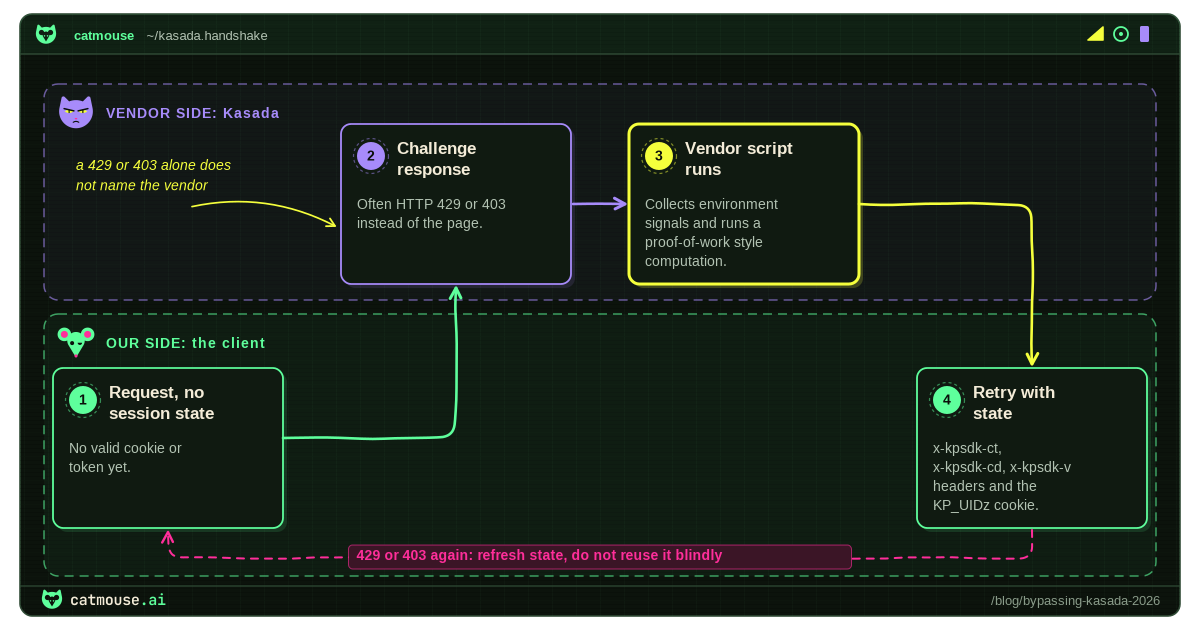
- Challenge bootstrap (ticketmaster kasada bot bypass)
- The initial HTTP challenge response on ticketmaster kasada bot bypass that delivers the vendor script or session seed to the client.
- Session state verification (ticketmaster kasada bot bypass)
- The header or cookie proof returned after telemetry evaluation on ticketmaster kasada bot bypass that authorizes subsequent API calls.
| Stage | Plain HTTP replay on ticketmaster kasada bot bypass | Verified session state on ticketmaster kasada bot bypass |
|---|---|---|
| Initial request | Missing session proof for ticketmaster kasada bot bypass | Bootstraps fresh challenge state for ticketmaster kasada bot bypass |
| Protected route | Challenged with HTTP 403 or 429 on ticketmaster kasada bot bypass | Attaches current session state for ticketmaster kasada bot bypass |
Next steps
Read the API reference, try a single read request in the playground against a host you are authorized to test, and record your own status codes before building anything further.
Scope, limitations, and recommendations
Whether Ticketmaster enforces either layer on a given endpoint is not established here. Last reviewed: 2026-10-09.
Evidence and sources
- IANA HTTP Status Code Registry and MDN HTTP response status codes: reference definitions for HTTP status codes observed during ticketmaster kasada bot bypass testing.
- Catmouse OpenAPI document: the request fields of
POST /Solver/solveused in the Kasada example (ipsBody,ipsUrl,ctToken,kpsdkV,tz,tzOffset,engine), the response fieldspayloadandheaders, and the absence of any Akamai engine. The API reference page renders the same contract. - Catmouse targets list: the source of the vendor label used in this article. It is Catmouse's own list and was not independently re-verified.
- Akamai Bot Manager product page: "Akamai Bot Manager effectively detects bot traffic and mitigates malicious bots at the edge". This is the extent of the vendor description relied on here.
- Kasada: vendor home page, cited only to identify Kasada as a bot-management vendor. Its challenge internals are not published there, which is why this article describes only the externally visible contract.
- RFC 9110, section 15.5.4: supports the meaning of 403. It states: "The 403 (Forbidden) status code indicates that the server understood the request but refuses to fulfill it."
- RFC 6585, section 4: supports the meaning of 429. It states: "The 429 status code indicates that the user has sent too many requests in a given amount of time ("rate limiting")."
- Public Law 114-274 (Better Online Ticket Sales Act of 2016), govinfo.gov: supports the statement that US law prohibits circumventing ticket sellers' control measures. Section 2(a)(1)(A) refers to circumventing "a security measure, access control system, or other technological control or measure". Official title: "To prohibit the circumvention of control measures used by Internet ticket sellers to ensure equitable consumer access to tickets for any given event, and for other purposes."
Methodology and limits
Reviewed on 2026-10-09. The meanings of HTTP 403 and 429 and of the navigator.webdriver flag rest on the standards above, and the solve request and response fields rest on the Catmouse OpenAPI document. The /fp and /tl details for ticketmaster.com were not verified. The Kasada header names come from the Catmouse OpenAPI document and the _abck cookie name from common observation; how Ticketmaster scores or enforces either layer is not documented and is not claimed.
Frequently Asked Questions
Does ticketmaster.com use Akamai and Kasada?
The Catmouse targets list labels it that way. The vendor label comes from the Catmouse targets list and has not been re-verified.
Does the Catmouse API have an Akamai engine?
The solve API covers Kasada only. Its engine value selects a Kasada device profile (chrome, snkrs, wkw, fl, whatnot-ios or android); there is no Akamai engine and no Ticketmaster engine.
Is it legal to automate ticket purchases?
Often not. In the United States the BOTS Act restricts circumventing ticket seller access controls, and site terms usually prohibit automation. This is not legal advice.
Can I use this on any website?
No. Use it only against ticketmaster.com properties you own or have written permission to test, and never to buy tickets in bulk.