Ticketmaster Akamai Bot Manager: How It Works
Ticketmaster bot detection is recorded by Catmouse as Akamai Bot Manager, with Kasada also listed. This guide explains how Akamai's client-side model generally works, what the _abck cookie is commonly reported to do, and why high-demand on-sales add queue and legal considerations that no solver removes, and the Catmouse solver API has no Akamai engine.
Who this is for
Engineers and data teams who own, or have explicit written authorization to test, Ticketmaster and want to understand how its Akamai BMP protection is described in this post before deciding on an approach.
On this page
- Vendor: the Catmouse targets page lists Akamai Bot Manager plus Kasada for ticketmaster.com. That entry has not been re-verified.
- Mechanism: Akamai documents a script added to monitored pages for client-side behavioral anomaly detection. Cookie and payload details come from community write-ups, not vendor documentation.
- Limits: no pass rates, queue throughput or latency figures are given, and no solver can buy tickets, move you up a queue or make a purchase lawful.
- Law: ticket purchasing automation is regulated in some countries, so get legal advice.
How Akamai Bot Manager works in general?
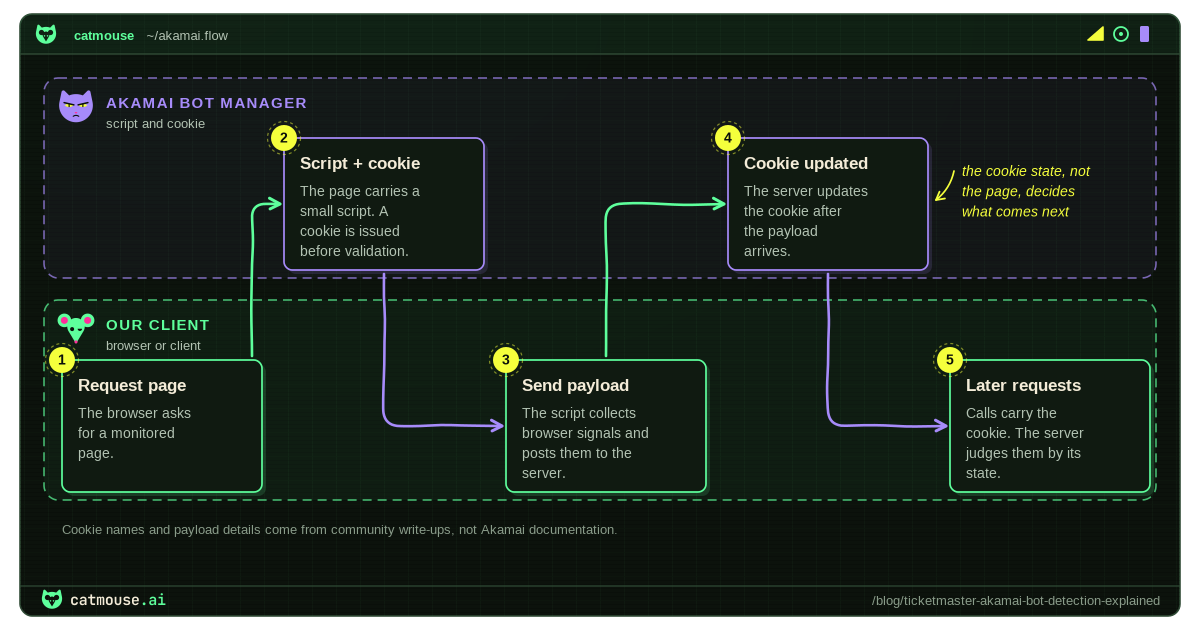
The Akamai Bot Manager product page says Bot Manager identifies automated traffic, stops harmful bots at the network edge, and manages legitimate ones. It also says a small script added to each monitored page sets up client-side behavioral anomaly detection. That is the vendor-documented part of the model.
Everything below the product-page level is reverse-engineered by third parties. Public write-ups describe a script that collects browser signals, sends them to the server as a payload, and receives a validated cookie. Because Akamai does not document those internals, treat names and formats as unverified and expect them to change.
Why a host can show more than one vendor?
Catmouse lists Kasada alongside Akamai Bot Manager for ticketmaster.com. When two products answer on one host, each issues its own cookie or token, and a token for one does not satisfy the other. The Catmouse article on Ticketmaster and Kasada covers that side of the listing.
The dual-vendor listing has not been re-verified. Check which products respond before you decide whether any solver applies; the Catmouse API addresses only the Kasada one.
Queues, purchases and the legal setting
High-demand on-sales commonly use a virtual queue or waiting room that admits visitors in order. A solver that returns request headers does not change queue position, and this article does not describe how any queue works internally.
In the United States, the BOTS Act of 2016 restricts using software to circumvent ticket-purchase controls, and site terms generally forbid automated purchasing. Research on a host you control or have written permission to test is a different matter from automating purchases.
What the Catmouse API covers for ticketmaster.com?
Catmouse also lists Kasada for ticketmaster.com, and that listing has not been re-verified. The Catmouse solver API documented in the OpenAPI document solves Kasada only: its engine field selects a Kasada device profile (chrome, snkrs, wkw, fl, whatnot-ios or android), not a vendor, and it has no Akamai Bot Manager engine. Nothing in this section applies to the Akamai layer described above.
If you confirm Kasada on a host you are authorized to test, the flow is: your own session fetches the vendor's ips.js and the x-kpsdk-ct header of the /fp request, you post the script text with the time zone of your proxy exit to /Solver/solve, and you send the returned x-kpsdk-* headers with the next request. The canonical request, from the published API samples, is:
import os
import requests

r = requests.post(
    "https://kasadaapi.catmouse.ai/Solver/solve",
    headers={"x-api-key": os.environ["CATMOUSE_KEY"]},
    json={
        "ipsBody": "<contents of the ips.js response, as UTF-8 text>",
        "ipsUrl": "https://www.example.com/149e9513-01fa-4fb0-aad4-566afd725d1b/2d206a39-8ed7-437e-a3be-862e0f06eea3/ips.js?x-kpsdk-v=j-1.2.661&x-kpsdk-im=ZXhhbXBsZQ",
        "ctToken": "<x-kpsdk-ct response header of the /fp request>",
        "kpsdkV": "j-1.2.661",
        "tz": "America/New_York",
        "tzOffset": 240,
        "acceptLanguage": "en-US",
        "engine": "chrome",
    },
    timeout=60,
)
print(r.status_code, r.text)
tz and tzOffset are required in production; derive them from a lookup through the same proxy you use for the target. A solve is charged only when a payload is returned, and an insufficient balance returns 402. Whether a successful solve is accepted by ticketmaster.com has not been tested for this article, and a solver does not change queue position. The Ticketmaster and Kasada article covers that side of the listing.
How does ticketmaster akamai bot detection explained validate a trusted TLS session?
For ticketmaster akamai bot detection explained, a client is a verified session when it sends fresh tokens versus static headers over a trusted TLS session.
Scope, limitations, and recommendations
This article describes how bot-management products behave in general and how to identify them on a host you are allowed to test. It contains no measured pass rates, latencies or costs for any named site. It cites no queue case study, because no records support one. Vendors change their products without notice, so treat every product label here as a starting hypothesis and confirm it against live traffic.
Authorized use: Test ticketmaster.com only with the operator's written permission, keep purchasing and queue entry manual, and follow the site's terms of service and applicable law. See the acceptable use policy.
Last reviewed: 2026-10-09.
What separates ticketmaster akamai bot detection explained telemetry from plain HTTP replay?
In contrast, on ticketmaster akamai bot detection explained, you must refresh session state whenever a route returns a challenge instead of reusing old headers.
- Challenge bootstrap (ticketmaster akamai bot detection explained)
- The initial HTTP challenge response on ticketmaster akamai bot detection explained that delivers the vendor script or session seed to the client.
- Session state verification (ticketmaster akamai bot detection explained)
- The header or cookie proof returned after telemetry evaluation on ticketmaster akamai bot detection explained that authorizes subsequent API calls.
Evidence and sources
- IANA HTTP Status Code Registry and MDN HTTP response status codes: reference definitions for HTTP status codes observed during ticketmaster akamai bot detection explained testing.
- Akamai Bot Manager product page: Behavior anomaly detection "is configured automatically by injecting a simple script into each monitored page", and the product detects bot traffic and mitigates malicious bots at the edge.
- RFC 6585 section 4: the 429 status code "indicates that the user has sent too many requests in a given amount of time ("rate limiting")".
- RFC 9110 section 15.5.4: the 403 (Forbidden) status code "indicates that the server understood the request but refuses to fulfill it".
- 15 U.S.C. 45c (Cornell LII): 15 U.S.C. 45c makes it unlawful "to circumvent a security measure, access control system, or other technological control or measure on an Internet website" used to enforce ticket purchasing limits or order rules (the clause continues beyond this quote). This is the statute behind the BOTS Act reference above, and it is not legal advice.
- Catmouse targets page: which vendor Catmouse lists for this host is a Catmouse directory entry, not a vendor statement, and it has not been re-verified
Methodology and limits
The description of the _abck cookie lifecycle is community-reported and unverified.
Frequently asked questions
Does Ticketmaster use Akamai Bot Manager?
Catmouse lists it for ticketmaster.com, along with Kasada. The entry has not been re-verified, so confirm it from live traffic on a page you are allowed to test.
What is the _abck cookie?
Community write-ups associate it with Akamai Bot Manager as the cookie whose state the server checks. Akamai does not document it publicly, so treat the details as unverified.
Can the Catmouse API get me tickets during an on-sale?
No. The documented API produces Kasada headers for HTTP requests and has no Akamai engine. It does not change queue position or make automated purchasing lawful.
Is automating ticket purchases legal?
Often not. Laws such as the US BOTS Act restrict circumventing ticket-purchase controls, and the site terms usually forbid it. This is not legal advice.
Next step
Next step: read the Ticketmaster Kasada article for the Kasada half of the listing and the API reference for the request contract.