_abck Cookie in Akamai: bm_sz Seed and sensor_data Lifecycle
Akamai Bot Manager tracks client validation through a quartet of edge cookies (_abck, bm_sz, ak_bmsc, and bm_sv), using the tilde-delimited integers inside bm_sz to seed the dynamic sensor_data payload that transitions _abck from unvalidated (~-1~) to validated (~0~). Below: how the cookie state machine and sensor exchange work.
Who this is for
Security researchers and protocol engineers inspecting HAR captures on Akamai-protected origins who want to understand how _abck status flags, bm_sz seeds, and sensor_data POSTs fit together.
On this page
- What roles do _abck, bm_sz, ak_bmsc, and bm_sv play?
- How does the _abck cookie transition from ~-1~ to ~0~?
- Why do sensor_data POSTs fail to validate _abck?
- How does Akamai's cookie state machine compare with Kasada's header model?
- Key takeaways
- Conclusion and scope
- Evidence and sources
- Frequently asked questions
How does the _abck cookie transition from ~-1~ to ~0~?
The sensor script reads the seed cookie from the browser jar, encodes environmental and behavioral telemetry into a JSON payload, and posts it to the dynamic script path.
On the first document response, the second tilde segment of _abck is -1 (for example, ...~-1~YAAQ...~-1~-1). Once the page loads the dynamic sensor script, the script executes an immediate initialization POST carrying baseline browser properties—screen dimensions, navigator properties, canvas/WebGL hashes, and execution timing—encrypted using the integer pair inside bm_sz.
Comparing _abck status codes versus edge enforcement
The table below compares the status codes observed in the second tilde-delimited field of the validation cookie:
_abck Status Segment | Lifecycle Stage | Edge Enforcement on Protected POSTs |
|---|---|---|
~-1~ (Initial / Pending) | Issued on initial HTML GET or after a rejected sensor POST | Protected login or checkout endpoints reject the request or demand another sensor round |
~0~ (Validated) | Returned via Set-Cookie after the edge accepts sensor_data | Protected transactional endpoints allow the request when TLS and IP match |
~-1~ with PoW challenge | Fourth tilde segment contains a non--1 challenge string | Client script must compute the proof-of-work solution and submit a follow-up sensor_data POST |
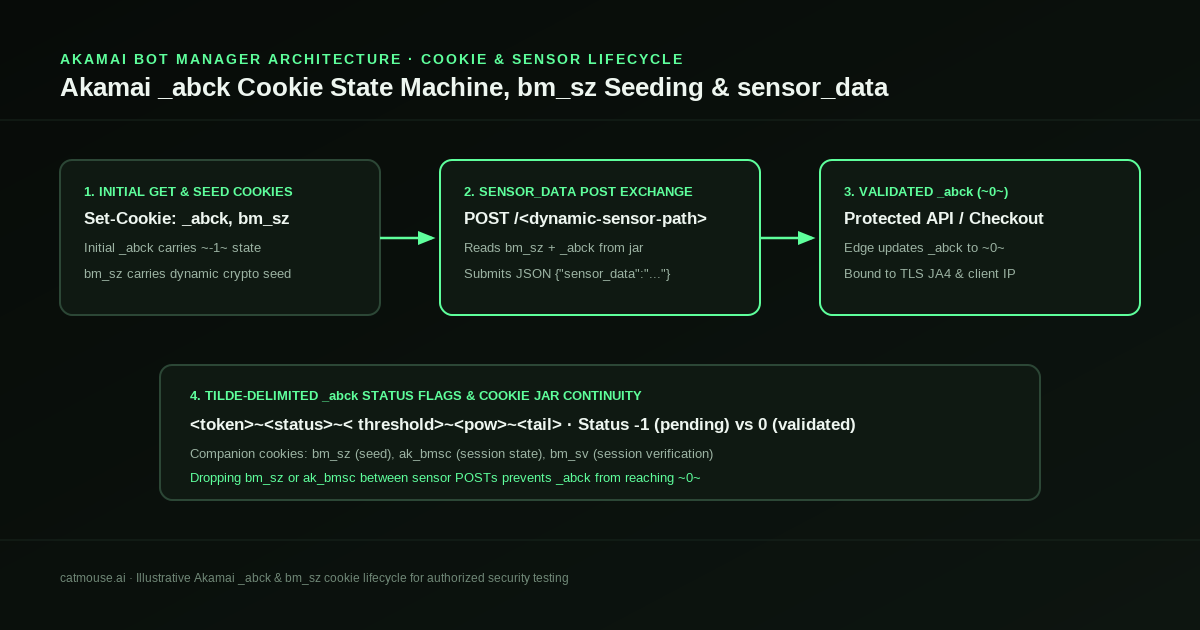
_abck state transition from ~-1~ to ~0~ using the bm_sz seed. Diagram by Catmouse Engineering.Why do sensor_data POSTs fail to validate _abck?
Validation fails whenever the cookie jar drops required seed cookies, the TLS or HTTP/2 fingerprint changes between GET and POST, or the payload uses stale seed values.
Three protocol invariants for cookie jar and transport continuity
When debugging an HTTP trace in which the Akamai edge responds to a sensor POST with a cookie that still contains an unvalidated status flag, check three protocol invariants:
- Complete cookie jar continuity: The POST to the dynamic sensor endpoint must carry the exact
_abck,bm_sz, andak_bmsccookies received on the preceding HTML GET, and the client must overwrite_abckwith each intermediate MDN Set-Cookie response header (RFC 6265). - TLS and HTTP/2 frame coherence: Akamai edge nodes record the client's TLS ClientHello and HTTP/2
SETTINGSframe on the initial document fetch (RFC 9113). Submittingsensor_dataover a different TLS stack or a rotated proxy exit IP invalidates the trusted session immediately. - Matching User-Agent and Client Hints: The
User-Agentstring and W3C High Resolution Time stamps embedded inside the encryptedsensor_dataarray must match the HTTP headers on the wire.
How does Akamai's cookie state machine compare with Kasada's header model?
Akamai stores session trust inside the validation cookie, whereas in contrast Kasada returns a token header and requires per-request proof-of-work headers.
For targets protected by Kasada, the Catmouse API generates per-request proof-of-work headers directly over HTTP via POST /Solver/cd. The Python snippet below demonstrates how a client mints a fresh x-kpsdk-cd proof-of-work header using its universal USD wallet key:
import os
import requests

cd_resp = requests.post(
    "https://kasadaapi.catmouse.ai/Solver/cd",
    headers={"x-api-key": os.environ["CATMOUSE_KEY"]},
    json={
        "host": "www.example.com",
        "platform": "web",
        "ct": "0123456789abcdef0123456789abcdef",
        "telemetry": "real",
        "seed": "auto",
    },
    timeout=15,
)
print(cd_resp.status_code, cd_resp.text)
Key takeaways
_abcksegment two indicates validation state:~-1~denotes an unvalidated or challenged cookie, while~0~indicates that the edge accepted the client'ssensor_datasubmission.bm_szseeds the sensor cipher: The dynamic integer pair insidebm_szmust be parsed from the initial GET response before constructingsensor_data.- Preserve all four cookies and the TLS session: Keep
_abck,bm_sz,ak_bmsc, andbm_svin the same HTTP/2 session and sticky proxy exit IP.
Conclusion and scope
Tracking the tilde-delimited fields of _abck alongside bm_sz and ak_bmsc in your HAR captures makes it straightforward to pinpoint whether an Akamai session failed at initial seed extraction, proof-of-work challenge handling, or TLS/IP session continuity.
Scope and limitations. Per the Catmouse OpenAPI 3.1 contract (/openapi.json), the hosted Catmouse solver endpoints (POST /Solver/solve and POST /Solver/cd) support Kasada only and do not expose an Akamai solver engine. This teardown is published for educational protocol analysis and authorized security research as of 2026-11-03.
Evidence and sources
The HTTP specifications, cookie standards, and API contracts referenced in this article are supported by the primary sources below:
- Catmouse OpenAPI 3.1 specification (
/openapi.json) and API reference (/reference.html). Supports:POST /Solver/cdrequest schema (host,platform,ct,telemetry,seed) and Kasada-only endpoint scope. Reviewed 2026-11-03. - IETF RFC 6265 (HTTP State Management Mechanism). Supports:
Set-Cookiereplacement rules and cookie jar state transitions. - IETF RFC 9113 (HTTP/2) and IETF RFC 8446 (TLS 1.3). Supports: connection reuse and transport-layer fingerprint correlation across GET and POST exchanges.
Methodology and limits. Derived from HAR inspection of public Akamai Bot Manager cookie headers and the Catmouse OpenAPI 3.1 contract. No performance benchmarks or pass rates are claimed. Reviewed 2026-11-03.
Frequently asked questions
What do the tilde-separated fields in the Akamai _abck cookie represent?
The Akamai _abck cookie contains five tilde-separated segments (<token>~<status>~<threshold>~<pow>~<tail>), where the second segment indicates validation status: -1 for an unvalidated initial cookie and 0 for a session validated by a sensor_data POST.
What is the purpose of the bm_sz cookie in Akamai Bot Manager?
The bm_sz cookie supplies the per-session cryptographic seed integers and obfuscation parameters read by the Akamai sensor script when encoding the sensor_data payload.
Why does _abck stay at ~-1~ after posting sensor_data?
An _abck cookie remains at ~-1~ if the client omits bm_sz or ak_bmsc from the cookie jar, mismatches its TLS JA4 or User-Agent header between the initial GET and the sensor POST, or sends stale script version constants.
How does Akamai Bot Manager Premier (BMP) mobile SDK differ from web _abck?
On iOS and Android, the Akamai BMP SDK collects native touch, accelerometer, and OS build telemetry and transmits it as an X-Akamai-BMP-Sensor-Data HTTP header rather than using browser _abck and bm_sz cookies.
Does the Catmouse API expose an Akamai solver endpoint?
No. Per the Catmouse OpenAPI 3.1 contract (/openapi.json), the hosted solver endpoints handle Kasada (POST /Solver/solve and POST /Solver/cd); Akamai Bot Manager mechanics are documented as a technical reference for security researchers.
What is the _abck cookie?
_abck is the Akamai Bot Manager validation token. It has five tilde-delimited parts. The second part is -1 while the session is pending and 0 after the edge accepts a sensor_data POST.
What is the ak_bmsc cookie?
ak_bmsc is the Akamai Bot Manager session context value. It supports edge routing and traffic classification and is bound to the connection and IP. Send it back together with _abck and bm_sz.