Akamai Bot Manager v2/v3: _abck Cookies, sensor_data, and SBSD Telemetry
Akamai Bot Manager is an edge defense system that seeds _abck and bm_sz cookies, runs an obfuscated client script that posts {"sensor_data":"..."} JSON payloads, and optionally layers SBSD state checks before permitting protected requests. Below: how to identify these artifacts in HAR captures and how they differ from Kasada.
Who this is for
Security researchers and engineers inspecting HAR captures from ticketing, airline, or retail applications they own or are authorized to test, who want a clear architectural reference for Akamai Bot Manager cookies, sensor_data POSTs, and SBSD flows versus Kasada.
On this page
- How do _abck, bm_sz, and ak_bmsc cookies work in an Akamai handshake?
- What is the difference between sensor_data POSTs and SBSD challenges?
- How does Akamai Bot Manager compare with Kasada in a HAR capture?
- How can you classify Akamai versus Kasada traffic programmatically?
- Key takeaways
- Conclusion and scope
- Evidence and sources
- Frequently asked questions
What is the difference between sensor_data POSTs and SBSD challenges?
A sensor POST delivers environment and behavioral telemetry to update the validation cookie, whereas SBSD evaluates per-page state transitions and issues state cookies.
Comparing classic sensor POSTs with SBSD state checks
In a web HAR capture (inspected with browser DevTools or a native viewer such as HarFiddle), the classic Bot Manager script makes one or more POST requests back to the same random multi-segment path from which the script was loaded. The request body is a small JSON object with a single key, {"sensor_data": "..."}, carrying an obfuscated string of browser environment signals, timing measurements, and challenge answers.
In contrast, deployments that also enable SBSD or interstitial challenges can serve a secondary script or return a Sec-Cp-Challenge / HTML interstitial response when a client exceeds rate thresholds or presents inconsistent TLS (RFC 8446) and HTTP/2 (RFC 9113) framing. Alternatively, native mobile applications protected by the Akamai BMP mobile SDK attach sensor payloads via mobile-specific request headers rather than browser cookies.
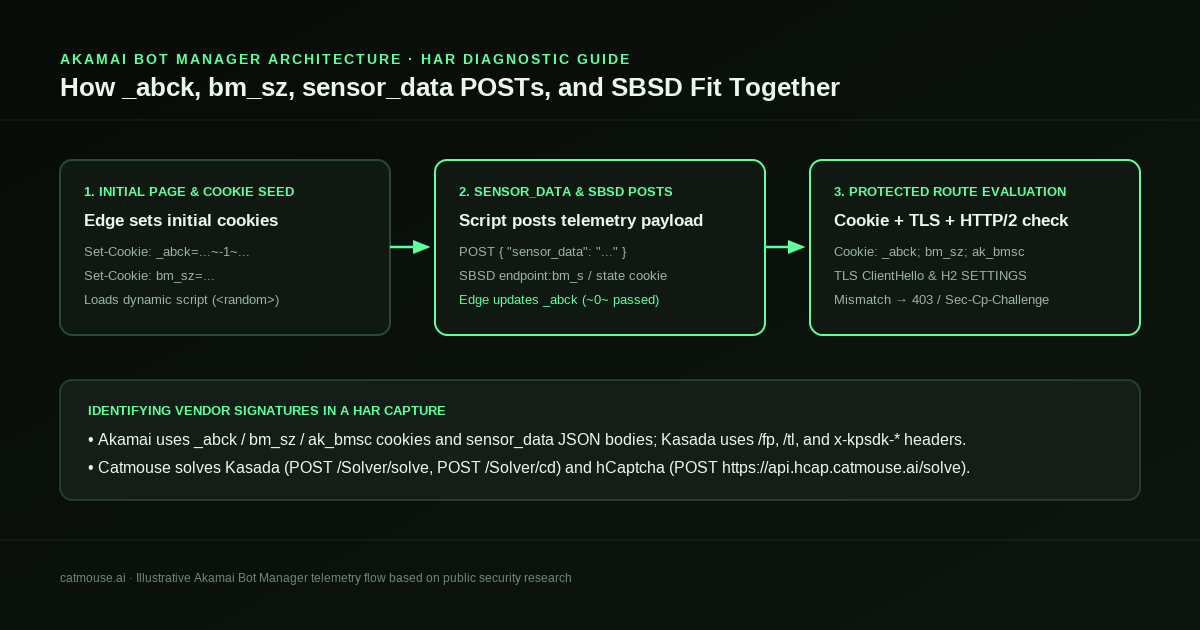
sensor_data POST exchanges, and SBSD evaluation in an Akamai Bot Manager HAR trace. Diagram by Catmouse Engineering.How does Akamai Bot Manager compare with Kasada in a HAR capture?
Akamai relies on _abck and bm_sz cookies plus JSON sensor_data POSTs, whereas Kasada uses /fp, ips.js, binary /tl POSTs, and x-kpsdk-* headers.
When an enterprise site deploys multiple edge rules—or migrates from one vendor to another—distinguishing Akamai from Kasada in your HAR file is the first step before writing any test harness:
| Artifact in HAR | Akamai Bot Manager | Kasada |
|---|---|---|
| Primary session carrier | HTTP cookies: _abck, bm_sz, ak_bmsc, bm_sv, bm_s | Custom HTTP headers: x-kpsdk-ct, x-kpsdk-cd, x-kpsdk-v |
| Client challenge script | Dynamic alphanumeric path loaded from the origin | /<guid>/ips.js?x-kpsdk-v=...&x-kpsdk-im=... loaded from /fp |
| Telemetry submission format | JSON POST body: {"sensor_data": "..."} | Raw binary POST body to /<guid>/tl (application/octet-stream) |
| Catmouse API coverage | Not registered in /openapi.json (diagnostic coverage only) | Solved via POST /Solver/solve (plus proof-of-work generation) |
How can you classify Akamai versus Kasada traffic programmatically?
Scan the HAR entries for _abck cookies and sensor_data bodies versus x-kpsdk-* headers, then route Kasada challenges to POST /Solver/solve.
As documented in the Catmouse OpenAPI 3.1 specification (/openapi.json), the Catmouse server registers Kasada solve routes alongside the separate hCaptcha gateway (POST https://api.hcap.catmouse.ai/solve), and does not register an Akamai solver route. Once your HAR inspection confirms that a route is protected by Kasada, you pass the fetched ips.js text to POST /Solver/solve:
import os
import requests

r = requests.post(
    "https://kasadaapi.catmouse.ai/Solver/solve",
    headers={"x-api-key": os.environ["CATMOUSE_KEY"]},
    json={
        "ipsBody": "<contents of the ips.js response, as UTF-8 text>",
        "ipsUrl": "https://www.example.com/149e9513-01fa-4fb0-aad4-566afd725d1b/2d206a39-8ed7-437e-a3be-862e0f06eea3/ips.js?x-kpsdk-v=j-1.2.899&x-kpsdk-im=ZXhhbXBsZQ",
        "ctToken": "<x-kpsdk-ct response header of the /fp request>",
        "kpsdkV": "j-1.2.899",
        "tz": "America/New_York",
        "tzOffset": 240,
        "acceptLanguage": "en-US",
        "engine": "chrome",
    },
    timeout=60,
)
print(r.status_code, r.text)
Key takeaways
- Cookie-centric state: Akamai Bot Manager tracks client verification through
_abck,bm_sz,ak_bmsc, andbm_scookies rather thanx-kpsdk-*headers. - Telemetry payload shape: The browser script posts a JSON object (
{"sensor_data": "..."}) to a dynamic script path to transition_abckfrom its initial~-1~state to an accepted~0~state. - Transport binding: Replaying an
_abckcookie from a different TLS stack, HTTP/2 frame order, or IP exit commonly triggers an HTTP403or interstitial challenge. - Verify the vendor first: Catmouse solves Kasada (`POST /Solver/solve`, `POST /Solver/cd`) and hCaptcha (`POST https://api.hcap.catmouse.ai/solve`); always inspect a HAR capture before integrating.
Conclusion and scope
Inspecting Set-Cookie headers and POST bodies in a HAR trace lets you immediately separate Akamai Bot Manager (_abck, bm_sz, sensor_data, and SBSD) from Kasada (/fp, ips.js, /tl, and x-kpsdk-* headers) before writing your client.
Scope and limitations. This article summarizes publicly observable HTTP cookies and payload formats in Akamai Bot Manager and compares them with the Kasada protocol as of 2026-10-22. Catmouse does not expose an Akamai solver endpoint in /openapi.json and publishes no pass-rate or latency benchmarks. Perform traffic analysis and automated testing only against systems you own or have explicit written authorization to test.
Evidence and sources
The protocol descriptions and standards referenced in this article are supported by the sources below:
- Akamai Bot Manager product overview. Supports: Akamai's bot management product for web and mobile endpoints. Does not publish internal cookie or
sensor_dataspecifications. - IETF RFC 6265 (HTTP State Management Mechanism) and MDN HTTP Cookies documentation. Supports:
Set-CookieandCookieheader semantics. - IETF RFC 9110 (HTTP Semantics), RFC 9113 (HTTP/2), RFC 8446 (TLS 1.3), and IANA HTTP Status Code Registry. Supports: HTTP status code
403 Forbidden, HTTP/2 framing, and TLS handshake negotiation. - Catmouse OpenAPI 3.1 specification (
/openapi.json) and hCaptcha API page (/hcaptcha.html). Supports: registered Catmouse endpoints (POST /Solver/solve,POST /Solver/cd, andPOST https://api.hcap.catmouse.ai/solve). Reviewed 2026-10-22.
Methodology and limits. Documented: HTTP cookie names, JSON wrapper keys, and HAR diagnostic differences between Akamai Bot Manager and Kasada. Not claimed: vendor internal scoring rules or numerical solve metrics. Reviewed 2026-10-22.
Frequently asked questions
How do you identify Akamai Bot Manager in a HAR capture?
Look for Set-Cookie headers setting _abck, bm_sz, or ak_bmsc on the initial page response, followed by a dynamically named script that sends an HTTP POST containing a JSON body of {"sensor_data":"..."} back to the same origin.
What is the difference between _abck, bm_sz, and bm_s cookies?
In public security analyses of Akamai Bot Manager, bm_sz carries initial session parameters seeded before script execution, _abck stores the session's challenge state updated when the edge receives a sensor_data POST, and bm_s is associated with SBSD (State-Based Scraping Detection) scripts.
How does Akamai Bot Manager differ architecturally from Kasada?
Akamai Bot Manager primarily exchanges state through HTTP cookies (_abck, bm_sz, ak_bmsc) and a JSON {"sensor_data":"..."} POST to a dynamic script path, whereas Kasada uses a /fp challenge frame, an ips.js script, a binary /tl POST, and custom x-kpsdk-ct, x-kpsdk-cd, and x-kpsdk-v headers.
Does the Catmouse API expose an Akamai Bot Manager endpoint?
No. The Catmouse OpenAPI specification (/openapi.json) registers Kasada endpoints (POST /Solver/solve and POST /Solver/cd), and the dedicated hCaptcha gateway (POST https://api.hcap.catmouse.ai/solve) handles hCaptcha challenges. Confirm which vendor protects your target in a HAR capture before integrating.
Why do plain HTTP clients fail even when copying an _abck cookie from a browser?
Edge defenses bind session cookies to transport and session attributes such as the TLS ClientHello fingerprint, HTTP/2 SETTINGS frames, User-Agent, and IP exit, and require periodic sensor refreshes as the user interacts with protected routes.