PerimeterX (HUMAN Security) Architecture: _px3 Cookies, _pxde, and Collector Payloads
PerimeterX (HUMAN Security) is a cookie-anchored bot management architecture that loads a first-party sensor (/<APP_ID>/init.js), posts encoded telemetry to a collector endpoint, and issues short-lived _px3 and _pxde cookies. Below: how to inspect its wire flow in a HAR capture and distinguish it from Kasada.
Who this is for
Security researchers and protocol engineers inspecting HAR captures who want to understand how PerimeterX (HUMAN Security) sensor scripts, collector payloads, and _px3 cookies operate on the wire.
On this page
- How does the PerimeterX sensor and collector lifecycle work?
- What is the difference between _px3, _px2, _pxvid, and _pxde cookies?
- How does PerimeterX cookie enforcement compare with Kasada headers?
- How can you classify PerimeterX versus Kasada in a HAR capture?
- Key takeaways
- Conclusion and scope
- Evidence and sources
- Frequently asked questions
How does the PerimeterX sensor and collector lifecycle work?
The browser loads a first-party sensor script that gathers environment signals, posts encoded telemetry to a collector route, and receives cookie baking instructions.
When a client connects to a PerimeterX-protected storefront over a trusted TLS session, the page HTML loads a first-party sensor script whose path is derived from the site's application identifier (an appId starting with PX followed by eight alphanumeric characters, such as /PX12345678/init.js with the prefix stripped on first-party reverse-proxy routes). Once loaded, the sensor initializes a visitor identifier (_pxvid) and posts an encoded form payload to the collector endpoint (commonly /<APP_ID_WITHOUT_PX>/xhr/api/v2/collector or https://collector-px...perimeterx.net/api/v2/collector).
In contrast to static challenge forms, the collector response returns an obfuscated array of instructions (keyed under do). The sensor splits each instruction string on pipe delimiters—most notably bake|..., which instructs the JavaScript runtime to write the _px3 and _pxde cookies via document.cookie (according to IETF RFC 6265, for example when refreshing a short-lived risk cookie on checkout).
Key wire fields in PerimeterX collector and 403 block payloads
When inspecting a PerimeterX exchange in HarFiddle or browser DevTools, four wire artifacts identify the protocol state:
appIdand First-Party Sensor Path- Every deployment has a unique
PX...application ID. First-party deployments proxy the sensor and collector under a path named after the ID with the leadingPXremoved so browser tracking blockers do not block third-party calls. - Collector Request Form Fields (
payload,appId,tag,uuid,ft,seq) - The sensor posts URL-encoded or JSON fields containing a base64-encoded encrypted telemetry blob (
payload), the client UUID (uuid), sequence counter (seq), and script tag version (tag). bakeInstruction and Cookie TTL- The collector response includes
bake|_px3|<ttl>|<value>commands that update the active risk cookie in the browser cookie jar before the page issues sensitive XHR calls. - HTTP
403Block JSON and Press & Hold (blockScript) - When the edge enforcer rejects a request (HTTP
403 Forbiddenper RFC 9110), XHR routes return a JSON object withappId,jsClientSrc,firstPartyEnabled,vid,uuid,hostUrl, andblockScriptto mount the interactive Press & Hold challenge.
What is the difference between _px3, _px2, _pxvid, and _pxde cookies?
Each PerimeterX cookie serves a distinct lifecycle role, separating long-lived visitor identity from short-lived risk decisions and signed edge data enrichment.
Because the PerimeterX edge enforcer evaluates incoming requests at the CDN or load balancer before forwarding traffic to the origin, it relies on a set of cooperating cookies rather than a single token. If an HTTP client replays a long-lived _pxvid cookie while omitting or failing to refresh _px3, the edge enforcer flags the request as expired or missing sensor telemetry.
Comparing PerimeterX cookies versus Kasada protocol headers
The table below maps each PerimeterX cookie to its role and contrasts it with the header-driven architecture used by Kasada:
| Artifact | Vendor | Wire Location | Protocol Role & Lifecycle |
|---|---|---|---|
_px3 (or _px2) | PerimeterX (HUMAN) | Cookie header / bake instruction | Short-TTL encrypted risk score and session token checked by the edge enforcer |
_pxde | PerimeterX (HUMAN) | Cookie header / bake instruction | Signed data-enrichment payload read by the edge and origin server |
_pxvid and _pxhd | PerimeterX (HUMAN) | Cookie / Set-Cookie | Long-lived visitor and host device identifiers persisted across sessions |
x-kpsdk-ct and x-kpsdk-cd | Kasada | Custom HTTP headers | Session token (/fp, /tl) and single-use per-request proof-of-work header |
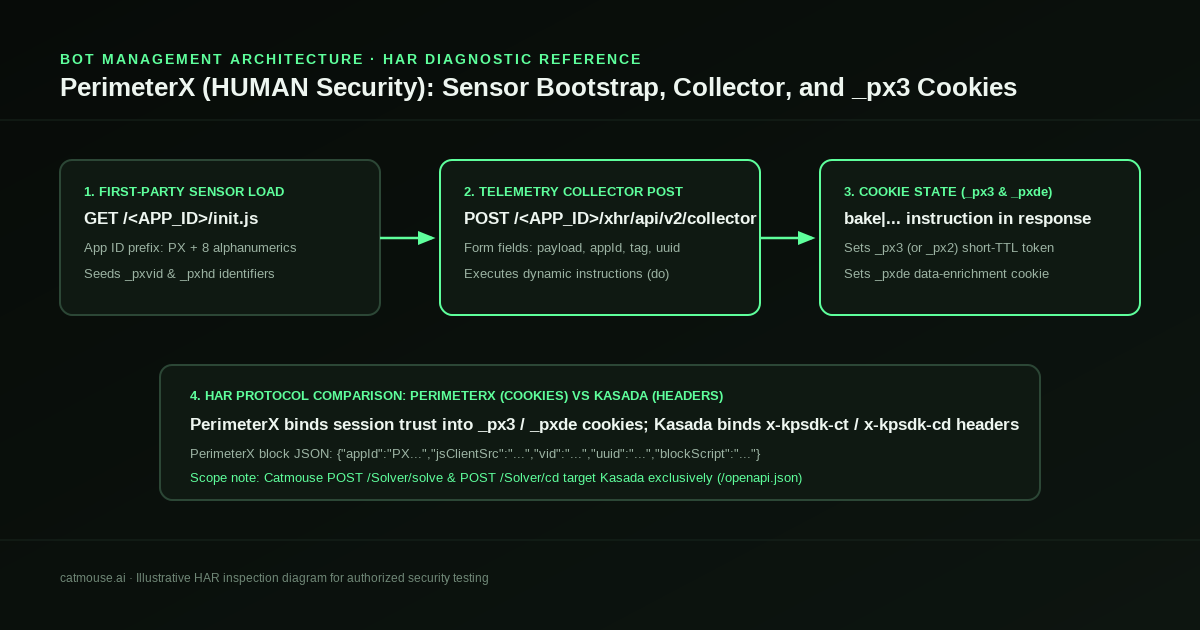
_px3 / _pxde cookie baking compared with Kasada headers. Diagram by Catmouse Engineering.How does PerimeterX cookie enforcement compare with Kasada headers?
Several retail and e-commerce storefronts layer multiple controls or migrate between PerimeterX and Kasada across web and mobile surfaces.
Distinguishing the two vendors before writing any client logic prevents wasted debugging time and avoids sending non-Kasada payloads to POST /Solver/solve (which validates that ipsBody is a real Kasada script and rejects HTML block pages or non-Kasada scripts with HTTP 400 invalid ipsBody per /openapi.json).
- Transport carrier: PerimeterX attaches its tokens to standard HTTP
Cookieheaders (_px3,_pxde,_pxvid), whereas Kasada attachesx-kpsdk-ct,x-kpsdk-cd, andx-kpsdk-vas explicit request headers. - Mobile SDK headers: Native mobile apps using the PerimeterX Mobile SDK attach headers prefixed with
x-px-(such asx-px-authorizationandx-px-original-token), whereas Kasada mobile SDKs usex-kpsdk-ct,x-kpsdk-fc,x-kpsdk-h, andx-kpsdk-dv. - Scope of the Catmouse API: Catmouse's production API solves Kasada only; PerimeterX is not a supported solver target on
kasadaapi.catmouse.ai.
How can you classify PerimeterX versus Kasada in a HAR capture?
You can run a short offline Python script against any saved HAR file to list whether the captured traffic carries PerimeterX cookies and collector routes or Kasada challenge headers:
import json
import sys

with open(sys.argv[1], "r", encoding="utf-8") as f:
    har = json.load(f)

px_signals, kasada_signals = set(), set()
for entry in har.get("log", {}).get("entries", []):
    url = entry.get("request", {}).get("url", "")
    if "/xhr/api/v2/collector" in url or "/init.js" in url:
        px_signals.add(url.split("?")[0])
    for c in entry.get("request", {}).get("cookies", []):
        if c.get("name", "").startswith("_px"):
            px_signals.add(f"cookie:{c['name']}")
    for h in entry.get("request", {}).get("headers", []):
        name = h.get("name", "").lower()
        if name.startswith("x-px-"):
            px_signals.add(f"header:{name}")
        elif name.startswith("x-kpsdk-"):
            kasada_signals.add(f"header:{name}")

print("PerimeterX artifacts:", sorted(px_signals))
print("Kasada artifacts:", sorted(kasada_signals))
Key takeaways
- Recognize PerimeterX wire markers: Look for
PX...application IDs, first-partyinit.jsscripts,/xhr/api/v2/collectorPOSTs, and_px3,_pxde,_pxvid, and_pxhdcookies. - Understand
bakeinstructions: The collector endpoint returns pipe-delimited instructions that refresh short-lived_px3and_pxdecookies in the client cookie jar. - Separate PerimeterX from Kasada: PerimeterX relies on
_px*cookies (andx-px-*mobile headers), whereas Kasada usesx-kpsdk-*headers. - Respect solver scope:
POST /Solver/solveandPOST /Solver/cdin/openapi.jsontarget Kasada exclusively and reject non-Kasada inputs with400 invalid ipsBody.
Conclusion and scope
Applying these HAR diagnostic recommendations lets you quickly distinguish PerimeterX (HUMAN Security) cookie and collector flows from Kasada header challenges before designing your test harness.
Scope and limitations. This article is an educational protocol reference describing observable PerimeterX wire artifacts in client HAR captures and contrasting them with the Kasada protocol documented in /openapi.json as of 2026-10-23. Catmouse does not offer a PerimeterX solver endpoint, and no performance or pass-rate figures are claimed. Test only against systems you own or have explicit written authorization to audit.
Evidence and sources
The protocol structures and HTTP specifications referenced in this article are grounded in the sources below:
- Catmouse OpenAPI 3.1 schema (
/openapi.json) together with the live endpoint reference (/reference.html). Supports: Kasada-only solver scope,400 invalid ipsBodyrejection of non-Kasada inputs, andx-kpsdk-*header definitions. Reviewed 2026-10-23. - IETF RFC 6265 (HTTP State Management Mechanism). Supports: standard HTTP
CookieandSet-Cookiesemantics used by_px3,_px2,_pxvid,_pxhd, and_pxde. - IETF RFC 9110 (HTTP Semantics) and IANA HTTP Status Code Registry. Supports: HTTP
403 Forbiddenchallenge response semantics. - MDN Document.cookie API documentation and W3C HAR 1.2 Specification Draft. Supports: client-side cookie assignment and HAR capture inspection.
Methodology and limits. Documented: client-visible PerimeterX cookie names, collector paths, and block JSON fields observable in standard browser DevTools and HAR captures. Not claimed: proprietary PerimeterX server-side scoring models or solver support. Reviewed 2026-10-23.
Frequently asked questions
How do you identify PerimeterX (HUMAN Security) in a HAR capture?
PerimeterX is identified by an application ID starting with PX followed by eight alphanumeric characters, first-party sensor requests to /<APP_ID>/init.js, collector POSTs to /<APP_ID>/xhr/api/v2/collector, and cookies named _px3, _px2, _pxvid, _pxhd, and _pxde.
What is the role of the _px3 and _pxde cookies in PerimeterX?
The _px3 cookie (or _px2 on older configurations) holds the short-lived encrypted risk token evaluated by the edge enforcer on each HTTP request, while _pxde carries signed data-enrichment attributes alongside long-lived visitor cookies (_pxvid and _pxhd).
What does a PerimeterX HTTP 403 block response body look like?
On API and XHR routes, a PerimeterX block typically returns HTTP 403 with a JSON object containing appId, jsClientSrc, firstPartyEnabled, vid, uuid, hostUrl, and blockScript, which instructs the client to render a Press & Hold challenge.
How does PerimeterX session binding differ from Kasada?
PerimeterX stores session state in HTTP cookies (_px3, _pxvid, _pxde) updated via bake instructions from its collector endpoint, whereas Kasada transmits session state in custom HTTP headers (x-kpsdk-ct, x-kpsdk-cd, x-kpsdk-v) obtained from /fp and /tl.
Does the Catmouse Solver API solve PerimeterX challenges?
No. As documented in the Catmouse OpenAPI 3.1 specification (/openapi.json), POST /Solver/solve and POST /Solver/cd solve Kasada challenges exclusively. Sending a PerimeterX script or block page to POST /Solver/solve returns HTTP 400 invalid ipsBody.