Walmart PerimeterX Bypass: Anti-Bot Guide
PerimeterX and ThreatMetrix (a LexisNexis Risk Solutions product) are two different kinds of defence that publicly available material associates with large retail sites. Which vendors protect walmart.com today has not been re-verified, so this guide explains the mechanisms in general terms and states plainly what the Catmouse API does and does not support.
Who this is for
Engineers and data teams who own, or have explicit written authorization to test, Walmart properties and want to understand how this post describes PerimeterX and ThreatMetrix before deciding on an approach.
On this page
- Short answer: a sensor-style bot defence sets a cookie such as
_px3after client-side code reports on the browser, and a device-profiling product assigns a session identifier to recognise a device across visits. - Catmouse coverage: the solve API covers Kasada only. PerimeterX and ThreatMetrix are not reachable through it, so this article is research and has no solver example.
- Vendor label: Walmart's bot-management vendor is not re-verified, and nothing here should be read as confirmation of what Walmart runs today.
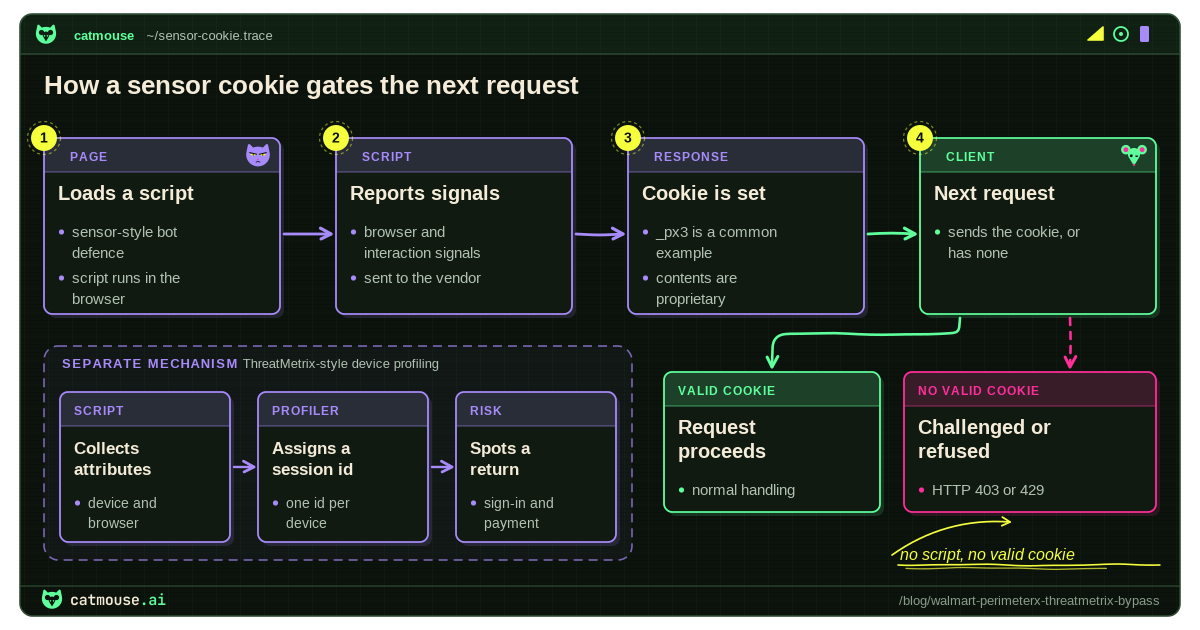
What ThreatMetrix-style device profiling is?
Device-profiling products such as ThreatMetrix run a script that collects attributes of the device and browser, then associate them with a session identifier so a risk system can recognise a returning device. LexisNexis describes ThreatMetrix as a fraud detection and risk management platform that uses device intelligence (source: LexisNexis Risk Solutions, linked under Evidence and sources). Where and how a specific retailer applies it is not public.
What the Catmouse API covers?
The Catmouse OpenAPI document describes a solve endpoint for one vendor, Kasada: the caller posts a fetched Kasada ips.js body and receives a /tl payload and x-kpsdk-* headers. Its engine value selects a Kasada device profile, not a vendor. It has no PerimeterX or ThreatMetrix engine, which is why this article includes no code and should be read as a description of the mechanisms, not of a Catmouse capability for Walmart.
Check for an official data route first
If your goal is product or pricing data, check whether an official programme covers it. According to its developer portal, Walmart publishes API documentation and guides at developer.walmart.com, and the available APIs and their terms are set there. An official route avoids bot-management friction altogether.
Next steps
If your target is protected by Kasada, read the API reference and try the playground on a host you are authorized to test.
Scope, limitations, and recommendations
Walmart's current configuration is not established here. Last reviewed: 2026-10-09.
How does walmart perimeterx threatmetrix bypass validate a trusted TLS session?
For walmart perimeterx threatmetrix bypass, a client is a verified session when it sends fresh tokens versus static headers over a trusted TLS session.
Evidence and sources
- IANA HTTP Status Code Registry and MDN HTTP response status codes: reference definitions for HTTP status codes observed during walmart perimeterx threatmetrix bypass testing.
- Catmouse OpenAPI document: supports the statement that the solve endpoint takes a Kasada
ips.jsbody and that itsenginefield selects a Kasada device profile, with no PerimeterX or ThreatMetrix option. The API reference page shows the same limits. - RFC 9110, section 15.5.4: supports the meaning of 403. It states: "The 403 (Forbidden) status code indicates that the server understood the request but refuses to fulfill it."
- RFC 6585, section 4: supports the meaning of 429. It states: "The 429 status code indicates that the user has sent too many requests in a given amount of time ("rate limiting")."
- LexisNexis Risk Solutions, ThreatMetrix: supports the description of ThreatMetrix as a LexisNexis Risk Solutions fraud detection and risk management product that uses device intelligence.
- Walmart developer portal: supports the statement that Walmart publishes developer resources. The page says: "Find API documentation, guides, and tools to streamline integration." Which APIs suit your use case is set out there.
Methodology and limits
Reviewed on 2026-10-09. Statements about HTTP status codes and the Catmouse API contract rest on the sources above. The _px3 cookie name and the PerimeterX sensor-cookie flow are common public observations rather than vendor documentation, and their contents are proprietary.
What separates walmart perimeterx threatmetrix bypass telemetry from plain HTTP replay?
In contrast, on walmart perimeterx threatmetrix bypass, you must refresh session state whenever a route returns a challenge instead of reusing old headers.
- Challenge bootstrap (walmart perimeterx threatmetrix bypass)
- The initial HTTP challenge response on walmart perimeterx threatmetrix bypass that delivers the vendor script or session seed to the client.
- Session state verification (walmart perimeterx threatmetrix bypass)
- The header or cookie proof returned after telemetry evaluation on walmart perimeterx threatmetrix bypass that authorizes subsequent API calls.
| Stage | Plain HTTP replay on walmart perimeterx threatmetrix bypass | Verified session state on walmart perimeterx threatmetrix bypass |
|---|---|---|
| Initial request | Missing session proof for walmart perimeterx threatmetrix bypass | Bootstraps fresh challenge state for walmart perimeterx threatmetrix bypass |
| Protected route | Challenged with HTTP 403 or 429 on walmart perimeterx threatmetrix bypass | Attaches current session state for walmart perimeterx threatmetrix bypass |
Frequently Asked Questions
Does Catmouse support PerimeterX?
No. The published OpenAPI document describes a solve endpoint for Kasada only, and its engine field selects a Kasada device profile. There is no PerimeterX option.
What is the _px3 cookie?
It is a cookie commonly observed on sites that use PerimeterX, set after client-side code reports on the browser. Its contents are proprietary.
What is ThreatMetrix?
A LexisNexis Risk Solutions fraud detection and risk management product that uses device intelligence.
Can I use this on any website?
No. Use it only against Walmart properties you own or where Walmart has authorized your testing in writing; for product data, start with its official developer programme.