DataDome Architecture: ddjskey, cid, and Cookie Lifecycle
DataDome is a cookie-centric bot management architecture that issues a single session cookie, evaluates background telemetry via /js/ (ddjskey), and serves interstitial (t: "it") or slider (t: "fe") challenges through window.dd. Below: how to inspect these flows in HAR captures versus Kasada.
Who this is for
Security researchers and protocol engineers analyzing HAR captures who want to decode window.dd parameters, x-dd-b headers, and session cookie rotation—and avoid sending non-Kasada challenge HTML to POST /Solver/solve.
On this page
- How does the edge module structure its window.dd challenge object?
- What is the difference between interstitial, slider, and bv blocks?
- How does the background /js/ tag rotate the session cookie?
- How can you separate these challenges from Kasada in a HAR file?
- Key takeaways
- Conclusion and scope
- Evidence and sources
- Frequently asked questions
How does the edge module structure its window.dd challenge object?
When the edge module intercepts a request, it returns an HTML page embedding a configuration object that selects the challenge delivery route.
Over a trusted TLS session, the protected origin seeds an initial session cookie via Set-Cookie (according to IETF RFC 6265). If the edge module decides to challenge the client (for example, on a checkout or ticket search route), it responds with HTTP 403 Forbidden (RFC 9110), an x-dd-b diagnostic header, and an HTML document or JSON wrapper declaring var dd = {...} on window.dd.
In contrast to Kasada's /fp challenge page—which loads ips.js from a first-party UUID path—the window.dd dictionary directs the browser to construct a script or iframe URL on geo.captcha-delivery.com using the keys below:
cid(Cookie / Session Identifier)- The current session cookie value or correlation token associated with the challenged HTTP request.
hshandddjskey(Site Hash / Customer Key)- The 32-character hexadecimal site key identifying the customer account on the vendor's edge network.
t(Challenge Type Selector:"it","fe", or"bv")- Determines which challenge flow the client must execute (for example,
"it"for interstitial device check,"fe"for slider/captcha, or"bv"for a hard block). s,e, andhost- Challenge script integer ID (
s), encrypted request context blob (e), and challenge delivery hostname (typicallygeo.captcha-delivery.com).
What is the difference between interstitial, slider, and bv blocks?
The single-letter t field inside the challenge configuration determines whether the client loads a background interstitial, an interactive slider, or a hard block.
Inspecting the t property inside window.dd before attempting any replay is essential. When t is "bv" (banned visitor), the edge has already rejected the IP address, TLS fingerprint, or tarnished cookie; fetching the /captcha/ URL will render a static block notice with no puzzle to complete.
Comparing challenge modes versus Kasada /fp and /tl
The table below compares the three window.dd modes and background /js/ tag against Kasada's challenge lifecycle:
| Flow / Signal | Vendor | Wire Trigger | Client Outcome & State Carrier |
|---|---|---|---|
t: "it" (Interstitial) | DataDome | geo.captcha-delivery.com/interstitial/ | Automated JS device check posts payload and returns a rotated session cookie |
t: "fe" (Slider / Captcha) | DataDome | geo.captcha-delivery.com/captcha/ | Interactive puzzle verification returns a new cookie JSON response |
t: "bv" (Hard Block) | DataDome | 403 with t: "bv" in window.dd | Session or proxy exit is blocked; requires a clean connection and fresh cookie jar |
/fp and /tl | Kasada | ips.js + binary POST /tl | Returns {"reload":false} and x-kpsdk-ct + x-kpsdk-r headers |
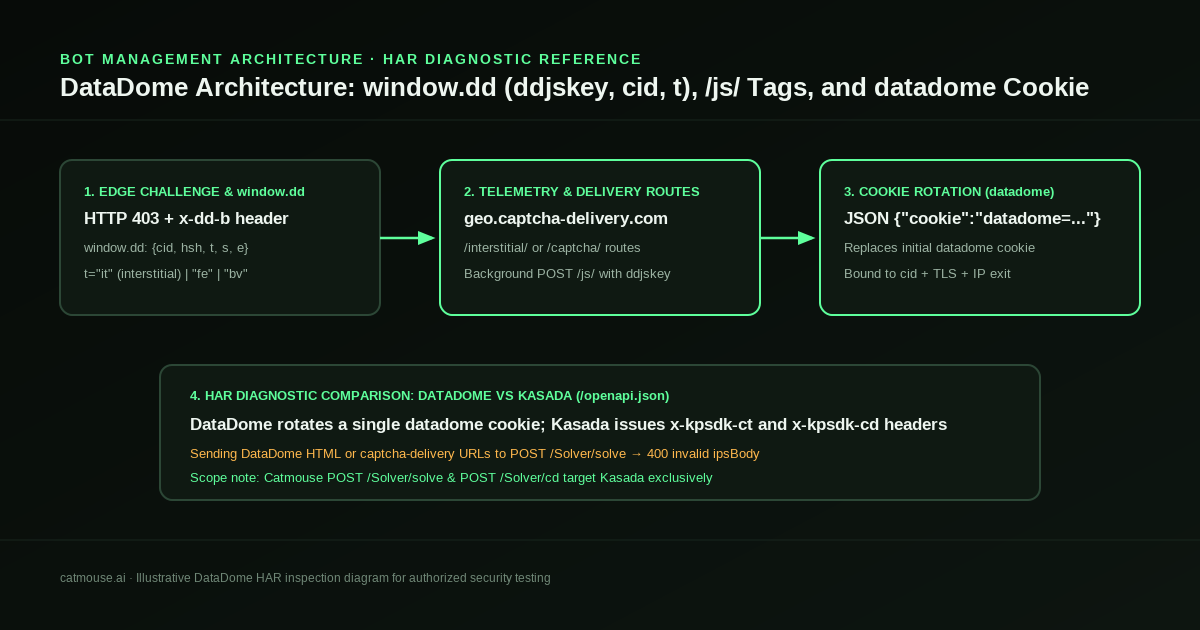
window.dd (cid, hsh, t), /js/ telemetry tags, and session cookie rotation compare with Kasada. Diagram by Catmouse Engineering.How can you separate these challenges from Kasada in a HAR file?
Before routing a challenge response to a solver, run an ingress check on the response headers and body so window.dd pages are never mistaken for Kasada /fp scripts:
import json
import re
import sys

with open(sys.argv[1], "r", encoding="utf-8") as f:
    har = json.load(f)

for entry in har.get("log", {}).get("entries", []):
    url = entry.get("request", {}).get("url", "")
    res = entry.get("response", {})
    headers = {h["name"].lower(): h["value"] for h in res.get("headers", [])}
    body = res.get("content", {}).get("text", "") or ""

    if "x-dd-b" in headers or "captcha-delivery.com" in body:
        m = re.search(r"'t'\s*:\s*'([a-z]{2})'", body)
        mode = m.group(1) if m else "unknown"
        print(f"[DD-Challenge] {url} -> x-dd-b={headers.get('x-dd-b')} mode={mode}")
    elif "x-kpsdk-ct" in headers or "KPSDK" in body:
        print(f"[Kasada]       {url} -> x-kpsdk-ct present")
Key takeaways
- Inspect
window.ddandx-dd-b: Challenge responses return anx-dd-bheader and awindow.ddobject containingcid,hsh,t,s, ande. - Check
tbefore retrying:t: "it"is a device-check interstitial,t: "fe"is an interactive captcha, andt: "bv"is a hard block requiring a fresh connection and clean cookie jar. - Guard
POST /Solver/solveingress: Validate that a fetched script is a real Kasadaips.jsbefore callingPOST /Solver/solve; sending HTML block pages or URLs returns HTTP400 invalid ipsBody. - Single-cookie state vs headers: This architecture rotates a single HTTP cookie via
Set-Cookieand/js/JSON responses, whereas Kasada usesx-kpsdk-*headers.
Conclusion and scope
Following these HAR classification recommendations lets your HTTP pipeline distinguish window.dd challenge responses (it, fe, bv) from Kasada challenges cleanly and prevents accidental 400 invalid ipsBody errors on POST /Solver/solve.
Scope and limitations. This article documents client-observable wire artifacts in browser HAR captures and the 400 invalid ipsBody validation rule in the Catmouse OpenAPI 3.1 contract (/openapi.json) as of 2026-10-24. Catmouse does not provide a solver endpoint for this vendor, and no performance or pass-rate figures are claimed. Test only on systems you own or have explicit written authorization to audit.
Evidence and sources
Every HTTP header, cookie rule, and solver validation behavior described in this post is grounded in the primary sources below:
- Catmouse OpenAPI 3.1 specification (
/openapi.json) alongside the solver reference page (/reference.html). Supports: Kasada-only scope ofPOST /Solver/solveandPOST /Solver/cd, and the400 invalid ipsBodyrejection when an HTML block page, URL, or non-Kasada payload is submitted. Reviewed 2026-10-24. - IETF RFC 6265 (HTTP State Management Mechanism). Supports: standard
CookieandSet-Cookielifecycle used by session cookies. - IETF RFC 9110 (HTTP Semantics) and IANA HTTP Status Code Registry. Supports: HTTP
200 OK,400 Bad Request, and403 Forbiddensemantics. - MDN Document.cookie documentation and W3C HAR 1.2 Specification. Supports: client-side cookie updates from
/js/JSON responses and HAR capture analysis.
Methodology and limits. Documented: client-visible headers, cookies, and window.dd keys observed in standard HAR captures, plus verified /openapi.json ingress validation rules. Not claimed: proprietary server-side detection models or solver coverage. Reviewed 2026-10-24.
Frequently asked questions
What wire signals identify this protection in an HTTP HAR capture?
The protection is identified by the datadome cookie in Set-Cookie or Cookie headers, response headers such as x-dd-b, background telemetry POSTs to /js/ with a ddjskey parameter, and challenge HTML containing a window.dd object.
What do the t values (it, fe, bv) inside window.dd mean?
Inside the window.dd challenge configuration object, t set to "it" selects a non-interactive device-check interstitial, "fe" selects an interactive slider or captcha challenge, and "bv" indicates a hard block (banned visitor) where solving is not offered on that IP or session.
How does the background /js/ tag update the session cookie?
The in-page tag script collects browser telemetry and posts form-encoded fields (including ddjskey, cid, and jsData) to the /js/ endpoint, which responds with a JSON object containing a fresh cookie string assigned via document.cookie.
What happens if a client sends an HTML block page or captcha URL to POST /Solver/solve?
Per the Catmouse OpenAPI 3.1 contract (/openapi.json), POST /Solver/solve validates that ipsBody looks like a Kasada ips.js script. Submitting an HTML block page, a URL, or a third-party script is rejected immediately with HTTP 400 invalid ipsBody and is not charged.
How does this single-cookie session state compare with Kasada?
This vendor rotates a single HTTP cookie across edge responses, /js/ telemetry posts, and geo.captcha-delivery.com challenges, whereas Kasada binds session state to custom x-kpsdk-ct and x-kpsdk-cd HTTP headers.