Allegiant Air Bot Detection Bypass: Flight Scraping Guide
A protocol-level guide for authorized users: how the Kasada challenge flow looks over HTTP for allegiantair.com, what the Catmouse solver takes and returns (a /tl payload and x-kpsdk-* headers), and where it stops working.
Who this is for
Engineers and data teams who own, or have explicit written authorization to test, Allegiant Air and want to understand how its Kasada protection is described in this post before deciding on an approach.
On this page
- What an Allegiant Air bot detection bypass workflow does
- How the Kasada challenge flow works at the HTTP level
- Why plain HTTP clients and browser automation get challenged on allegiantair.com
- Python example: posting the fetched Kasada script to the solver
- Scope and limitations
- Evidence and sources
- Frequently asked questions
- Conclusion and next step
- The vendor for allegiantair.com is listed as Kasada in the Catmouse directory and was not re-verified on 2026-10-09.
- The solver returns a base64 /tl payload and x-kpsdk-* headers for your own client to send. The API never contacts allegiantair.com.
- No benchmark figures are published here. Measure on your own workload.
What an Allegiant Air bot detection bypass workflow does?
An Allegiant Air bot detection bypass workflow lets your own HTTP client complete the Kasada challenge for allegiantair.com and then read public route pricing and seat data. Your client fetches the site's Kasada script with its own session and posts it to the Catmouse solver. The solver returns a base64 /tl payload and x-kpsdk-* headers, and your client sends them to the site. The Catmouse directory lists allegiantair.com as protected by Kasada; that label was not re-verified on 2026-10-09.
Who this guide is for
Engineers and analysts who have permission to collect airline pricing or seat data, and security teams testing their own bot-management setup. If you do not have that permission, this guide is not for you.
How the Kasada challenge flow works at the HTTP level?
A client that has no valid session usually gets a challenge instead of the page. That response is typically a 4xx status such as 429 Too Many Requests (RFC 6585 section 4) or 403 Forbidden (RFC 9110 section 15.5.4). Kasada does not publish its challenge internals, so the rest of this paragraph is the general pattern of such challenges, not vendor documentation: a script runs in the browser, collects signals about the environment, and returns a result to the edge, which then issues tokens for later requests.
The flow is three steps in your client, one solver call, and one more step in your client. Your client requests the site's /fp page and keeps the x-kpsdk-ct response header, reads the ips.js URL from that page, and fetches ips.js as UTF-8 text. It then posts that text to POST /Solver/solve with the timezone of its proxy exit address, and sends the returned payload to the site's /tl URL. The /fp and /tl URL shapes differ by target and were not verified for allegiantair.com. Field names come from the Catmouse OpenAPI document. The engine field selects a Kasada device profile (chrome by default), not a vendor.
payload: base64 of the body your client POSTs to the site's/tlURL.headers: thex-kpsdk-*request headers to send with that request, such asx-kpsdk-ct,x-kpsdk-dt,x-kpsdk-imandx-kpsdk-v.success,mappedandcost: whether a payload was built, an identified/total count (the spec notes that a result with identified below total failed live in a dated measurement), and the price charged for the call.
The Catmouse directory describes this target as a US ultra-low-cost airline with direct route pricing, vacation bundle packaging and seat feeds. Bundled and add-on pricing makes comparisons easy to get wrong, so record exactly which fare components each captured price includes.
Why plain HTTP clients and browser automation get challenged on allegiantair.com?
A plain HTTP client without the session tokens is challenged by design, so the first request fails regardless of headers you copy from a browser. Browser automation fails for different reasons. These are general, documented mechanisms and not measurements taken on allegiantair.com.
- Automation signals: the W3C WebDriver specification defines
navigator.webdriver, which is true in a browser under automation control, and scripts can read it. - Network fingerprints: JA4 TLS fingerprinting summarizes a TLS client hello, and HTTP/2 clients differ in the SETTINGS they send (RFC 9113). A client whose TLS and HTTP/2 behaviour does not match its claimed User-Agent can stand out.
- Operating cost: a headless browser runs a full browser, so capacity is planned differently from HTTP connections. This is an engineering observation, not a measurement.
Python example: posting the fetched Kasada script to the solver
The script below is the canonical solve call from the Catmouse API samples. It assumes your own client already completed the fetch steps against allegiantair.com and holds the ips.js text (ips_body), its URL, the x-kpsdk-ct value and the served x-kpsdk-v. The URL and the timezone values are placeholders.
import base64, os, requests

# Steps 1-3 run in YOUR client against YOUR target (authorized use only); the solver API never contacts the target.
# ips_body: UTF-8 text of the ips.js you fetched; ips_url: where you fetched it; ct_token: x-kpsdk-ct of the /fp response;
# kpsdk_v: the x-kpsdk-v the served script declares.
r = requests.post("https://kasadaapi.catmouse.ai/Solver/solve",
    headers={"x-api-key": os.environ["CATMOUSE_KEY"]},
    json={
        "ipsBody": ips_body,
        "ipsUrl": ips_url,
        "ctToken": ct_token,
        "kpsdkV": kpsdk_v,
        "tz": "America/New_York",
        "tzOffset": 240,
        "acceptLanguage": "en-US",
        "engine": "chrome",
    },
    timeout=60)
out = r.json()
if not out.get("success"):
    raise RuntimeError(f"{r.status_code} {out.get('error')}")   # 4xx/5xx are not charged
# Step 5 (your own client): POST base64.b64decode(out["payload"]) as the raw body to the target's /tl URL
# with the headers in out["headers"].
The server's default requires tz and tzOffset (a request without them is a 400 missing geo), and they should match the proxy exit your client uses for allegiantair.com. The API has no proxy field and never contacts the target. The API bills a call only when it returns a payload.
How does allegiant kasada airline bypass validate a trusted TLS session?
For allegiant kasada airline bypass, a client is a verified session when it sends fresh tokens versus static headers over a trusted TLS session.
Scope, limitations, and recommendations
Last reviewed: 2026-10-09. The protection vendor on this page (Kasada) is taken from the Catmouse targets directory and was not re-verified on the review date. Confirm what a host currently runs before you depend on it.
- Protection deployments change without notice. A flow that worked on one date can fail on another, so check status and targets before relying on a result.
- Token lifetimes are set by the target site. This article does not state a lifetime. Treat any 4xx response as a signal to request a fresh solve and to slow down.
- The
/fpand/tlURL shapes and the/tlheader order are target-specific and were not verified for allegiantair.com. A successful solver response is not proof that the site accepts the payload. - This article contains no latency, pass-rate, memory or cost benchmarks. Measure those on your own workload.
- Availability of a data source does not grant permission to collect it. Read the site terms and its robots.txt (RFC 9309) and send solved requests to allegiantair.com only for route and seat pricing collection that Allegiant permits.
What separates allegiant kasada airline bypass telemetry from plain HTTP replay?
In contrast, on allegiant kasada airline bypass, you must refresh session state whenever a route returns a challenge instead of reusing old headers.
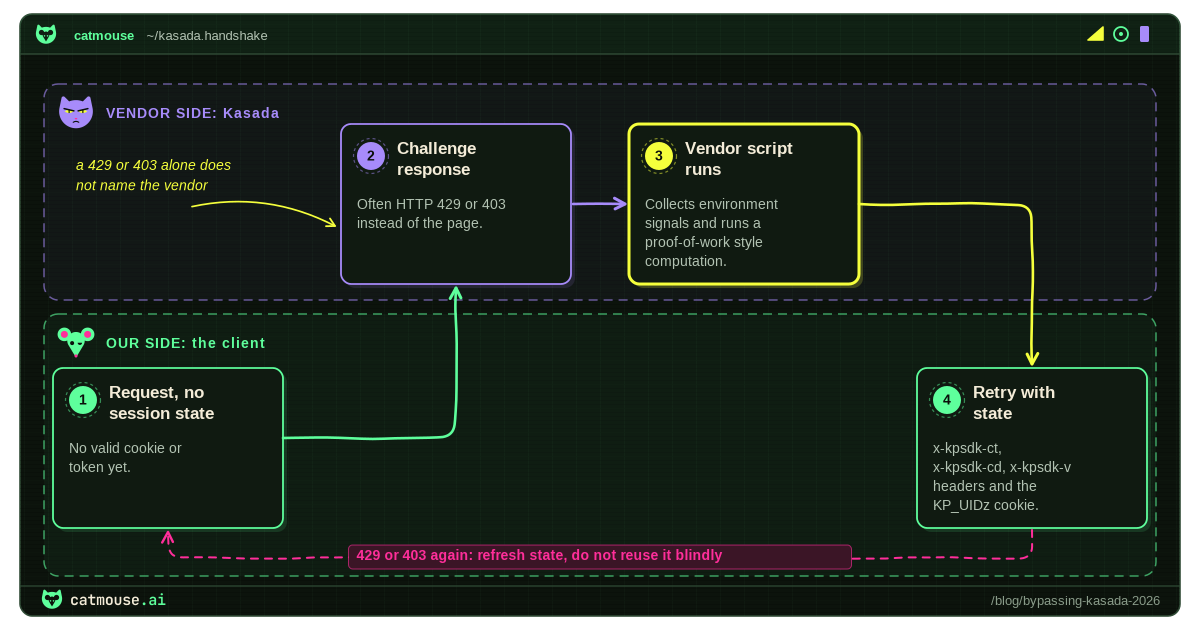
- Challenge bootstrap (allegiant kasada airline bypass)
- The initial HTTP challenge response on allegiant kasada airline bypass that delivers the vendor script or session seed to the client.
- Session state verification (allegiant kasada airline bypass)
- The header or cookie proof returned after telemetry evaluation on allegiant kasada airline bypass that authorizes subsequent API calls.
| Stage | Plain HTTP replay on allegiant kasada airline bypass | Verified session state on allegiant kasada airline bypass |
|---|---|---|
| Initial request | Missing session proof for allegiant kasada airline bypass | Bootstraps fresh challenge state for allegiant kasada airline bypass |
| Protected route | Challenged with HTTP 403 or 429 on allegiant kasada airline bypass | Attaches current session state for allegiant kasada airline bypass |
Evidence and sources
Each source below was opened on 2026-10-09 and the quoted text was read there.
- IANA HTTP Status Code Registry and MDN HTTP response status codes: reference definitions for HTTP status codes observed during allegiant kasada airline bypass testing.
- RFC 6585 section 4: supports the statement that 429 means too many requests. Verbatim: "The 429 status code indicates that the user has sent too many requests in a given amount of time ("rate limiting")."
- RFC 9110 section 15.5.4: supports the statement that 403 means the server refuses the request. Verbatim: "The 403 (Forbidden) status code indicates that the server understood the request but refuses to fulfill it."
- W3C WebDriver: supports the statement that
navigator.webdriverreflects automation control. Verbatim from the Interface section: "Returns true if webdriver-active flag is set, false otherwise." - JA4 technical details: supports the statement that JA4 fingerprints a TLS client. Verbatim: "JA4 looks at the TLS Client Hello packet and builds a fingerprint of the client based on attributes within the packet."
- RFC 9113 section 6.5: supports the statement that HTTP/2 endpoints send SETTINGS. Verbatim: "The SETTINGS frame (type=0x04) conveys configuration parameters that affect how endpoints communicate".
- RFC 9309, Robots Exclusion Protocol: the specification for robots.txt referred to in the scope section.
- Kasada website: supports only the statement that Kasada sells a bot management and defense product. Verbatim: "Kasada transcends bot management with a radical approach to defeat automated threats and online fraud." It does not document the challenge internals described in this post.
- Catmouse OpenAPI document and API reference: the source for the solve endpoint, request fields and response fields (
payload,headers,success,mapped) used here. The contract was checked against the server source on 2026-10-10. This is our own documentation, so it documents the API but is not independent evidence about any vendor.
Methodology and limits
Statements about HTTP status codes, WebDriver, TLS and HTTP/2 fingerprints and robots.txt are documented in the specifications above. Solver field names are documented in the Catmouse OpenAPI document. The description of how a challenge script and tokens flow is the general pattern of such challenges, an observation, not something Kasada documents publicly. The vendor label for allegiantair.com comes from the Catmouse targets directory, which itself marks it "per article, not re-verified", so there is no independent source for it here. Vendor behaviour changes without notice. Review date: 2026-10-09.
Frequently asked questions
Which protection does allegiantair.com use?
The Catmouse targets directory lists allegiantair.com as protected by Kasada. That label was not re-verified on 2026-10-09, and sites change vendors, so confirm it on the live site before relying on it.
Do I still need a headless browser?
Not for the Kasada step: the solver builds a /tl payload and x-kpsdk-* headers from the ips.js text your client fetched, and your own HTTP client sends them. The solver does not render pages, so you still need a real browser when you must render JavaScript-built pages or capture what a person would see on allegiantair.com. A solver does not replace a browser in every case.
What do HTTP 429 and 403 responses mean here?
HTTP 429 Too Many Requests is defined in RFC 6585 section 4 and tells a client to slow down. HTTP 403 Forbidden is defined in RFC 9110 section 15.5.4 and means the server understood the request and refuses to fulfil it. Neither status alone identifies which vendor sits in front of Allegiant Air.
Is it allowed to use this on any website?
No. This guide is for route and seat pricing collection that Allegiant Air has agreed to in writing, plus testing of systems you operate. Check the site terms and robots.txt (RFC 9309) first. Catmouse documentation does not grant permission to access a third-party system.
Conclusion and next step
Confirm that you are authorized, confirm the protection on the host, and test one request at a time before scaling. The API reference lists every request field, response field and error code. Limits and the review date are in the scope section above.