Virgin Australia Bot Detection Bypass: Kasada Guide
Virgin Australia (virginaustralia.com) is listed on the Catmouse targets page as protected by Kasada bot management. The vendor label comes from the Catmouse targets list and has not been re-verified.
This guide explains what a Kasada-style challenge asks a client to present, why plain HTTP clients and headless browsers are often rejected, and how the Catmouse solve endpoint is called, for teams that are authorized to test.
Who this is for
Engineers and data teams who own, or have explicit written authorization to test, Virgin Australia and want to understand how its Kasada protection is described in this post before deciding on an approach.
On this page
- Short answer: requests to a Kasada-protected host are expected to carry
x-kpsdk-*headers built from the site's ownips.jsscript. The Catmouse solve endpoint turns that script into a/tlpayload and those headers (see the Catmouse OpenAPI document). - Who it is for: engineers who own virginaustralia.com or have written authorization to test it, and teams evaluating how protocol-level token handling differs from running a browser.
- Limits: no performance numbers are published here, token lifetimes are not documented, and the vendor label is not re-verified.
What protects virginaustralia.com and what a client must present?
The Catmouse targets list shows Virgin Australia as a Kasada target. A client talking to a Kasada-protected endpoint is expected to present the x-kpsdk-* headers that the flow in the Catmouse OpenAPI document produces, and requests without valid tokens can be challenged or rejected. The vendor label comes from the Catmouse targets list and has not been re-verified.
Virgin Australia is an airline, and airline sites expose fare search, booking and loyalty (Velocity) pages that change frequently. Those pages are the kind of dynamic content that bot management is usually applied to.
- Fare and schedule search pages, which change often and are usually the most heavily protected.
- Account and loyalty pages, which require sign-in and are outside the scope of this article.
- Static informational pages, which may not require tokens at all.
How a Kasada-style client challenge works?
A client-side challenge asks the visiting client to run vendor code, report signals about its environment, and return proof that the work was done. The server then accepts or rejects later requests based on the tokens attached to them. Kasada does not publish its internals, so this section describes only the externally visible contract: the x-kpsdk-* header names in the Catmouse OpenAPI document, and the HTTP status codes a rejected client may see.
When a request is refused, the response is typically an HTTP error status. A 403 means the server understood the request but refuses to fulfil it (RFC 9110, section 15.5.4). A 429 signals rate limiting (RFC 6585, section 4). Which status a given site returns, and whether it returns a status at all, should be observed in your own authorized tests rather than assumed.
What the solve response contains
Per the Catmouse OpenAPI document, a successful solve returns success, a base64 payload that is the body of the follow-up /tl request, and a headers map of x-kpsdk-* values to send with it. For a protected POST action, POST /Solver/cd generates a fresh x-kpsdk-cd value right before that action. The documents do not state token lifetime, so treat any validity window as something to measure, not assume.
Why plain HTTP clients and headless automation get rejected?
A plain HTTP client does not run the vendor script, so it has no tokens to send. A headless browser runs the script, but automation frameworks change observable browser state. For example, the W3C WebDriver specification defines navigator.webdriver as true when a browser is under remote control, and sites can read it. Browser fleets also cost far more memory and CPU per session than an HTTP client, which matters when you run many sessions.
Neither point is a measurement. This article does not claim how often a given approach is rejected on virginaustralia.com. Measure that yourself against systems you are authorized to test.
Network identity matters too
Token handling is only one input. IP reputation, TLS and HTTP/2 client characteristics, and request ordering can all influence how a request is treated, and vendors do not document how they weigh them. The solve API has no proxy field and never contacts the target, so keep the egress of your own requests consistent and send tz and tzOffset that match the proxy exit you use.
Calling the Catmouse solve endpoint (illustrative example)
The solve endpoint never contacts virginaustralia.com. Your own client, with a session you are authorized to use, fetches the virginaustralia.com /fp response and keeps its x-kpsdk-ct header and cookies, reads the ips.js URL from it, downloads that script as UTF-8 text, and posts the text to /Solver/solve as ipsBody together with ipsUrl, ctToken, kpsdkV, tz, tzOffset and an engine profile. It then sends the returned base64 payload as the raw body of its own /tl request to virginaustralia.com, with the returned headers. Virgin Australia fare search is the kind of page this applies to.
The /fp and /tl URL shapes and the /tl header order for virginaustralia.com are target-specific and were not verified for this article; Catmouse's reference script documents them only for the targets it covers. The generic version of this flow is explained in the bot-management reference, and the code below is the same flow in Python.
import base64, os, requests

# Steps 1-3 run in YOUR client against YOUR target (authorized use only); the solver API never contacts the target.
# ips_body: UTF-8 text of the ips.js you fetched; ips_url: where you fetched it; ct_token: x-kpsdk-ct of the /fp response;
# kpsdk_v: the x-kpsdk-v the served script declares.
r = requests.post("https://kasadaapi.catmouse.ai/Solver/solve",
    headers={"x-api-key": os.environ["CATMOUSE_KEY"]},
    json={
        "ipsBody": ips_body,
        "ipsUrl": ips_url,
        "ctToken": ct_token,
        "kpsdkV": kpsdk_v,
        "tz": "America/New_York",
        "tzOffset": 240,
        "acceptLanguage": "en-US",
        "engine": "chrome",
    },
    timeout=60)
Check the response, then replay the payload on the target.
out = r.json()
if not out.get("success"):
    raise RuntimeError(f"{r.status_code} {out.get('error')}")   # 4xx/5xx are not charged
# Step 5 (your own client): POST base64.b64decode(out["payload"]) as the raw body to the target's /tl URL
# with the headers in out["headers"].
Fare and booking data is commercially sensitive, so confirm in writing that your use is permitted before sending any request. For virginaustralia.com, the engine value chrome selects a Kasada desktop-Chrome device profile; it names a device profile, not a vendor, and the API lists other profiles (snkrs, wkw, fl, whatnot-ios, android). tz and tzOffset are required in production and should match the proxy exit you use for your own virginaustralia.com requests. Check the mapped field of a successful response: identified below total failed in a dated live measurement.
Documented error responses are 400 (missing or invalid ipsBody, or missing tz/tzOffset), 401 (missing or invalid key), 403 (key disabled, expired or service not enabled), 422 (the script cannot be solved), 402 (insufficient balance: the USD balance is used up), 503 (load shedding) and 504 (solve timed out). A virginaustralia.com solve that errors returns no payload and is not charged.
How does virgin australia kasada airline bypass validate a trusted TLS session?
For virgin australia kasada airline bypass, a client is a verified session when it sends fresh tokens versus static headers over a trusted TLS session.
Next steps
Read the API reference, try a single request in the playground against a host you are authorized to test, and record your own status codes and timings before building anything on top of it.
Scope, limitations, and recommendations
Whether virginaustralia.com currently uses Kasada on every endpoint, and how it scores requests, is not established here. Last reviewed: 2026-10-09.
What separates virgin australia kasada airline bypass telemetry from plain HTTP replay?
In contrast, on virgin australia kasada airline bypass, you must refresh session state whenever a route returns a challenge instead of reusing old headers.
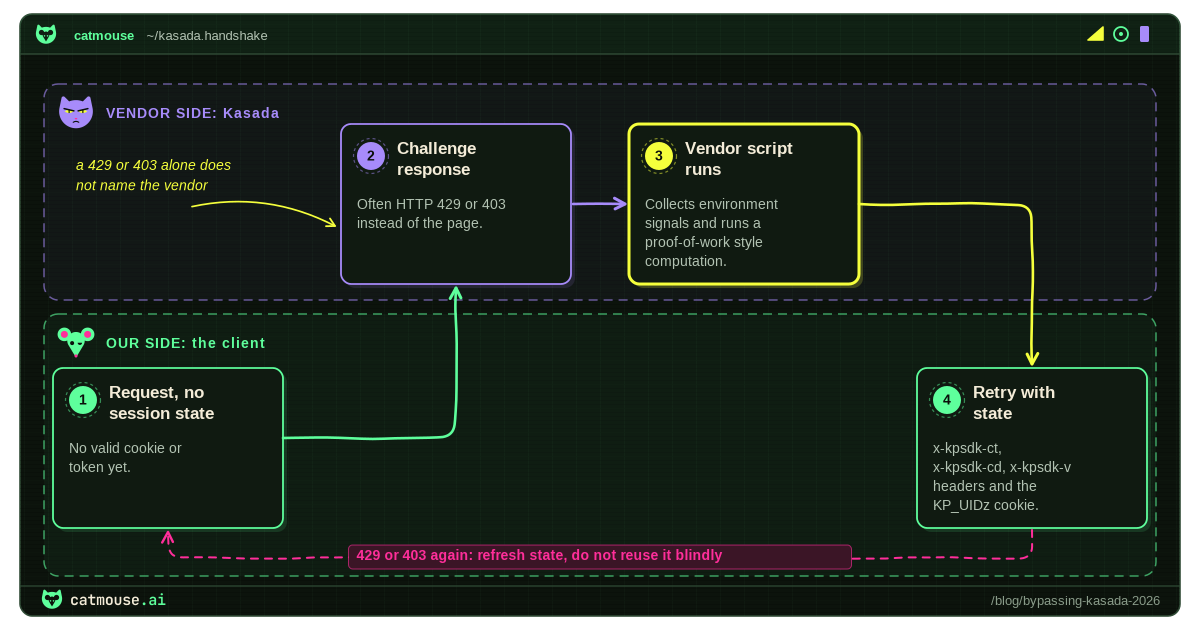
- Challenge bootstrap (virgin australia kasada airline bypass)
- The initial HTTP challenge response on virgin australia kasada airline bypass that delivers the vendor script or session seed to the client.
- Session state verification (virgin australia kasada airline bypass)
- The header or cookie proof returned after telemetry evaluation on virgin australia kasada airline bypass that authorizes subsequent API calls.
| Stage | Plain HTTP replay on virgin australia kasada airline bypass | Verified session state on virgin australia kasada airline bypass |
|---|---|---|
| Initial request | Missing session proof for virgin australia kasada airline bypass | Bootstraps fresh challenge state for virgin australia kasada airline bypass |
| Protected route | Challenged with HTTP 403 or 429 on virgin australia kasada airline bypass | Attaches current session state for virgin australia kasada airline bypass |
Evidence and sources
- IANA HTTP Status Code Registry and MDN HTTP response status codes: reference definitions for HTTP status codes observed during virgin australia kasada airline bypass testing.
- Catmouse OpenAPI document: the request fields of
POST /Solver/solveused in the Virgin Australia example (ipsBody,ipsUrl,ctToken,kpsdkV,tz,tzOffset,engine), the response fieldspayloadandheaders, and the error statuses listed for it. The API reference page renders the same contract for Virgin Australia readers. - Catmouse targets list: the source of the vendor label used in this article. It is Catmouse's own list and was not independently re-verified.
- Kasada: vendor home page, cited only to identify Kasada as a bot-management vendor. Its challenge internals are not published there, which is why this article describes only the externally visible contract.
- RFC 9110, section 15.5.4: supports the meaning of 403. It states: "The 403 (Forbidden) status code indicates that the server understood the request but refuses to fulfill it."
- RFC 6585, section 4: supports the meaning of 429. It states: "The 429 status code indicates that the user has sent too many requests in a given amount of time ("rate limiting")."
- W3C WebDriver: supports the statement that
navigator.webdriverreflects remote control. It states: "The webdriver-active flag is set to true when the user agent is under remote control." - MDN, Navigator.webdriver: "The webdriver read-only property of the navigator interface indicates whether the user agent is controlled by automation."
Methodology and limits
Reviewed on 2026-10-09. The meanings of HTTP 403 and 429 and of the navigator.webdriver flag rest on the standards above, and the solve request and response fields rest on the Catmouse OpenAPI document. The /fp and /tl details for virginaustralia.com were not verified. Statements about how sites treat plain HTTP clients or headless browsers are general engineering observations, not documented vendor behaviour, and no rate of rejection is claimed.
Frequently Asked Questions
Is virginaustralia.com protected by Kasada?
The Catmouse targets list labels Virgin Australia as a Kasada target. The vendor label comes from the Catmouse targets list and has not been re-verified.
Which headers does a Kasada-protected request need?
The solve endpoint returns a base64 /tl payload and a headers map of x-kpsdk-* values (for example x-kpsdk-ct, x-kpsdk-dt, x-kpsdk-im and x-kpsdk-v); your own client sends them with its /tl request.
How long do the tokens stay valid?
That is not documented. Measure it in your own authorized tests and refresh tokens on any challenge or error response.
Can I use this on any website?
No. Use it only against virginaustralia.com or other systems you own, or where Virgin Australia has authorized your testing in writing.