Jetstar Bot Detection Bypass: Kasada Notes
A Jetstar bot detection bypass starts with identifying the protection. Catmouse lists jetstar.com as a Kasada target, a label this article has not re-verified. This guide is for engineers with authorization to test who need to confirm the vendor in their own traffic and understand where a solver API fits.
Who this is for
Engineers and data teams who own, or have explicit written authorization to test, Jetstar and want to understand how its Kasada protection is described in this post before deciding on an approach.
On this page
- How to confirm which bot protection jetstar.com uses
- How a client-side challenge fits into a flight search request
- Why plain HTTP clients and default headless browsers are blocked
- Python example: calling the documented solve endpoint
- Choosing between browser automation and a solver API
- Evidence and sources
- Frequently asked questions
Limitations
- This post reflects the mechanism as reviewed on 2026-10-09. Protections change, so details may no longer match what a site serves today.
- No success rate, latency or uptime figure is stated or implied; outcomes depend on the target, your account state and your traffic.
- It applies only to systems you own or are explicitly authorized to test, and does not replace site terms, applicable law or rate limits.
- Catmouse's target list labels jetstar.com as Kasada. Treat that as a lead and confirm it in your own network capture.
- An HTTP 429 response alone does not identify a vendor, because 429 is the generic rate-limiting status defined in RFC 6585.
- The documented solve endpoint takes the ips.js text your client fetched and returns a /tl payload plus x-kpsdk-* headers for your client to send to the site; it never contacts jetstar.com itself. This article publishes no success rate or latency figure for Jetstar.
How to confirm which bot protection jetstar.com uses?
Open the site in a normal browser with DevTools on the Network tab and look for two observable markers: an obfuscated script loaded from the site's own domain, and request headers named x-kpsdk-ct, x-kpsdk-cd and x-kpsdk-v on API calls. Those header names are what the Catmouse API reference associates with Kasada. If you see neither, the label does not apply to your capture.
A 429 status is weak evidence. RFC 6585 section 4 defines it as the server telling a client it has sent too many requests in a given amount of time, and any rate limiter can return it. Record the full response headers and body before deciding which vendor you face.
Vendor background is on the Kasada site, which describes its product as bot defense that does not rely on CAPTCHA challenges. Vendor labels in this article come from Catmouse's own target list and are not independent verification.
How a client-side challenge fits into a flight search request?
In a client-side challenge design, the page loads a vendor script, the script gathers signals from the browser and submits them, and the server answers with tokens that later requests must carry. The server can then reject API calls that arrive without matching tokens, even when the IP address and cookies look ordinary.
Catmouse's API reference states that its solve call turns the ips.js text into a /tl payload and headers and leaves every request to the target to your client. This article does not describe the internals of the vendor script, because Catmouse has not published evidence for those details and they can change without notice.
Practical consequence for flight data work: the token must be produced for the same host you call, and it should be sent from the same network identity that requested it. Use one proxy for the whole sequence: the tz and tzOffset you send to the solve call must describe that proxy's exit IP, and the /fp, ips.js and /tl requests must leave through it. The API has no proxy field, because it never makes a request to the target.
Why plain HTTP clients and default headless browsers are blocked?
A plain HTTP client never runs the vendor script, so it cannot present tokens. A default headless browser runs the script but is identifiable through standard automation signals. MDN documents navigator.webdriver the navigator.webdriver property as indicating whether the user agent is controlled by automation, and automation frameworks also expose Chrome DevTools Protocol artifacts that a script can probe.
Browser automation is also resource-heavy because each instance is a full browser process. Measure memory and CPU on your own hardware before choosing an architecture, since this article publishes no benchmark numbers.
Python example: calling the documented solve endpoint
The solve call does not fetch jetstar.com for you and never contacts the site. For a flight search host such as jetstar.com, your client loads the Kasada /fp page with its own authorized session and keeps the x-kpsdk-ct response header, reads the ips.js URL from that page and fetches it, then posts the script text as ipsBody, with ipsUrl, ctToken, kpsdkV and the time zone of the proxy it uses (tz, tzOffset), to /Solver/solve. The engine field is a Kasada device profile (chrome is the default), not a vendor switch. The canonical request below uses placeholder values, not a Jetstar-specific endpoint, since Catmouse has not published one.
import os
import requests

r = requests.post(
    "https://kasadaapi.catmouse.ai/Solver/solve",
    headers={"x-api-key": os.environ["CATMOUSE_KEY"]},
    json={
        "ipsBody": "<contents of the ips.js response, as UTF-8 text>",
        "ipsUrl": "https://www.example.com/149e9513-01fa-4fb0-aad4-566afd725d1b/2d206a39-8ed7-437e-a3be-862e0f06eea3/ips.js?x-kpsdk-v=j-1.2.661&x-kpsdk-im=ZXhhbXBsZQ",
        "ctToken": "<x-kpsdk-ct response header of the /fp request>",
        "kpsdkV": "j-1.2.661",
        "tz": "America/New_York",
        "tzOffset": 240,
        "acceptLanguage": "en-US",
        "engine": "chrome",
    },
    timeout=60,
)
print(r.status_code, r.text)
The sample prints the raw response. A success has success: true, a payload and headers; a failure has success: false and an error code. After the solve, post the decoded payload to the site's /tl endpoint with the returned headers and request the page again. A non-200 result there means the tokens were not accepted, so log the response and stop instead of retrying in a tight loop. A protected POST action needs a fresh x-kpsdk-cd from POST /Solver/cd. How long tokens stay valid is set by the site and can change, so measure it with your own test traffic. The /fp and /tl URL shapes are unverified for jetstar.com.
How does jetstar kasada bot bypass validate a trusted TLS session?
For jetstar kasada bot bypass, a client is a verified session when it sends fresh tokens versus static headers over a trusted TLS session.
Choosing between browser automation and a solver API
- Browser automation exercises the real vendor script, so it is a useful reference when you diagnose a failure. It costs more compute and is easier to identify.
- A solver API returns a payload and headers that a plain HTTP client posts itself. It reduces compute, but you depend on the provider keeping pace with vendor changes, and you must handle error codes such as 401, 402 and 403 from the API (402 means the key's USD balance is used up).
- Either way, keep request volume low, honor Retry-After when present, and stop when the site tells you to.
This article covers identification and integration concepts only. It contains no measured success rate, latency or cost for jetstar.com, and the vendor label comes from Catmouse's target list without independent verification. The Python example is the canonical solve request with placeholder values and has not been run against jetstar.com.
Use this material only on systems you own or are explicitly authorized to test, and follow the target site terms of service and applicable law. Last reviewed: 2026-10-09.
Evidence and sources
Sources are listed below, each one with the claim it supports.
- IANA HTTP Status Code Registry and MDN HTTP response status codes: reference definitions for HTTP status codes observed during jetstar kasada bot bypass testing.
- RFC 6585 section 4 defines 429 Too Many Requests as indicating that "the user has sent too many requests in a given amount of time", so 429 is a generic rate-limiting status and not a vendor marker. It also says a 429 response may include a Retry-After header.
- MDN, Navigator.webdriver states that the property "indicates whether the user agent is controlled by automation".
- Kasada (vendor site) describes Kasada as a security platform that defends against bots and online fraud. The page does not document x-kpsdk headers or script internals, so none of those are attributed to it.
- Catmouse OpenAPI document documents POST /Solver/solve with the request fields ipsBody, ipsUrl, ctToken, kpsdkV, tz, tzOffset and engine (a Kasada device profile), the x-kpsdk-* response headers, and the error responses 400, 401, 403, 429, 503 and 504.
- Catmouse targets page lists jetstar.com with a Kasada engine label. This is the label the article treats as unverified.
Methodology and limits: the RFC 6585 and MDN statements were read on 2026-10-09. The jetstar.com Kasada label comes from the Catmouse targets page and is unverified, and the solve fields come from the Catmouse OpenAPI document, which was written from the solver server's source. Nothing in this article was measured on jetstar.com.
What separates jetstar kasada bot bypass telemetry from plain HTTP replay?
In contrast, on jetstar kasada bot bypass, you must refresh session state whenever a route returns a challenge instead of reusing old headers.
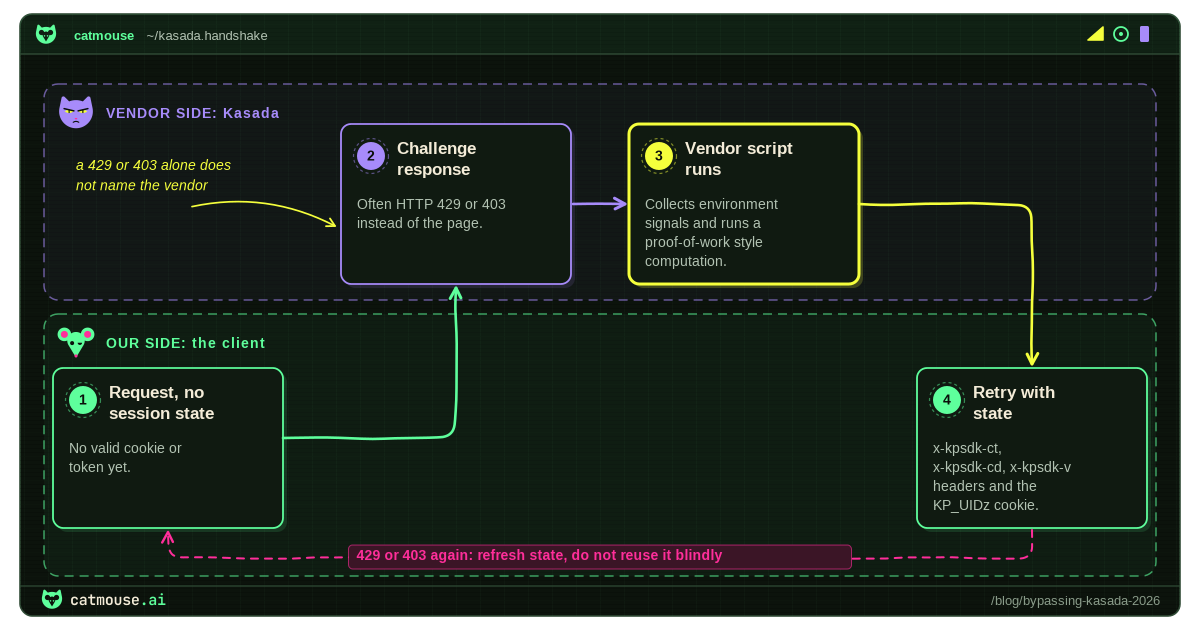
- Challenge bootstrap (jetstar kasada bot bypass)
- The initial HTTP challenge response on jetstar kasada bot bypass that delivers the vendor script or session seed to the client.
- Session state verification (jetstar kasada bot bypass)
- The header or cookie proof returned after telemetry evaluation on jetstar kasada bot bypass that authorizes subsequent API calls.
| Stage | Plain HTTP replay on jetstar kasada bot bypass | Verified session state on jetstar kasada bot bypass |
|---|---|---|
| Initial request | Missing session proof for jetstar kasada bot bypass | Bootstraps fresh challenge state for jetstar kasada bot bypass |
| Protected route | Challenged with HTTP 403 or 429 on jetstar kasada bot bypass | Attaches current session state for jetstar kasada bot bypass |
Frequently asked questions
Does jetstar.com use Kasada?
Catmouse lists it as a Kasada target. That label has not been independently re-verified for this article, so confirm it by checking your own network capture for x-kpsdk headers.
Does an HTTP 429 response mean Kasada is blocking me?
Not by itself. RFC 6585 defines 429 as a generic too-many-requests status. Inspect the response headers and body before attributing it to a vendor.
How long do the returned session tokens last?
This article does not state a figure. Lifetime is controlled by the site and can change, so measure it in your own authorized tests.
Is access to jetstar.com assured?
No. Results depend on the site configuration, your network identity and changes by the vendor. Test on systems you own or are authorized to test.