Emirates Bot Detection Bypass: Global Flight Scraping Guide
Emirates bot detection bypass comes down to how emirates.com verifies browser-side signals and issues the tokens later requests carry. A plain HTTP client lacks those tokens, so a request built without running the page's script can be refused or challenged. The shared reference covers the rest.
The vendor in front of the site was not re-verified, so this is a research note on the general mechanism and not an integration guide for Emirates.
Who this is for
Engineers and data teams who own, or have explicit written authorization to test, Emirates and want to understand how its bot protection is described in this post before deciding on an approach.
On this page
- Audience: engineers with authorization to test or collect data from the site.
What this guide covers for emirates.com?
Here, how the challenge and token flow works is the same as for any browser-verified bot management, so it is explained once in the bot-management reference. This section keeps only what is specific to this site.
Emirates (emirates.com) sits behind bot-management protection (vendor not re-verified). Protections of this kind serve a script to the browser, collect environment signals, and issue a token or cookie that later requests must carry.
The vendor for the site has not been re-verified, so this guide uses the neutral label "bot-management protection (vendor not re-verified)" and describes only behaviour common to browser-verified bot management. The pages in scope typically include flight search results, fare availability and award pages.
Who it is for: engineers with written authorization to test or collect data from the site, for example an authorized security assessment, a contracted data feed, or a property they operate.
How browser-side verification works (Emirates)?
Here, how the challenge and token flow works is the same as for any browser-verified bot management, so it is explained once in the bot-management reference. This section keeps only what is specific to this site.
- Script delivery: A protected page triggers a client-side script, or the first request is answered with a challenge.
- Signal collection: The script gathers browser and environment signals and submits them to the protection vendor.
- Token or cookie issuance: If the signals are accepted, the client receives a token or cookie that later requests carry.
- Enforcement: Here, a request that arrives without the token can be answered with an error status or a fresh challenge; which of these emirates.com returns was not observed for this article.
Browser automation compared with protocol-level solving (Emirates)
Here, the browser versus protocol-level trade-off is the same as for any browser-verified bot management, so it is explained once in the bot-management reference. This section keeps only what is specific to this site.
What the Catmouse API covers (Emirates)?
Here, the shape of a solver request and token reuse is the same as for any browser-verified bot management, so it is explained once in the bot-management reference. This section keeps only what is specific to this site.
The Catmouse solver API handles one vendor, Kasada. POST /Solver/solve takes the ips.js body your own client fetched and returns a base64 /tl payload plus x-kpsdk-* headers; the engine field only picks a Kasada device profile. The vendor in front of the site was not re-verified, so this article does not claim the API applies to it.
If your own authorized capture of the site shows a Kasada script, the request flow is the one in the Flight Centre guide; otherwise treat this article as research on the mechanism only.
Scope, limitations and authorized use
This guide for Emirates is a general explanation, not a test report. It contains no measured pass rates, latency, cost or uptime figures for the site, and it does not promise that any request will be accepted.
What separates emirates airline bot detection bypass telemetry from plain HTTP replay?
In contrast, on emirates airline bot detection bypass, you must refresh session state whenever a route returns a challenge instead of reusing old headers.
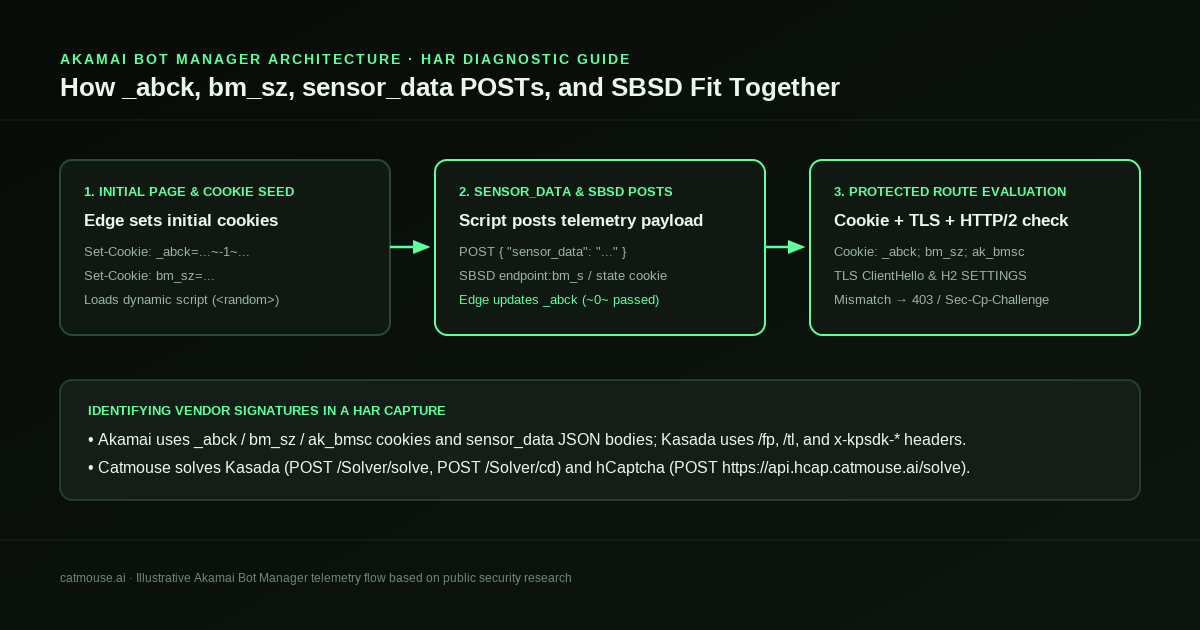
- Challenge bootstrap (emirates airline bot detection bypass)
- The initial HTTP challenge response on emirates airline bot detection bypass that delivers the vendor script or session seed to the client.
- Session state verification (emirates airline bot detection bypass)
- The header or cookie proof returned after telemetry evaluation on emirates airline bot detection bypass that authorizes subsequent API calls.
| Stage | Plain HTTP replay on emirates airline bot detection bypass | Verified session state on emirates airline bot detection bypass |
|---|---|---|
| Initial request | Missing session proof for emirates airline bot detection bypass | Bootstraps fresh challenge state for emirates airline bot detection bypass |
| Protected route | Challenged with HTTP 403 or 429 on emirates airline bot detection bypass | Attaches current session state for emirates airline bot detection bypass |
Next step
To continue with Emirates, read the API reference and check the targets directory for the current label. Treat any request to the site as in scope only under written permission from Emirates or the site operator.
How does emirates airline bot detection bypass validate a trusted TLS session?
For emirates airline bot detection bypass, a client is a verified session when it sends fresh tokens versus static headers over a trusted TLS session.
Evidence and sources
The sources below back the claims in this article; each entry states the claim it supports.
- IANA HTTP Status Code Registry and MDN HTTP response status codes: reference definitions for HTTP status codes observed during emirates airline bot detection bypass testing.
- RFC 9110, section 15.5.4 (403 Forbidden). Supports: the generic meaning of the 403 status code. It says nothing about how any particular site decides to return it.
- RFC 6585, section 4 (429 Too Many Requests). Supports: "The 429 status code indicates that the user has sent too many requests in a given amount of time (“rate limiting”)."
- W3C WebDriver. Supports: the navigator.webdriver attribute, which the specification describes as "Returns true if webdriver-active flag is set, false otherwise."
- Catmouse OpenAPI file and the API reference. Supports: the /Solver/solve request fields ipsBody, ipsUrl, ctToken, kpsdkV, tz, tzOffset, acceptLanguage and engine, and that engine selects a Kasada device profile. The API has no Akamai, DataDome, Turnstile or FunCaptcha engine.
Documented: status code meanings (RFC 9110, RFC 6585), the navigator.webdriver attribute (W3C) and the API fields (OpenAPI). Observation or general model, not documentation: the four-step verification flow and how any site answers a tokenless request. Which vendor protects emirates.com was not re-verified. Vendor behaviour changes without notice, so re-check against current responses you are authorized to inspect. Claims without a source here are qualified in the text.
Frequently Asked Questions
What protects emirates.com?
emirates.com uses bot-management protection (vendor not re-verified). The vendor was not re-verified on 2026-10-09, so this page makes no vendor-specific claims.
Is access assured?
No. Acceptance for Emirates depends on the target's current configuration, your network and your request behaviour. The article reports no measured acceptance figure for the site.
Where can I use this?
Only for properties of the site that you operate, or under written authorization from Emirates, and within the site's terms and applicable law.