StubHub Bot Detection: Layered Protection on Resale Pages
StubHub bot detection is recorded in the Catmouse targets list as Akamai Bot Manager combined with DataDome. This guide explains what layered bot management means in practice, how to tell the products apart on a host you are authorized to test, and why the Catmouse solver API, which documents Kasada only, has no engine for either product.
Who this is for
Engineers and data teams who own, or have explicit written authorization to test, StubHub and want to understand how its Akamai BMP protection is described in this post before deciding on an approach.
On this page
- Vendor: the Catmouse targets page lists Akamai Bot Manager plus DataDome for stubhub.com. That entry has not been re-verified.
- Who it is for: engineers with permission to collect resale listing data who need to understand why plain HTTP clients are challenged.
- Mechanism: two products can answer on one host, each with its own cookie and challenge, so a token for one does not satisfy the other.
- Limits: no pass rates, latencies or cost figures are given, and nothing here promises access.
What layered bot management means on a resale marketplace?
A resale marketplace publishes prices and inventory that competitors, brokers and researchers all want to read, so it has a reason to run more than one defense. Catmouse lists stubhub.com as protected by Akamai Bot Manager and DataDome. The entry has not been re-verified, so treat it as a hypothesis to confirm on live traffic.
Layering matters for collectors because each product issues its own cookie or token after its own check. A request that satisfies one product can still be rejected by the other. The Akamai Bot Manager product page describes a script added to monitored pages for client-side behavioral anomaly detection, and DataDome publishes its product documentation at docs.datadome.co.
How to tell Akamai and DataDome responses apart?
On a page you are allowed to test, record status codes, cookie names, request headers and script hosts in your browser developer tools, then compare them with the table. The cookie and header names come from public community write-ups, not from vendor documentation, so confirm each one before you rely on it.
| Observed signal | What it can indicate | Evidence level |
|---|---|---|
| HTTP 429 with a Retry-After header | Rate limiting. RFC 6585 defines 429 as "too many requests in a given amount of time". It does not say which product issued it. | Standard |
| HTTP 403 | The server refuses the request. Causes include WAF rules, geography, or bot management. See RFC 9110. | Standard |
| Cookies named _abck or bm_sz | Commonly associated with Akamai Bot Manager in public technical write-ups. | Community observation, not vendor documentation |
| Request headers starting with x-kpsdk- | Commonly associated with Kasada in public technical write-ups. | Community observation, not vendor documentation |
| A cookie named datadome | Commonly associated with DataDome. | Community observation, not vendor documentation |
A 429 is defined as rate limiting (RFC 6585), and a 403 means the server refuses the request (RFC 9110). Both can come from either product or from the origin itself.
Why scripted clients and automated browsers get challenged?
Client-side checks compare what a client claims to be with what it actually does. A plain HTTP client runs no page script at all, so it cannot produce the token the script would have earned. An automated browser runs the script, but it exposes automation markers. The W3C WebDriver specification defines a webdriver-active flag that is true when the user agent is under remote control.
Resale pages add a second pressure. Listings change quickly, so a collector that needs fresh data must renew its session often, and every renewal is another chance to be challenged.
What the Catmouse API covers for stubhub.com?
This article is a research write-up on stubhub.com's protection, not an integration guide. For stubhub.com, the Catmouse solver API documented in the OpenAPI document solves Kasada only: its engine field selects a Kasada device profile (chrome, snkrs, wkw, fl, whatnot-ios or android), not a vendor. It documents no Akamai Bot Manager or DataDome engine, so no request for this host is shown and none is implied.
If a Kasada-protected host sits in your authorized scope instead of stubhub.com, the request flow is described in the bot-management reference and the API reference.
Scope, limitations, and recommendations
This article describes how bot-management products behave in general and how to identify them on a host you are allowed to test. It contains no measured pass rates, latencies or costs for any named site. Seat maps, pricing feeds and resale inventory endpoints were not tested for this article. Vendors change their products without notice, so treat every product label here as a starting hypothesis and confirm it against live traffic.
Authorized use: Read resale listing pages only on hosts and accounts you own or have written permission to test, and follow the marketplace terms and applicable law. See the acceptable use policy.
Last reviewed: 2026-10-09.
What separates stubhub akamai datadome scraping telemetry from plain HTTP replay?
In contrast, on stubhub akamai datadome scraping, you must refresh session state whenever a route returns a challenge instead of reusing old headers.
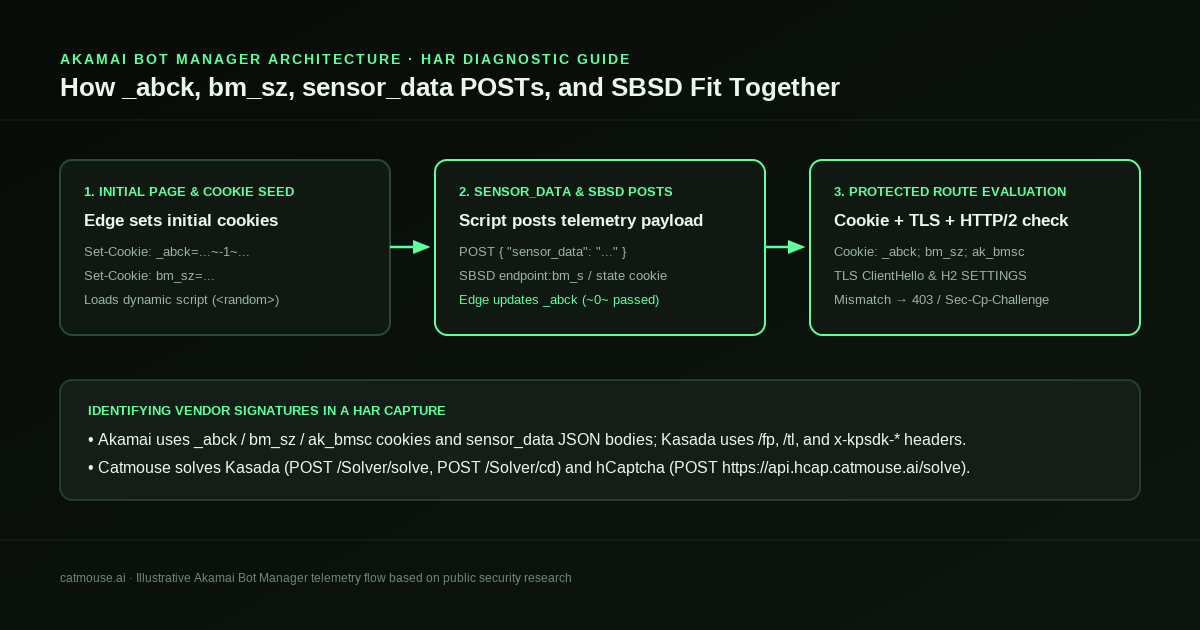
- Challenge bootstrap (stubhub akamai datadome scraping)
- The initial HTTP challenge response on stubhub akamai datadome scraping that delivers the vendor script or session seed to the client.
- Session state verification (stubhub akamai datadome scraping)
- The header or cookie proof returned after telemetry evaluation on stubhub akamai datadome scraping that authorizes subsequent API calls.
Evidence and sources
Every claim here rests on the sources listed below, and each entry says which claim it supports.
- IANA HTTP Status Code Registry and MDN HTTP response status codes: reference definitions for HTTP status codes observed during stubhub akamai datadome scraping testing.
- Akamai Bot Manager product page: Behavior anomaly detection "is configured automatically by injecting a simple script into each monitored page", and the product detects bot traffic and mitigates malicious bots at the edge.
- DataDome documentation: DataDome publishes product documentation, which describes dashboards to "follow up on traffic quality and understand bot activity". Cookie names are not asserted from it.
- RFC 6585 section 4: the 429 status code "indicates that the user has sent too many requests in a given amount of time ("rate limiting")".
- RFC 9110 section 15.5.4: the 403 (Forbidden) status code "indicates that the server understood the request but refuses to fulfill it".
- W3C WebDriver specification: the webdriver-active flag is "set to true when the user agent is under remote control", and
navigator.webdriverreturns its value. - Catmouse targets page: which vendor Catmouse lists for this host is a Catmouse directory entry, not a vendor statement, and it has not been re-verified
Methodology and limits
How does stubhub akamai datadome scraping validate a trusted TLS session?
For stubhub akamai datadome scraping, a client is a verified session when it sends fresh tokens versus static headers over a trusted TLS session.
Frequently asked questions
Does StubHub use Akamai, DataDome, or both?
The Catmouse targets page lists both for stubhub.com. That has not been re-verified, so confirm it from live traffic on a page you are allowed to test.
Why does a token from one product not work against the other?
Each product issues its own cookie or token after its own check, and each validates only its own. This is a general property of layered defenses and has not been measured for this site.
Can I collect resale prices if I am blocked?
Only with permission. Check the marketplace terms, ask about an official data arrangement, and do not bypass restrictions you have not been authorized to test. This is not legal advice.
Next step
Next step: read the DataDome interstitial article for that product's challenge flow and the API reference for what the solver API covers today.