Delta Air Lines Bot Detection: Research Notes for Fare Collection
This guide covers Delta Air Lines bot detection bypass for teams that are authorized to collect fare and schedule data from delta.com. The short answer: delta.com shows bot-management behavior, but no vendor is asserted because the attribution has not been re-verified. This is a research note, not an integration guide.
Catmouse's Solver API handles Kasada only, so it is relevant to delta.com only if your own authorized recordings show Kasada, and this article does not claim that.
Who this is for
Engineers and data teams who own, or have explicit written authorization to test, Delta Air Lines and want to understand how its bot protection is described in this post before deciding on an approach.
On this page
- How bot-management protection appears to a client on delta.com
- What a client-side challenge script does
- Where headless browser automation runs into limits
- How to choose between a browser and a solver API
- Where the Catmouse Solver API applies
- Billing and errors in the Catmouse API
- Scope and limitations
- Evidence and sources
- Frequently Asked Questions
- The Catmouse targets directory lists delta.com, but the vendor has not been re-verified.
- What you see: challenge or block responses (for example HTTP 403, see RFC 9110 section 15.5.4, or HTTP 429, see RFC 6585 section 4) and scripts that must run before requests are accepted.
- First step: identify the vendor from recorded requests, cookies and script URLs. The Catmouse Solver API in /openapi.json covers Kasada only.
- Limits: vendors change their scripts, and no outcome is guaranteed. This article publishes no benchmark for delta.com.
- Who it is for: engineers who are authorized to collect airline data and want to understand the mechanism before choosing a tool.
How bot-management protection appears to a client on delta.com?
A client that sends flight search or fare requests to delta.com without a valid session may be answered with a challenge or a block instead of data. Common signals are HTTP 403 (RFC 9110 section 15.5.4 defines it as a refusal to fulfil the request) and HTTP 429 (RFC 6585 section 4), plus scripts or cookies that must be present on later requests. These are observations, not proof of a particular vendor.
Fares and availability can differ by market, currency and time, so treat collected data as a snapshot. Terms of service, robots.txt and any airline data program apply. Where an airline or a licensed distributor offers an official API or feed, use that first.
Identifying the vendor yourself
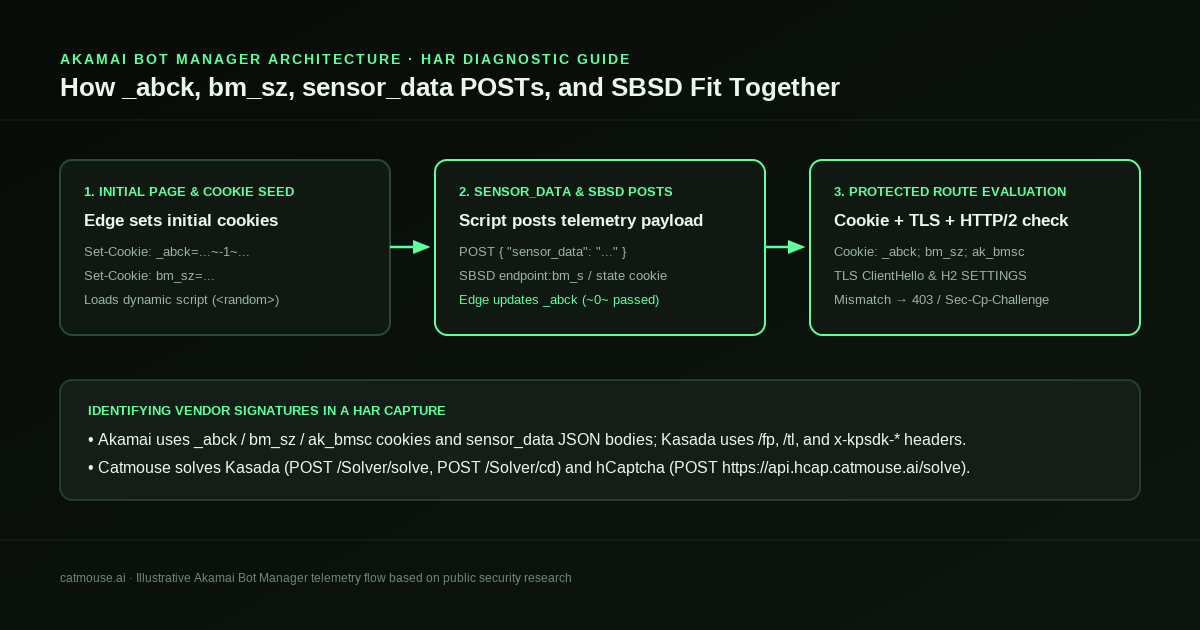
Record the first requests in browser developer tools. Kasada deployments commonly show x-kpsdk-* headers and a KP_UIDz cookie. Third-party practitioner write-ups, not Akamai documentation (which was not publicly retrievable on 2026-10-09), describe Akamai Bot Manager as setting cookies such as _abck and bm_sz; treat that as an unverified observation. DataDome sets a datadome cookie. These are patterns reported by practitioners (only the DataDome cookie is backed by vendor documentation, see Evidence and sources), and sites can run more than one product, so decide from your own recordings.
What a client-side challenge script does?
Client-side challenge scripts run in the visitor's browser, collect signals about the device and the way the page is used, and send them to the vendor, which then decides whether to issue a trusted session. Details differ by vendor and change over time, so the list is a general outline and not a specification of any one product.
- Script delivery: the page or a challenge response loads a JavaScript file that the client must execute.
- Signal collection: the script reads browser, device and input-timing values. On mobile web it may read motion or touch data where the browser exposes it.
- Submission: the collected values are sent to the vendor's endpoint in an encoded form.
- Session decision: the vendor sets cookies or tokens that later requests must carry, or keeps challenging the client.
Catmouse does not publish the internals of its solver, and this article does not describe any vendor's payload format.
Where headless browser automation runs into limits?
Browser automation can retrieve fares at small scale, but automation leaves traces and each session costs a full browser. Both limits grow with the number of searches you run, which is why travel data teams look at protocol-level clients for volume work.
The W3C WebDriver specification defines navigator.webdriver, which is true when a browser is under remote control, and challenge scripts can read it. Patching it is not enough on its own if other signals disagree with the claimed platform.
A browser process also uses far more memory and CPU than an HTTP connection. We give no figure here because it depends on the browser, the page and your hardware, so measure it on your own infrastructure.
How to choose between a browser and a solver API?
Choose a real browser when you need rendered output, run low volume, or cannot depend on an external service. Choose a protocol-level client when you only need the data, run at higher concurrency, and accept the cost of acquiring valid session state without a browser. A Catmouse solver exists only for Kasada. The table compares them by criteria and contains no measured numbers.
| Criterion | Real browser automation | Protocol-level client with a solver API |
|---|---|---|
| Setup | Install a browser, a driver and often stealth patches | An HTTP client plus an API key |
| Per-request resource use | A full browser process per session, which is the largest cost item at high concurrency | One HTTP connection per session, no rendering |
| What it must match | Browser signals must look consistent with a real device | TLS handshake, HTTP/2 settings and headers must look consistent with the client you claim to be |
| Maintenance | Driver and patch updates when the challenge script changes | Handled by the solver provider, but you still depend on that provider keeping pace |
| Visibility | You can watch what the page does | You see only status codes and the response of the solver API |
| Measured numbers for delta.com | Not published here | Not published here. Measure it on your own infrastructure |
Where the Catmouse Solver API applies?
Catmouse's Solver API handles one vendor, Kasada: its engine values are Kasada device profiles (chrome, snkrs, wkw, fl, whatnot-ios, android), not vendors. Neither the API reference nor the server source lists an engine for Akamai Bot Manager, so this article contains no request example for delta.com and does not imply one exists.
If your recordings show that a site runs Kasada, the real call sequence (fetch ips.js yourself, post it to /Solver/solve, send the returned /tl body) is shown with the canonical Python sample in the Chewy guide.
Billing and errors in the Catmouse API
These points apply to the Kasada Solver API only and say nothing about delta.com.
- Your own egress
- The solve request has no proxy field and the API never contacts the target. Your own client makes every request to the site.
- Account charge
- A balance is added through
POST /key/billing/create-checkout, a hosted crypto payment session (0xProcessing), or a Binance Pay deposit. - Errors you should handle
- 401 for a missing or invalid key, 403 for a disabled or expired key or a key without the solve service, and 402 when the key's USD balance is used up.
Scope, limitations, and recommendations
This article describes publicly observable behavior and the Catmouse API reference as of 2026-10-09, which covers Kasada only. It reports no measurements taken against delta.com and claims no success rate. The vendor protecting delta.com is deliberately not asserted because the site gave conflicting labels and none was re-verified. Vendor behavior can change without notice. Terms such as service levels or compliance attestations are not claimed here.
How does delta united akamai bmp scraping validate a trusted TLS session?
For delta united akamai bmp scraping, a client is a verified session when it sends fresh tokens versus static headers over a trusted TLS session.
Apply this material only to delta.com fare and schedule pages that you own or hold written permission to collect. Check the target site's terms of service, robots.txt and any partner or API program before you automate access, and prefer an official feed where one exists.
Last reviewed: 2026-10-09.
Evidence and sources
The statements above that rest on outside material are listed here with the source that supports each. Every link was opened on 2026-10-09 and the quoted text was read there.
- RFC 6585 section 4: “The 429 status code indicates that the user has sent too many requests in a given amount of time ("rate limiting").” Supports: what HTTP 429 means. It does not say that any vendor uses 429 as a challenge; that part of this article is an observation.
- RFC 9110 section 15.5.4: “The 403 (Forbidden) status code indicates that the server understood the request but refuses to fulfill it.” Supports: what HTTP 403 means, not which product returns it.
- W3C WebDriver specification (webdriver-active flag): “The webdriver-active flag is set to true when the user agent is under remote control.” Also MDN: Navigator.webdriver: “The webdriver read-only property of the navigator interface indicates whether the user agent is controlled by automation.” Supports:
navigator.webdriverexists and reflects automation. That challenge scripts read it is an inference, not something these pages state. - /openapi.json (Catmouse OpenAPI file, read 2026-10-10): describes
POST /Solver/solveas taking the text of a fetched Kasadaips.jsand anenginethat selects a Kasada device profile (chrome,snkrs,wkw,fl,whatnot-ios,android). Supports: the statement in this article that the Catmouse API offers no engine for this vendor. Catmouse wrote that file; see the bot management reference for the shared background. - DataDome cookie documentation: “Used for both server-side and client-side detection to assess the legitimacy of a request.” Supports: that DataDome sets a
datadomecookie. Nothing there ties it to delta.com.
Not sourced: no Akamai or Kasada vendor page was publicly retrievable on 2026-10-09, so the Akamai cookie names and the Kasada header patterns are observations. The vendor behind delta.com is deliberately not asserted.
Methodology and limits
Documented: HTTP status meanings, the WebDriver flag and the Catmouse API fields, each from the source named above. Observation, not documented by a vendor: which anti-bot product a site runs, what its challenge response looks like and how it behaves for a given client. Catmouse made no measurements for this article. Reviewed 2026-10-09; vendor behavior changes without notice, so re-check on your own authorized traffic.
What separates delta united akamai bmp scraping telemetry from plain HTTP replay?
In contrast, on delta united akamai bmp scraping, you must refresh session state whenever a route returns a challenge instead of reusing old headers.
Frequently Asked Questions
Which anti-bot vendor protects delta.com?
This article does not assert one. Earlier text named different vendors in different places and none was re-verified on 2026-10-09. Identify it from your own recordings of authorized traffic, using the cookie and header patterns described above.
Does the Catmouse API have an engine for delta.com?
Not on the evidence in this article. The engine field selects a Kasada device profile, and the API solves Kasada only. This article does not assert that delta.com runs Kasada, so confirm the vendor on your own authorized traffic first.
Can I use Playwright or Selenium on airline sites?
It can work at low volume, but automation traces such as navigator.webdriver and the per-session cost of a browser both become problems as volume grows.
Is there an official way to get airline fares?
Often yes. Airlines and licensed distributors offer partner or API programs. Prefer those when they cover your use case, and use protocol-level collection only where you are authorized to.