Ryanair Bot Detection Bypass: European Fare Scraping Guide
This guide is a research summary of how Ryanair bot detection can be studied. The Catmouse targets directory lists ryanair.com without naming a vendor, so this page does not name one either. The Catmouse API solves Kasada only, so it applies to the site only if your own authorized capture shows Kasada.
Nothing here is measured, and any testing should stay on Ryanair systems you operate or hold written permission to assess.
Who this is for
Engineers and data teams who own, or have explicit written authorization to test, Ryanair and want to understand how its bot protection is described in this post before deciding on an approach.
On this page
- What protects ryanair.com and what this article can confirm
- How bot-management protection evaluates a client
- HTTP status codes you may see and what they mean (Ryanair)
- Headless browsers versus protocol-level solving: the trade-offs (Ryanair)
- What the Catmouse API covers, and why it does not apply to Ryanair
- Scope and limitations
- Evidence and sources
- Frequently asked questions
- Next step
- Protection: no vendor is named in the Catmouse directory for the site, and none is asserted here.
- API coverage: the Catmouse solve endpoint handles Kasada only, so it is relevant only if your own capture shows Kasada.
- Not covered: any vendor attribution, success rate or fare-page behaviour. Catmouse did not measure Ryanair.
What protects ryanair.com and what this article can confirm?
The Catmouse targets directory lists ryanair.com without naming a vendor, so this article uses the label "bot-management protection (vendor not re-verified)". This article describes flight search and fare availability pages only in general terms and makes no claim about private or internal endpoints.
A practical check: Compare the response headers, cookies and challenge scripts in your own authorized capture with the vendor pages cited under Evidence and sources to see which vendor, if any, is present.
How bot-management protection evaluates a client?
Here, how the challenge and token flow works is the same as for any browser-verified bot management, so it is explained once in the bot-management reference. This section keeps only what is specific to this site.
The Catmouse targets directory does not name a specific vendor for this site. This article therefore uses the neutral label "bot-management protection (vendor not re-verified)".
Naming the vendor comes first: the Catmouse API covers Kasada only, so a capture that does not show Kasada means the API does not apply to the site. Public vendor pages such as Kasada and Akamai Bot Manager describe the product categories this label could cover.
HTTP status codes you may see and what they mean (Ryanair)
Here, what 403 and 429 mean is the same as for any browser-verified bot management, so it is explained once in the bot-management reference. This section keeps only what is specific to this site.
| Status | Defined in | Meaning |
|---|---|---|
| 403 Forbidden | RFC 9110 | Request understood, but refused |
| 429 Too Many Requests | RFC 6585 | Too many requests in a given time |
Some protection products return a challenge page under a 200 or 403 status instead of 429, and Catmouse has not documented which status ryanair.com uses.
Headless browsers versus protocol-level solving: the trade-offs (Ryanair)
Here, the browser versus protocol-level trade-off is the same as for any browser-verified bot management, so it is explained once in the bot-management reference. This section keeps only what is specific to this site.
For a site whose vendor is unknown, the browser-versus-protocol question cannot be answered yet, because a protocol-level client has to reproduce whatever the unnamed script expects. A browser driven by automation tooling can still be told apart from a normal one, and the W3C WebDriver specification defines a navigator.webdriver flag that automated browsers are expected to set. Catmouse has no tested approach for the site to compare.
Limits of this comparison
- Catmouse has not published benchmark figures for the site, so this article compares the approaches qualitatively only.
What the Catmouse API covers, and why it does not apply to Ryanair?
Catmouse does not name a vendor for the site, and the solve endpoint handles only one. POST /Solver/solve takes the body of a fetched Kasada ips.js script, and its engine field selects a Kasada device profile (chrome, snkrs, wkw, fl, whatnot-ios or android), not a protection vendor. Content that is not a Kasada script is refused with a 400 invalid ipsBody error.
For the supported flow with a worked request, see the Scheels Kasada guide and the API reference. Here, the useful next step is your own authorized capture compared with the vendor documentation cited under Evidence and sources.
Scope, limitations, and recommendations
Catmouse did not measure success rates, latency or cost for the site, did not identify its vendor, and makes no claim that any request will succeed.
The Catmouse API never contacts ryanair.com: your own client makes every request to it, and the API receives only the fields of the solve request. Treat anything about the site that is not in the evidence list as unverified until you confirm it with your own capture.
What separates ryanair bot detection scraping bypass telemetry from plain HTTP replay?
In contrast, on ryanair bot detection scraping bypass, you must refresh session state whenever a route returns a challenge instead of reusing old headers.
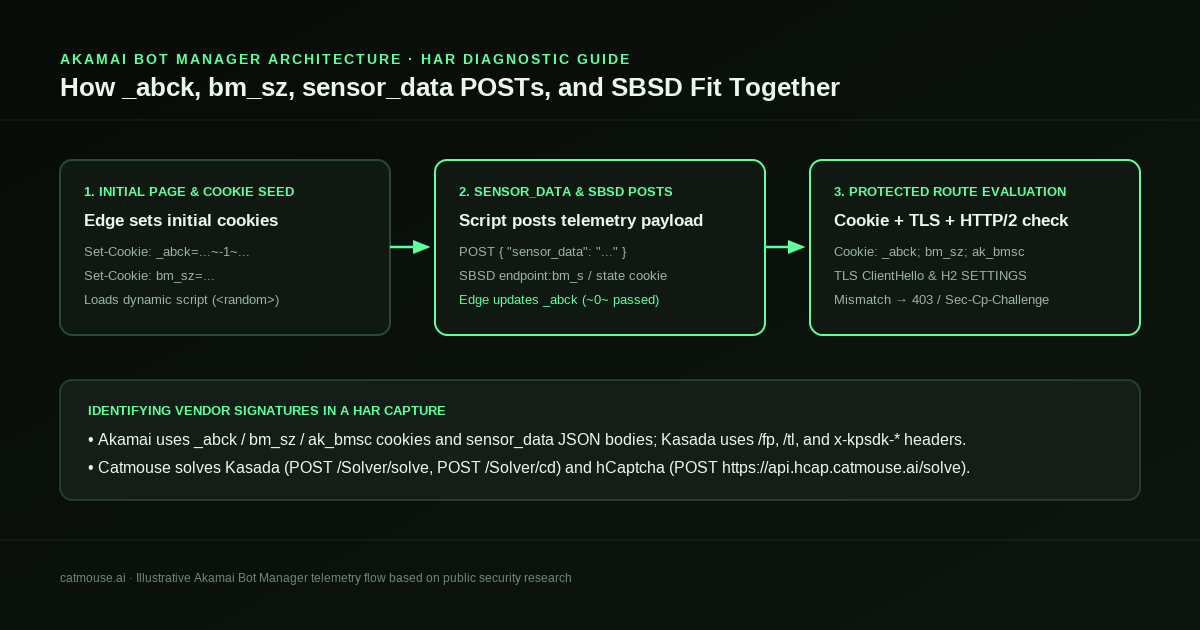
- Challenge bootstrap (ryanair bot detection scraping bypass)
- The initial HTTP challenge response on ryanair bot detection scraping bypass that delivers the vendor script or session seed to the client.
- Session state verification (ryanair bot detection scraping bypass)
- The header or cookie proof returned after telemetry evaluation on ryanair bot detection scraping bypass that authorizes subsequent API calls.
Evidence and sources
Sources opened on 2026-10-09 for this Ryanair article; each one says what is claimed next to it.
- IANA HTTP Status Code Registry and MDN HTTP response status codes: reference definitions for HTTP status codes observed during ryanair bot detection scraping bypass testing.
- Kasada product page. Supports: the general category description. The page mentions client-side sensors and a "Proof of Execution" section. It does not say Kasada protects ryanair.com.
- Akamai Bot Manager product page. Supports: the general category description. The page lists "AI models for user behavior analysis, browser fingerprinting, and more". It does not say Akamai protects ryanair.com.
- RFC 6585, section 4. Supports: the definition of 429, which the RFC ties to a user sending too many requests in a given amount of time.
- RFC 9110, section 15.5.4. Supports: the definition of 403, a response where the server understood the request but refuses to fulfil it.
- W3C WebDriver (Level 2). Supports: the definition of
navigator.webdriver, a flag that any script served by the site can read. - Catmouse OpenAPI file (openapi.json) together with the API reference. Supports: that
/Solver/solvetakes a fetched Kasadaips.jsbody (ipsBody) and thatenginenames a Kasada device profile, so the API lists no engine for any other vendor engine. Catmouse publishes this contract itself, so it confirms nothing about how ryanair.com behaves.
Methodology and limits. Documented: the statements attributed above to an RFC, the W3C specification, the two vendor product pages or the Catmouse API reference. Not documented: which vendor protects ryanair.com, which status code it returns, and any success rate. Catmouse did not run measurements for this article. Reviewed 2026-10-09; vendor behaviour can change without notice.
How does ryanair bot detection scraping bypass validate a trusted TLS session?
For ryanair bot detection scraping bypass, a client is a verified session when it sends fresh tokens versus static headers over a trusted TLS session.
Frequently asked questions
What bot protection does Ryanair use?
Catmouse does not name a vendor for the site, so this article calls it bot-management protection (vendor not re-verified). Identify the vendor from your own traffic; the Catmouse API is relevant only if that shows Kasada.
Why do airlines restrict automated access to fare pages?
Airlines publish their own terms of use and often limit automated collection of fares. The exact terms for Ryanair are in its published terms, which you should read before collecting any data.
Does the Catmouse API solve Ryanair's protection?
Only if your own authorized capture shows Kasada, because the solve endpoint handles Kasada only. Testing ryanair.com is limited to Ryanair staff or testers with written permission from Ryanair, and its terms of use still apply. This is not legal advice.
Next step
If you are authorized to assess ryanair.com, start from your own capture and the vendor documentation cited above. The API reference states which protection the solve endpoint handles, and the targets directory shows how Catmouse labels ryanair.com. This article is written for travel-data engineers and fare-comparison teams that have permission to collect Ryanair data. This article is a general explanation, not a test report.