British Airways Bot Detection Bypass: Avios Flight Scraping Guide
British Airways bot detection bypass comes down to one fact: the Catmouse targets directory lists britishairways.com as protected by Akamai Bot Manager, and a plain HTTP client only gets through with the session state that the vendor's browser-side script produces.
This article explains that mechanism and states what the Catmouse Solver API does and does not cover. Treat it as research, and apply it only to British Airways systems you own or are authorized to test.
Who this is for
Engineers and data teams who own, or have explicit written authorization to test, British Airways and want to understand how its bot protection is described in this post before deciding on an approach.
On this page
- Short answer and who this guide is for
- How Akamai Bot Manager challenges a plain HTTP client
- Headless browsers versus a solver service: the trade-off
- What the Catmouse Solver API covers for britishairways.com
- Scope and limitations
- Operational options documented in the API reference
- Evidence and sources
- Frequently Asked Questions
- Next step
- Target protection: britishairways.com is listed as Akamai Bot Manager-protected in the Catmouse targets directory (label not independently re-verified in this article).
- Symptom: requests without valid session state receive challenge responses, often HTTP 429 or 403.
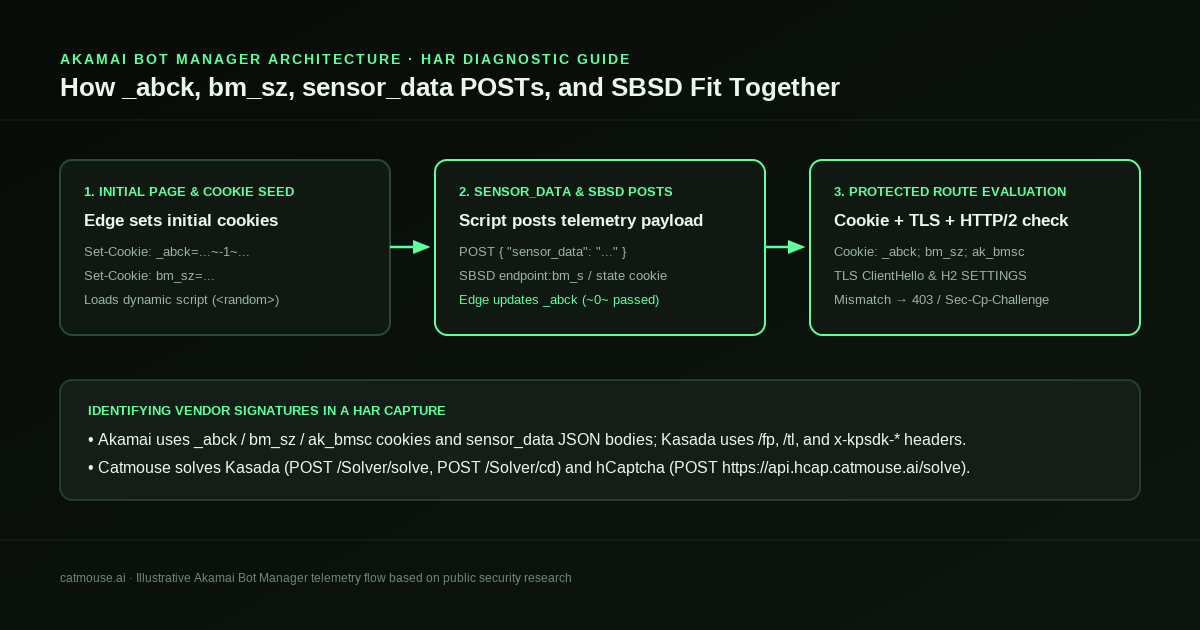
- Mechanism: a browser-side script returns a result to the server, which issues the session state used on later requests.
- Catmouse Solver API: it solves Kasada only (engine selects a Kasada device profile), so it has no Akamai Bot Manager engine and this post contains no API sample.
- Limits: no pass rate or latency is claimed here, tokens can be rejected, and use is restricted to authorized systems.
Short answer and who this guide is for
British Airways bot detection bypass is not a single trick. The Catmouse targets directory lists britishairways.com as protected by Akamai Bot Manager, and a plain HTTP client is only let through when it presents the session state that the vendor's browser-side script produces. The Catmouse Solver API is not a way to obtain it here: the API solves Kasada only, so this post is a research note on the mechanism and not an integration guide.
This guide is for engineers and data teams who need programmatic access to flight search and fare pages that they own or are authorized to test, and who want to understand the mechanism before choosing between browser automation and a solver service.
How Akamai Bot Manager challenges a plain HTTP client?
A request without valid session state is typically answered with a challenge instead of the page. The status code is often 429 or 403. RFC 6585 describes 429 as follows: "The 429 status code indicates that the user has sent too many requests in a given amount of time (“rate limiting”)." See RFC 6585. The 403 status is defined in RFC 9110 HTTP Semantics. Neither code names the product behind it.
The challenge delivers JavaScript that runs in the browser, collects environment signals, and returns a result to the server, which then issues session state for later requests. The Catmouse OpenAPI description documents Kasada solving only, so it says nothing about the headers or cookies an Akamai Bot Manager flow would need. Inspect the traffic of your own authorized session to see what the target actually sets.
- Without that session state, an HTTP client keeps receiving the challenge response.
- With it, requests can reach the application, provided the rest of the request (IP address, TLS and HTTP characteristics, request rate) is also acceptable to the target.
- The vendor can change the challenge at any time, so any solver or emulator needs ongoing maintenance.
Headless browsers versus a solver service: the trade-off
A real or headless browser runs the vendor script itself, so it can pass the challenge when it is configured to look like an ordinary browser. The cost is one browser process per session and the upkeep of that configuration. A solver service moves that work off your servers, in exchange for depending on the service and its coverage of the target. This article publishes no benchmark figures for either approach.
What the Catmouse Solver API covers for britishairways.com?
Nothing in the Catmouse server source or its public OpenAPI file provides a solver for Akamai Bot Manager. POST /Solver/solve takes the body of a fetched Kasada ips.js script, and its engine field selects a Kasada device profile (chrome, snkrs, wkw, fl, whatnot-ios or android), not an anti-bot vendor. For that reason this post shows no API code: any sample for britishairways.com would imply an engine that does not exist. If you need a request example for a Kasada-protected site, the Kasada architecture teardown and the API reference carry the real flow.
Scope, limitations, and recommendations
This guide for British Airways is a general explanation, not a test report. It contains no measured pass rates, latency, cost or uptime figures for britishairways.com, and it does not promise that any request will be accepted.
What separates british airways bot detection bypass telemetry from plain HTTP replay?
In contrast, on british airways bot detection bypass, you must refresh session state whenever a route returns a challenge instead of reusing old headers.
| Stage | Plain HTTP replay on british airways bot detection bypass | Verified session state on british airways bot detection bypass |
|---|---|---|
| Initial request | Missing session proof for british airways bot detection bypass | Bootstraps fresh challenge state for british airways bot detection bypass |
| Protected route | Challenged with HTTP 403 or 429 on british airways bot detection bypass | Attaches current session state for british airways bot detection bypass |
Operational options documented in the API reference
- Egress and geography
- The API has no proxy field.
tzandtzOffsetare required in production and should describe the exit IP of the proxy your own client uses for the target. - Error responses
- The server answers 400 for a malformed body (for example an empty
ipsBodyor missing geography), 401 for a missing or invalid key, 403 for a disabled or expired key, 422 when a script cannot be solved and 402insufficient_balancewhen the USD balance is used up. - Crypto top-up
- Funds are added to the USD balance through
POST /key/billing/create-checkout, which creates a real payment order with 0xProcessing. See the pricing page for current options.
Evidence and sources
- IANA HTTP Status Code Registry and MDN HTTP response status codes: reference definitions for HTTP status codes observed during british airways bot detection bypass testing.
- RFC 6585, section 4. Supports: the meaning of HTTP 429. Verbatim: "The 429 status code indicates that the user has sent too many requests in a given amount of time (“rate limiting”)." It does not say that a bot-management product sent the response.
- RFC 9110, HTTP Semantics, section 15.5.4. Supports: the meaning of HTTP 403. Verbatim: "The 403 (Forbidden) status code indicates that the server understood the request but refuses to fulfill it."
- Catmouse OpenAPI description (/openapi.json). Supports: that POST /Solver/solve is described around a Kasada ips.js body and that engine names Kasada device profiles. It documents no Akamai Bot Manager engine. Catmouse publishes this file itself, so for a British Airways reader it is a vendor statement and not a third-party check.
- Akamai Bot Manager product page. Supports only that Akamai offers Bot Manager, which per the page "effectively detects bot traffic and mitigates malicious bots at the edge." It does not document the challenge mechanism described in this post.
Methodology and limits. Reviewed 2026-10-09. Statements about how a vendor challenge works in practice are general observations, not vendor documentation: no vendor page cited here documents them. The protection label for britishairways.com comes from the Catmouse targets directory and was not independently re-verified.
How does british airways bot detection bypass validate a trusted TLS session?
For british airways bot detection bypass, a client is a verified session when it sends fresh tokens versus static headers over a trusted TLS session.
Frequently Asked Questions
What protects britishairways.com?
The Catmouse targets directory lists britishairways.com as protected by Akamai Bot Manager. This article did not independently re-verify that label, so confirm it from the response headers and scripts you see in your own authorized traffic before relying on it.
What does an HTTP 429 response mean?
RFC 6585 defines 429 as meaning that the user has sent too many requests in a given amount of time (rate limiting). Bot-management products can also return it, or a 403, when a client fails a challenge, so the status code alone does not identify the cause.
Does the Catmouse Solver API support Akamai Bot Manager?
No. The API solves Kasada only, and its engine field selects a Kasada device profile, so this article treats britishairways.com as a research subject and gives no API call for it.
Can I use this on any website?
No. Use it only on systems you own or are explicitly authorized to test, and check the site's terms and the laws that apply to you. This article is technical information, not legal advice.
Next step
Read the API reference to see which routes and engines exist. See also the targets directory and the Kasada architecture teardown.