Kith Bot Detection Bypass: Shopify and hCaptcha Notes
This Kith bot detection bypass guide separates what can be checked from what cannot. Catmouse lists kith.com as Shopify with hCaptcha, a label this article has not re-verified, and the Catmouse API documents no hCaptcha engine. It is for engineers with authorization to test who need a method, not a promise.
Who this is for
Engineers and data teams who own, or have explicit written authorization to test, Kith and want to understand how its bot protection is described in this post before deciding on an approach.
On this page
Limitations
- This post reflects the mechanism as reviewed on 2026-10-09. Protections change, so details may no longer match what a site serves today.
- No success rate, latency or uptime figure is stated or implied; outcomes depend on the target, your account state and your traffic.
- It applies only to systems you own or are explicitly authorized to test, and does not replace site terms, applicable law or rate limits.
- Catmouse's own target list labels kith.com as Shopify plus hCaptcha. The vendor is not re-verified here.
- The Catmouse solve endpoint is a Kasada solver: its engine field selects a Kasada device profile, and the public API has no hCaptcha engine, so this article has no solve example.
- No public Shopify documentation found describes a checkout queue, so this article does not describe queue internals.
What Catmouse labels on kith.com and what is not verified?
Catmouse's targets page lists kith.com with the engine label "Shopify + hCaptcha". The page notes drop-time checkout throttling, but this article could not confirm that with public documentation. The vendor label is therefore stated as "Shopify storefront with hCaptcha, vendor not re-verified".
The URL of this article contains "kasada" for historical reasons and is kept so that existing links keep working. Nothing in the article claims the site uses Kasada.
What hCaptcha Enterprise adds to a storefront?
hCaptcha describes itself in its developer guide as a service that protects websites and apps from bots, spam and other automated abuse. The same guide lists bot scores and passive "No-CAPTCHA" modes as Enterprise features, and describes the score field in siteverify responses as an Enterprise feature that indicates malicious activity.
Practical meaning: a visitor may never see a puzzle and still be scored by the widget. Whether kith.com uses those modes is not something this article can state.
How to inspect a Shopify storefront for challenge widgets?
- Load the page in a normal browser profile with DevTools open on the Network tab and keep the log across navigations.
- Filter requests for
hcaptchato see whether the widget script and its verification calls load, and on which pages. - Note any response with status 429 or 403. RFC 6585 describes 429 as rate limiting, so read the body and headers instead of assuming a vendor.
- Record any waiting-room or queue page you are shown, including its URL, so you can identify the product from its own documentation.
- Save the capture as a HAR file for later comparison. Do not share it publicly if it contains cookies or account data.
Handling 429 responses politely in Python
RFC 6585 section 4 says a 429 response may include a Retry-After header telling the client how long to wait. The snippet honors it and gives up after a few attempts. Point it only at kith.com paths you have permission to test.
import time
import requests


def get_with_backoff(url, attempts=3, default_wait=30):
    for _ in range(attempts):
        resp = requests.get(url, timeout=30)
        if resp.status_code != 429:
            return resp
        retry_after = resp.headers.get("Retry-After", "")
        wait = int(retry_after) if retry_after.isdigit() else default_wait
        time.sleep(wait)
    return resp  # still 429: stop and review, do not hammer the host
How does kith kasada shopify queue bypass validate a trusted TLS session?
For kith kasada shopify queue bypass, a client is a verified session when it sends fresh tokens versus static headers over a trusted TLS session.
What the Catmouse API supports today?
The /Solver/solve endpoint takes a Kasada ips.js script that your own client fetched, plus an engine value that selects a Kasada device profile (chrome, snkrs, wkw, fl, whatnot-ios or android). hCaptcha is a different product, so do not expect a request for kith.com to work. Check the API reference before building on any engine name you see in an article.
This article offers an inspection method and a rate-limit handling example. It contains no measured results for kith.com, no confirmation of queue behavior and no claim that any Catmouse engine works on this site. The vendor label comes from Catmouse's target list.
Use this material only on systems you own or are explicitly authorized to test, and follow the target site terms of service and applicable law. Last reviewed: 2026-10-09.
Evidence and sources
Sources are listed below, each one with the claim it supports.
- IANA HTTP Status Code Registry and MDN HTTP response status codes: reference definitions for HTTP status codes observed during kith kasada shopify queue bypass testing.
- hCaptcha developer guide says hCaptcha "helps to protect your sites and apps from bots, spam, and other automated abuse", lists bot scores and passive "No-CAPTCHA" modes as Enterprise capabilities, and calls the siteverify score an Enterprise feature.
- RFC 6585 section 4 defines 429 Too Many Requests as indicating that "the user has sent too many requests in a given amount of time", so 429 is a generic rate-limiting status and not a vendor marker. It also says a 429 response may include a Retry-After header.
- Catmouse OpenAPI document describes
/Solver/solveas taking a Kasada ips.js body and an engine that selects a Kasada device profile, and it has no hCaptcha engine, which is why this article has no solve example. It is Catmouse's own documentation, not independent evidence. - Catmouse targets page lists kith.com as Shopify with hCaptcha. This label is not independently verified here.
Methodology and limits: the hCaptcha and RFC statements above are quoted from the cited pages, read on 2026-10-09. The Shopify with hCaptcha label for kith.com and the API facts come from Catmouse's own targets page and OpenAPI document, so they are labels, not independent findings. This article reports no measurements of kith.com.
What separates kith kasada shopify queue bypass telemetry from plain HTTP replay?
In contrast, on kith kasada shopify queue bypass, you must refresh session state whenever a route returns a challenge instead of reusing old headers.
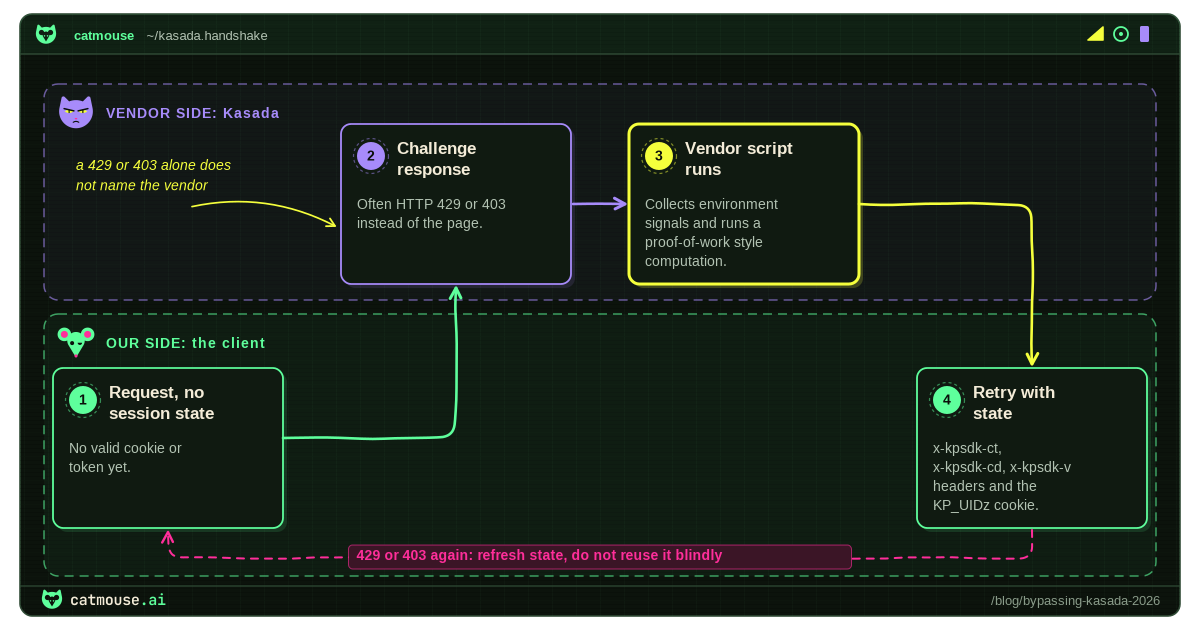
- Challenge bootstrap (kith kasada shopify queue bypass)
- The initial HTTP challenge response on kith kasada shopify queue bypass that delivers the vendor script or session seed to the client.
- Session state verification (kith kasada shopify queue bypass)
- The header or cookie proof returned after telemetry evaluation on kith kasada shopify queue bypass that authorizes subsequent API calls.
| Stage | Plain HTTP replay on kith kasada shopify queue bypass | Verified session state on kith kasada shopify queue bypass |
|---|---|---|
| Initial request | Missing session proof for kith kasada shopify queue bypass | Bootstraps fresh challenge state for kith kasada shopify queue bypass |
| Protected route | Challenged with HTTP 403 or 429 on kith kasada shopify queue bypass | Attaches current session state for kith kasada shopify queue bypass |
Frequently asked questions
Does kith.com use Kasada?
Catmouse's target list labels it Shopify plus hCaptcha, not Kasada. The article URL keeps the word Kasada for link stability only. The label is not independently re-verified.
Does Catmouse solve hCaptcha?
No. The Catmouse solve endpoint is a Kasada solver, and the public API has no hCaptcha endpoint. Do not plan an integration for kith.com around it.
Is there a Shopify checkout queue I can document?
No public Shopify page found describes one, so this article makes no claim about queue behavior.
Is it acceptable to automate a retail checkout?
Only where you own the store or have written authorization. Check the site terms of service and applicable law first.