Riot Games hCaptcha: How Enterprise Tokens Work
An hCaptcha deployment issues a response token to a client that passes its check, and the site's server then verifies that token with hCaptcha before it trusts the request. This page explains that public flow. The URL names Riot Games, but Catmouse has not re-verified which challenge product any Riot login flow uses today. On Catmouse, POST /Solver/solve handles Kasada scripts only, while hCaptcha token solving is served through the dedicated synchronous gateway documented on /hcaptcha.html. Apply it to hCaptcha integrations you operate, or to a Riot property only with written permission from Riot.
Key points
- Short answer: the browser receives an
h-captcha-responsetoken, the site's server posts it with its secret to the hCaptcha verification endpoint, and the token can be used once. - Who it is for: engineers who integrate or defend hCaptcha on their own sites, and testers who are authorized to assess a login flow.
- Catmouse coverage:
POST /Solver/solvetakes a fetched Kasadaips.jsbody and covers Kasada device profiles, while the dedicated hCaptcha gateway documented at /hcaptcha.html acceptssite_key,host, andproxy(plus optionaltask_id,href, andrqdata) and charges a charge only when a token is returned. - Riot Games: whether a given Riot flow uses hCaptcha or hCaptcha Enterprise is not re-verified here.
Who this is for
Engineers and data teams who own, or have explicit written authorization to test, a Riot Games property and want to understand the public hCaptcha verification flow described in this post before deciding on an approach.
On this page
- How an hCaptcha response token is issued and verified
- Why an hCaptcha token cannot be reused or stockpiled
- What this page does not cover about hCaptcha Enterprise
- What the Catmouse API covers today and what to use instead
- Scope, limitations and authorized use
- Evidence and sources
- Frequently asked questions
How an hCaptcha response token is issued and verified?
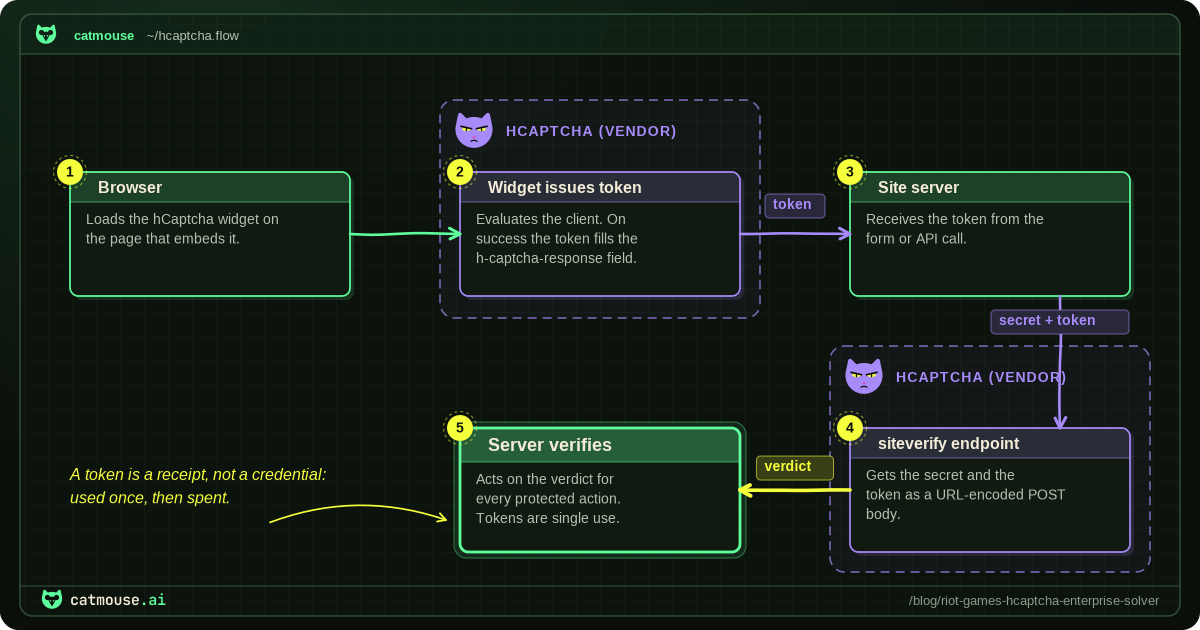
The page that embeds hCaptcha receives a response token in the browser after the client passes the check, and the site's server verifies it. Per the hCaptcha developer documentation, the verification endpoint is https://api.hcaptcha.com/siteverify, called with a POST request that carries the site's secret and the token as a URL-encoded form body.
- The browser loads the hCaptcha widget and the client is evaluated (Catmouse's summary; the documentation does not detail the evaluation).
- On success the widget places the token in the form field named
h-captcha-response. - The form or API call sends the token to the site's own server.
- The site's server posts the secret and the token to the hCaptcha verification endpoint and acts on the verdict.
Why an hCaptcha token cannot be reused or stockpiled?
hCaptcha tokens are single use and short lived. The hCaptcha developer documentation states that tokens can only be used once and must be verified within a short period after being issued, and its error table gives 120 seconds as the default expiry window.
For defenders this means verification must happen on the server for every protected action, and a token must never be trusted because it merely exists. For testers it means a token captured earlier is not a credential: each protected request needs a fresh token verified within the expiry window.
What this page does not cover about hCaptcha Enterprise?
hCaptcha Enterprise adds features beyond the basic flow above, and hCaptcha documents them itself. This page does not describe risk scoring, passive mode or custom request data in detail because those details were not verified against hCaptcha's public documentation. Read the vendor documentation for the behaviour of your integration.
Claims about how a specific game login evaluates risk, how often challenges appear, or what they cost to pass need a dated test on a system you are authorized to assess. Catmouse has not published one.
What the Catmouse API covers today and what to use instead?
On Catmouse, the Kasada and hCaptcha gateways are separate surfaces. In /openapi.json, POST /Solver/solve takes the body of a fetched Kasada ips.js script, and its engine field selects a Kasada device profile (chrome, snkrs, wkw, fl, whatnot-ios or android). Content that is not a Kasada script is refused with a 400 invalid ipsBody error.
For authorized hCaptcha testing, Catmouse operates the separate synchronous gateway documented on the hCaptcha API page (POST https://api.hcap.catmouse.ai/solve). A request carries site_key, host, and a residential or mobile proxy (plus optional task_id, href, and rqdata), holds the connection open until completion, and spends a charge only when a redeemable P1_ token is returned. If you are defending your own login flow, verify every token server-side at siteverify as described above. For the Kasada flow, see the Scheels Kasada guide, the targets directory and the API reference.
Scope, limitations and authorized use
Last reviewed: 2026-10-10.
Next step: read the hCaptcha developer documentation for your integration, or see the Catmouse hCaptcha API page and API reference.
How does riot games hcaptcha enterprise solver validate a trusted TLS session?
For riot games hcaptcha enterprise solver, a client is a verified session when it sends fresh tokens versus static headers over a trusted TLS session.
Evidence and sources
- IANA HTTP Status Code Registry and MDN HTTP response status codes: reference definitions for HTTP status codes observed during riot games hcaptcha enterprise solver testing.
- hCaptcha developer documentation: supports the verification endpoint
https://api.hcaptcha.com/siteverifycalled with a POST request, theh-captcha-responsefield, single use, and the 120-second default expiry. Source text: "Tokens can only be used once and must be verified within a short period of time after being issued." and, forexpired-input-response, "The response parameter (verification token) is expired. (120s default)" Fetched 2026-10-09. - Catmouse OpenAPI file and Catmouse hCaptcha API page: support the distinction between
POST /Solver/solve(which takes a fetched Kasadaips.jsbody and a Kasada device profile) and the separate synchronous hCaptcha gateway (POST https://api.hcap.catmouse.ai/solve, takingsite_key,host,proxy, and optionaltask_id,href,rqdata). Catmouse publishes these contracts itself, so they confirm nothing about how Riot behaves.
Methodology and limits. Documented: the token flow, single use, the 120-second default expiry and the scope of the Catmouse endpoints from the sources above. Observation or inference: how any Riot Games flow is configured is not documented in these sources and is not claimed; the first step of the flow is a summary, not hCaptcha wording. Reviewed 2026-10-10.
What separates riot games hcaptcha enterprise solver telemetry from plain HTTP replay?
In contrast, on riot games hcaptcha enterprise solver, you must refresh session state whenever a route returns a challenge instead of reusing old headers.
- Challenge bootstrap (riot games hcaptcha enterprise solver)
- The initial HTTP challenge response on riot games hcaptcha enterprise solver that delivers the vendor script or session seed to the client.
- Session state verification (riot games hcaptcha enterprise solver)
- The header or cookie proof returned after telemetry evaluation on riot games hcaptcha enterprise solver that authorizes subsequent API calls.
| Stage | Plain HTTP replay on riot games hcaptcha enterprise solver | Verified session state on riot games hcaptcha enterprise solver |
|---|---|---|
| Initial request | Missing session proof for riot games hcaptcha enterprise solver | Bootstraps fresh challenge state for riot games hcaptcha enterprise solver |
| Protected route | Challenged with HTTP 403 or 429 on riot games hcaptcha enterprise solver | Attaches current session state for riot games hcaptcha enterprise solver |
Frequently asked questions
What is the h-captcha-response token?
It is the token the hCaptcha widget places in the h-captcha-response form field after a client passes the check. The site's server sends it to the hCaptcha verification endpoint to confirm it.
How long is an hCaptcha token valid?
hCaptcha documents tokens as single use, and its error table gives 120 seconds as the default expiry window. Verify each token promptly on the server.
Does Catmouse solve hCaptcha?
Catmouse provides a separate synchronous hCaptcha gateway documented at /hcaptcha.html (POST https://api.hcap.catmouse.ai/solve) that accepts a site_key, host, and caller proxy and spends a charge only when a redeemable token is returned. By contrast, POST /Solver/solve in openapi.json takes a fetched Kasada ips.js body and covers Kasada device profiles only.
Does Riot Games use hCaptcha Enterprise?
This page does not establish that. The URL names Riot Games, but which challenge product a given Riot flow uses was not re-verified.