ThreatMetrix Device Profiling: Signals and Limits
ThreatMetrix device profiling is a fraud-risk technique from LexisNexis Risk Solutions that combines device, location and behavior signals into a risk decision. This article explains what such profiling does, the categories of signals involved, and why inconsistent signals are hard to hide. It is an explainer, not a how-to for evading fraud controls.
Who this is for
Engineers who own or are explicitly authorized to test a ThreatMetrix-protected system and want the mechanism explained before choosing an approach.
On this page
- What it is: ThreatMetrix is described by LexisNexis as a risk decision engine that uses digital identity and behavioral intelligence to detect fraud in real time.
- Difference from bot management: it scores transaction risk, so a visit can pass a bot check and still be scored as risky.
- Catmouse coverage: the public solver API solves Kasada only, and the API reference documents no ThreatMetrix endpoint, so this article has no solver code.
- Limits: signal counts, hashing details and detection rules are vendor-internal and are not asserted here.
What ThreatMetrix device profiling is?
LexisNexis describes ThreatMetrix as a risk decision engine that applies digital identity and behavioral intelligence, with AI-powered models, to detect fraud and inform risk decisions in real time. The vendor lists devices, location and behavior among the signals it unifies with historical patterns.
Where a site calls such a service, for example at login or checkout, is that site's decision, and Catmouse has not documented it for any named site. The vendor frames the product as delivering risk decisions, so the goal is to judge the transaction, not only to detect automation. In principle, a genuine customer on an unusual device could be stepped up to extra verification and an automated session on a clean device could be allowed; Catmouse has not tested either case.
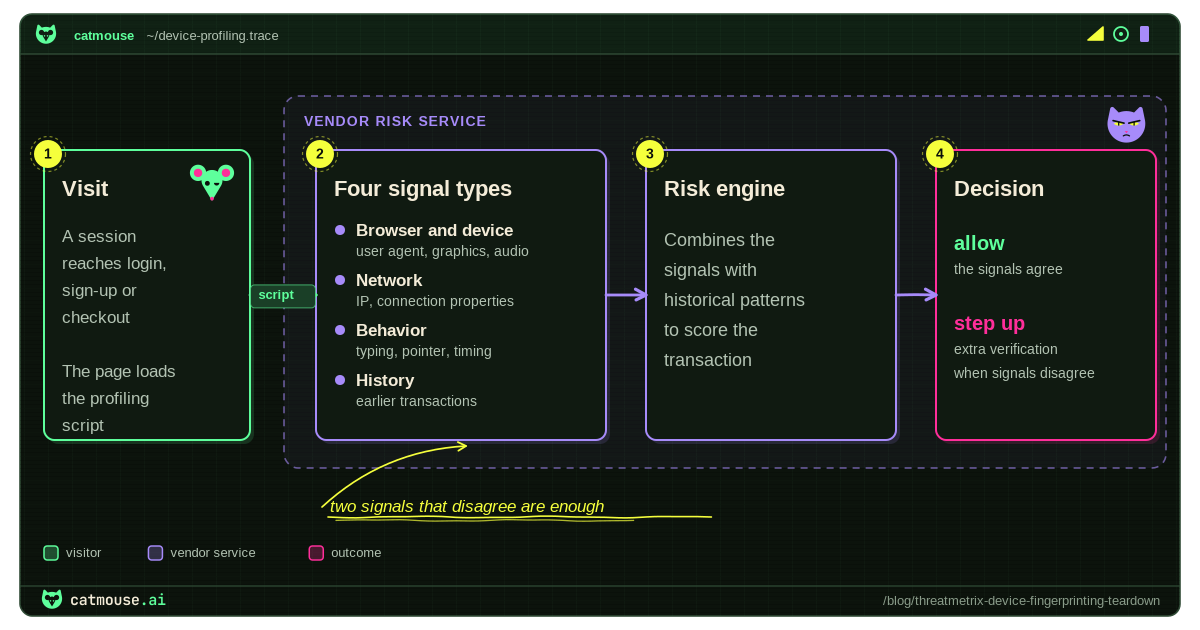
The categories of signals a profiling service can combine
Vendors do not publish their full signal lists, so the exact number of signals and the hashing used to build an identifier are not stated here. The categories below are common to browser-based device profiling in general.
| Category | Examples | Why it is useful to a risk engine |
|---|---|---|
| Browser and device attributes | User agent, screen size, language, time zone, graphics and audio capabilities exposed by web APIs | Helps recognize a returning device without relying on a cookie |
| Network attributes | IP address, connection properties, consistency between network and claimed device | Flags mismatches such as a mobile device claim over a datacenter network |
| Behavior | Typing and pointer patterns, navigation order, timing | Separates scripted flows from typical customer sessions |
| History | Whether a device or identity has appeared in earlier transactions | Lets one organization carry prior risk knowledge into a new session |
Why inconsistent signals are hard to hide?
A risk engine does not need to identify the automation tool. It only needs two signals that disagree, such as a user agent that claims one platform and a graphics capability that implies another. Each added layer of spoofing creates one more value that must agree with the rest.
Automation itself is also visible by design. The W3C WebDriver specification defines a webdriver-active flag that is true when the user agent is under remote control, which gives pages a standard way to notice driven browsers.
What legitimate testers and integrators can do?
If you operate a site that uses a risk service, test your own integration with the vendor's documentation and sandbox, use test accounts, and agree the scope with your fraud team. If you are a researcher without that relationship, you need written permission before testing any third-party deployment.
Do not use profiling research to evade fraud controls on checkout or payment flows. That is fraud, whatever the tooling.
Scope, limitations, and recommendations
This article explains what device-profiling fraud-risk products such as ThreatMetrix do and how they differ from bot management. It is an explainer, not a how-to for evading fraud controls. It contains no measured pass rates, latencies or costs for any named site. It cites no signal count, device-ID format or checkout case study, because no source supports them. Vendors change their products without notice, so treat every product label here as a starting hypothesis and confirm it against live traffic.
Authorized use: Exercise device profiling only in your own deployment or a vendor sandbox you are authorized to use, with test accounts, and follow your organization's fraud-team scope and applicable law. See the acceptable use policy.
Last reviewed: 2026-10-09.
What separates threatmetrix device fingerprinting teardown telemetry from plain HTTP replay?
In contrast, on threatmetrix device fingerprinting teardown, you must refresh session state whenever a route returns a challenge instead of reusing old headers.
- Challenge bootstrap (threatmetrix device fingerprinting teardown)
- The initial HTTP challenge response on threatmetrix device fingerprinting teardown that delivers the vendor script or session seed to the client.
- Session state verification (threatmetrix device fingerprinting teardown)
- The header or cookie proof returned after telemetry evaluation on threatmetrix device fingerprinting teardown that authorizes subsequent API calls.
Evidence and sources
- IANA HTTP Status Code Registry and MDN HTTP response status codes: reference definitions for HTTP status codes observed during threatmetrix device fingerprinting teardown testing.
- LexisNexis ThreatMetrix product page: LexisNexis describes ThreatMetrix on its product page with phrases such as "One holistic risk decision engine", "Best-in-class digital identity and behavioral intelligence", "Embedded AI-powered models" and "delivering risk decisions in real time", and says digital identity intelligence works by "unifying devices, location, behavior, anonymized PII and historical patterns such as previous risk associations."
- W3C WebDriver specification: the webdriver-active flag is "set to true when the user agent is under remote control", and
navigator.webdriverreturns its value. - Catmouse API: the
/Solver/solveendpoint (authenticated with thex-api-keyheader) and its Kasada device-profileenginevalues are defined in the Catmouse OpenAPI document and described in the API reference.
Methodology and limits
The signal categories in Table 1 are general descriptions of browser-based profiling, not a statement of ThreatMetrix internals.
How does threatmetrix device fingerprinting teardown validate a trusted TLS session?
For threatmetrix device fingerprinting teardown, a client is a verified session when it sends fresh tokens versus static headers over a trusted TLS session.
Frequently asked questions
What does ThreatMetrix evaluate?
LexisNexis says it combines device, location and behavior signals with historical patterns to inform real-time risk decisions. The full signal list is not public.
Does rotating IP addresses defeat device profiling?
Not by itself. Profiling looks at device and behavior signals as well as the network, and a new IP does not make the other signals consistent. Exact rules are vendor-internal.
Does Catmouse offer a ThreatMetrix solver?
No. The public solver API solves Kasada only (its engine field selects a Kasada device profile), and the API reference documents no ThreatMetrix endpoint.
How do I test my own deployment?
Use the vendor documentation and sandbox, work with test accounts, and agree the scope with your fraud and security teams first.
Next step
Next step: compare how bot-management products differ from risk engines in the article on headless browsers, or read the API reference for what the solver API covers today.