ThreatMetrix org_id, fp_server CNAME, and clear.png Profiling
ThreatMetrix (LexisNexis Digital Identity Network) binds every client profiling session to an 8-character tenant org_id and a per-transaction session_id dispatched through a first-party fp_server CNAME using /fp/tags.js, /fp/clear.png, and /fp/check.js. Below: how the beacon pipeline operates and how it interacts with edge bot managers like Kasada.
Who this is for
Security researchers and protocol engineers analyzing multi-layer enterprise stacks that pair an edge gate (such as Kasada or Akamai) with asynchronous ThreatMetrix transaction risk profiling at login or checkout.
On this page
- What do org_id and fp_server control in ThreatMetrix?
- How do tags.js, clear.png, and check.js profile a session?
- How does the backend Session Query API evaluate session_id coherence?
- How do you align proxy timezone and TLS when a site stacks Kasada with ThreatMetrix?
- Key takeaways
- Conclusion and scope
- Evidence and sources
- Frequently asked questions
What do org_id and fp_server control in ThreatMetrix?
ThreatMetrix is a session-profiling platform keyed by an eight-character organization identifier and a collector hostname that routes beacons to the LexisNexis risk cluster.
Unlike edge WAFs that block HTTP requests inline with a 403 or 429 status code, ThreatMetrix operates as a silent out-of-band telemetry collector. When a browser or mobile app loads a login, registration, or payment view, the page initializes a profiling tag carrying four core parameters:
org_id(Organization Identifier)- The
org_idparameter is an 8-character alphanumeric string (for example,k8vif92e) identifying the merchant environment (sandbox versus production) inside the LexisNexis Digital Identity Network. session_id(Transaction Profiling Key)- The
session_idvalue is a high-entropy token—often prefixed with the merchant slug—generated per checkout or authentication attempt. Both the client beacons and the merchant's backend risk query join on this exact string. fp_server(First-Party CNAME vsh.online-metrix.net)- While legacy integrations point directly at
h.online-metrix.net, modern retail and banking deployments configure a first-party DNS CNAME (such asfp.example.com). Using a first-party subdomain prevents browser privacy filters from blocking/fp/tags.jsand exposes parent-domain cookies during beacon transmission (RFC 6265). page_id(Policy Context)- An optional integer or label indicating which workflow (login, account creation, add-card, or checkout) triggered the profile so the backend policy engine applies matching risk weights.
How do tags.js, clear.png, and check.js profile a session?
ThreatMetrix splits collection into a passive network pixel and an active JavaScript instrumentation bundle orchestrated by the bootstrap loader script.
When the storefront executes /fp/tags.js?org_id=<org_id>&session_id=<session_id>, the loader spawns an isolated iframe and fires a sequence of sub-requests against fp_server. Even if a client blocks or strips JavaScript execution, the fallback <noscript> or image beacon to /fp/clear.png still records the client's network-layer identity.
Comparing ThreatMetrix profiling endpoints across the beacon lifecycle
The table below summarizes the role of each endpoint under the collector path during a single profiling cycle:
| Endpoint Path | Trigger Mechanism | Primary Signals Recorded | Failure Mode if Omitted |
|---|---|---|---|
/fp/tags.js | Script tag with org_id and session_id | Initializes iframe context and generates dynamic sub-request nonces | session_id remains completely unprofiled on the backend |
/fp/clear.png | 1x1 image beacon with query parameters | Passive TCP/IP stack parameters, TLS cipher order, and egress IP | Backend flags missing passive network telemetry |
/fp/check.js | Dynamic script loaded inside profiling context | Canvas, WebGL renderer, AudioContext, fonts, screen geometry, and IANA timezone | Profile marks JavaScript instrumentation as incomplete or headless |
/fp/ls_fp.html | Iframe persistence helper | Reads and writes persistent device tokens across localStorage and IndexedDB | Device appears as a brand-new unseen browser on every run |
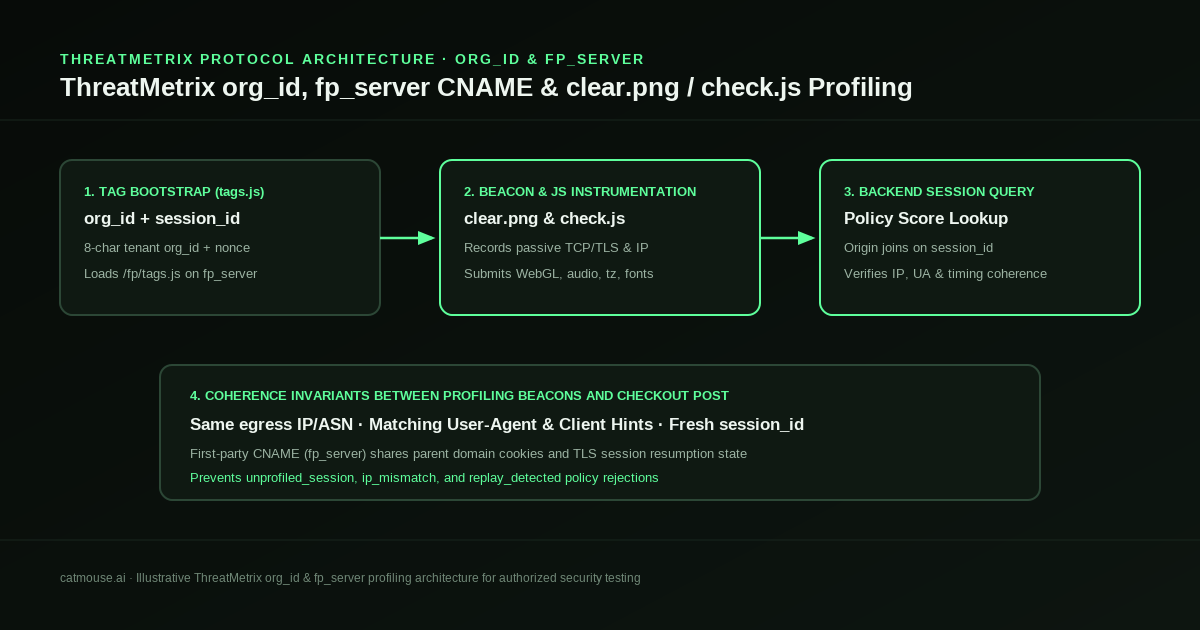
org_id and first-party fp_server beacon correlation with backend Session Query evaluation. Diagram by Catmouse Engineering.How does the backend Session Query API evaluate session_id coherence?
The merchant backend queries LexisNexis with the submitted session identifier and compares the recorded network and browser attributes against the checkout HTTP request.
Three coherence checks enforced by the Session Query policy engine
Submitting a syntactically valid session_id string in a checkout JSON body does nothing on its own unless that exact session_id completed its trusted beacon exchange against fp_server seconds earlier. During the backend Session Query API call, the policy engine cross-checks three invariants:
- Egress IP and ASN continuity: The merchant server passes the client's checkout IP address (
service_type=session-policy) to LexisNexis. If/fp/clear.pngand/fp/check.jswere executed from a different proxy exit IP—or were never executed at all—the policy engine flags an IP mismatch or unprofiled session. - Timezone and locale alignment:
check.jsreads bothIntl.DateTimeFormat().resolvedOptions().timeZoneandnew Date().getTimezoneOffset(). When the reported timezone contradicts the GeoIP location of the residential proxy exit, risk rules increment the anomaly score. - Single-use freshness: Reusing an already-queried
session_idacross multiple checkout attempts triggers duplicate-session velocity rules immediately.
How do you align proxy timezone and TLS when a site stacks Kasada with ThreatMetrix?
Pin a single sticky residential proxy exit and pass its matching IANA timezone and offset to the solver so both edge and fraud layers observe identical geo telemetry.
On retail and ticketing origins that gate the storefront behind Kasada while running ThreatMetrix on checkout, your HTTP session must keep its proxy exit IP, User-Agent, and timezone consistent across every step. The Python example below requests a Kasada /tl payload via POST /Solver/solve with explicit tz and tzOffset parameters aligned to a US Eastern proxy exit:
import os
import requests

solve_resp = requests.post(
    "https://kasadaapi.catmouse.ai/Solver/solve",
    headers={"x-api-key": os.environ["CATMOUSE_KEY"]},
    json={
        "ipsUrl": "https://www.example.com/149e9513-01fa-4fb0-aad4-566afd725d1b/2d206a39-8ed7-437e-a3be-862e0f06eea3/ips.js",
        "ipsBody": "<UTF-8 ips.js script fetched via sticky proxy>",
        "tz": "America/New_York",
        "tzOffset": 300,
        "engine": "chrome",
    },
    timeout=25,
)
print(solve_resp.status_code, solve_resp.text)
Key takeaways
org_idandsession_idjoin client and server: Every beacon sent tofp_servercarries the 8-character tenantorg_idand the per-transactionsession_idverified by the backend Session Query API.- First-party
fp_serverCNAMEs share origin context: Enterprise deployments route/fp/tags.js,/fp/clear.png, and/fp/check.jsthrough a subdomain of the merchant origin so cookies and TLS sessions correlate. - Never reuse a
session_id: Generate and profile a freshsession_idfor each authentication or checkout flow over the same sticky proxy IP. - Keep
tzandtzOffsetcoherent across layers: When a target combines Kasada edge protection with downstream risk scoring, pass the proxy exit's exact IANA timezone toPOST /Solver/solve.
Conclusion and scope
Understanding how ThreatMetrix links org_id, first-party fp_server CNAME beacons, and backend Session Query checks helps engineers diagnose why a checkout request can pass an edge challenge yet fail downstream fraud evaluation when proxy IPs or timezones drift mid-session.
Scope and limitations. Per the Catmouse OpenAPI 3.1 contract (/openapi.json), our hosted solver endpoints (POST /Solver/solve and POST /Solver/cd) solve Kasada challenges only and do not expose a ThreatMetrix engine. All protocol descriptions in this article are provided for defensive analysis and authorized testing as of 2026-11-03.
Evidence and sources
The protocol mechanics, HTTP specifications, and API contracts cited in this article are backed by the references below:
- Catmouse OpenAPI 3.1 specification (
/openapi.json) and API reference (/reference.html). Supports:POST /Solver/solverequest fields (ipsUrl,ipsBody,tz,tzOffset,engine),GET /Solver/getBalancewallet fields, and Kasada-only engine scope. Reviewed 2026-11-03. - IETF RFC 6265 (HTTP State Management Mechanism) and IETF RFC 9110 (HTTP Semantics). Supports: first-party CNAME cookie scoping and HTTP header semantics.
- ECMA-402 Intl.DateTimeFormat Specification and W3C Fingerprinting Guidance. Supports: browser timezone extraction and client surface correlation.
Methodology and limits. Based on inspection of public client-side tags.js loader integrations and documented Catmouse OpenAPI schemas. No pass-rate or latency figures are claimed. Reviewed 2026-11-03.
Frequently asked questions
What is the ThreatMetrix org_id parameter?
The ThreatMetrix org_id is an 8-character alphanumeric tenant identifier assigned by LexisNexis Risk Solutions that routes client profiling beacons (tags.js, clear.png, and check.js) to the merchant's policy ruleset.
Why do enterprise sites use a first-party fp_server CNAME instead of h.online-metrix.net?
Routing ThreatMetrix beacons through a first-party CNAME (such as fp.example.com) avoids third-party tracker blockers, allows the collector to read parent-domain cookies, and correlates TLS session resumption with the merchant origin.
What is the role of clear.png in ThreatMetrix session profiling?
The /fp/clear.png beacon records passive network attributes—including the client egress IP, TCP/IP packet signature, TLS handshake, and HTTP headers—under the session_id even before JavaScript instrumentation completes.
How does the merchant backend verify a ThreatMetrix session_id?
When the client submits a login or checkout request containing the session_id, the merchant server invokes the LexisNexis Session Query API using its org_id and API key to retrieve the risk score and device attributes recorded for that session_id.
Does the Catmouse API expose a hosted ThreatMetrix solver endpoint?
No. Per the Catmouse OpenAPI 3.1 contract (/openapi.json), the hosted solver endpoints handle Kasada (POST /Solver/solve and POST /Solver/cd); ThreatMetrix architecture is documented for protocol analysis and multi-layer stack diagnostics.