Kasada Protected Sites: Target List and How to Check
This directory of Kasada protected sites is a list of labels, not a certification. It reproduces the hosts that Catmouse's targets page marks as Kasada, explains how to confirm a label with your own capture, and is for teams planning authorized testing or integration work.
Who this is for
Engineers and researchers who want a list of sites this post associates with Kasada, to decide which of them to read about before testing a system they are authorized to test.
On this page
Limitations
- This post reflects the mechanism as reviewed on 2026-10-09. Protections change, so details may no longer match what a site serves today.
- No success rate, latency or uptime figure is stated or implied; outcomes depend on the target, your account state and your traffic.
- It applies only to systems you own or are explicitly authorized to test, and does not replace site terms, applicable law or rate limits.
- The table lists 23 hosts whose engine label on the Catmouse targets page includes Kasada. Labels are not independently re-verified for this article.
- Sites change vendors, and a label can be out of date. Confirm in your own capture before you rely on it.
- Listing a site here is not a statement that it is easy or permitted to automate. Use only systems you own or are authorized to test.
How to check whether a site uses Kasada?
Open the site in a normal browser with DevTools on the Network tab. Look for request headers named x-kpsdk-ct, x-kpsdk-cd and x-kpsdk-v, and an obfuscated script served from the site's own domain. These are the markers the Catmouse API reference associates with Kasada.
An HTTP 429 status is not a marker by itself. RFC 6585 section 4 defines it as the generic too-many-requests status, and any rate limiter can return it.
For the vendor's own description, see Kasada.
Hosts labelled as Kasada on the Catmouse targets page
The engine column is copied from the targets page and may include a second vendor. A guide link is shown where Catmouse has a dedicated article. Those articles are being reviewed separately and may use more cautious vendor language than this table.
| Site | Host | Engine label | Guide |
|---|---|---|---|
| Scheels | scheels.com | Kasada | article |
| Chewy | chewy.com | Kasada | article |
| Whatnot | whatnot.com | Kasada | article |
| Canada Goose | canadagoose.com | Kasada | article |
| Bunnings Warehouse | bunnings.com.au | Kasada | article |
| Qantas Airways | qantas.com | Kasada | article |
| Air New Zealand | airnewzealand.com | Kasada | article |
| Virgin Australia | virginaustralia.com | Kasada | article |
| Cotton On Group | cottonon.com | Kasada | article |
| Officeworks | officeworks.com.au | Kasada | article |
| Chipotle | chipotle.com | Kasada Mobile + Web | article |
| Kmart Australia | kmart.com.au | Kasada | article |
| Jetstar Airways | jetstar.com | Kasada | article |
| Flight Centre | flightcentre.com.au | Kasada | article |
| Webjet | webjet.com.au | Kasada | article |
| Allegiant Air | allegiantair.com | Kasada | article |
| Carnival Cruise | carnival.com | Kasada | article |
| Avis Car Rental | avis.com | Kasada | article |
| Hertz | hertz.com | Kasada | article |
| Moncler and Dior | moncler.com | Kasada | article |
| Moshtix | moshtix.com.au | Kasada | article |
| Rebel Sport | rebelsport.com.au | Kasada | article |
| Ticketmaster | ticketmaster.com | Kasada + Akamai BMP | article |
How to read an engine label responsibly?
- A label records what Catmouse believed when the targets page was written. It is not a vendor statement and it does not expire automatically.
- Combined labels such as "Kasada + Akamai" mean more than one product may be present. Identify which one issues the token a given request needs.
- A site can deploy a vendor on some paths only, for example login or checkout, and not on others.
- If your capture disagrees with a label, trust your capture and tell us through the contact details on the about page.
Next step after you confirm a label
Read the solver API walkthrough for the documented request and response fields, then try the documented solve flow once against a host you are authorized to test. Record the result from your own traffic instead of relying on figures in articles.
How does kasada protected sites and retailers list validate a trusted TLS session?
For kasada protected sites and retailers list, a client is a verified session when it sends fresh tokens versus static headers over a trusted TLS session.
This page republishes Catmouse's own target labels and a verification method. It contains no per-site success rate, pricing, traffic share or case study. Vendor deployments change without notice, so a label may be outdated.
Use this material only on systems you own or are explicitly authorized to test, and follow the target site terms of service and applicable law. Last reviewed: 2026-10-09.
Evidence and sources
The statements in this article rest on the sources below. Each entry names the claim it supports.
- IANA HTTP Status Code Registry and MDN HTTP response status codes: reference definitions for HTTP status codes observed during kasada protected sites and retailers list testing.
- RFC 6585 section 4 defines 429 Too Many Requests as indicating that "the user has sent too many requests in a given amount of time", so 429 is a generic rate-limiting status and not a vendor marker. It also says a 429 response may include a Retry-After header.
- Kasada (vendor site) describes Kasada as a security platform that defends against bots and online fraud. The page does not document x-kpsdk headers or script internals, so none of those are attributed to it.
- Catmouse targets page is the source of every row in Table 1. A row records the engine label Catmouse assigned, not a vendor statement.
- Catmouse OpenAPI document documents x-kpsdk-ct, x-kpsdk-cd and x-kpsdk-v as the headers of the Kasada flow, which is why they are used here as markers to look for.
Methodology and limits: the RFC 6585 quotation was read on 2026-10-09. Every row in Table 1 is a label copied from the Catmouse targets page, not a finding of this article, and a host that moves vendors or protects only some paths can make its row wrong. Nothing here was measured on the listed hosts.
What separates kasada protected sites and retailers list telemetry from plain HTTP replay?
In contrast, on kasada protected sites and retailers list, you must refresh session state whenever a route returns a challenge instead of reusing old headers.
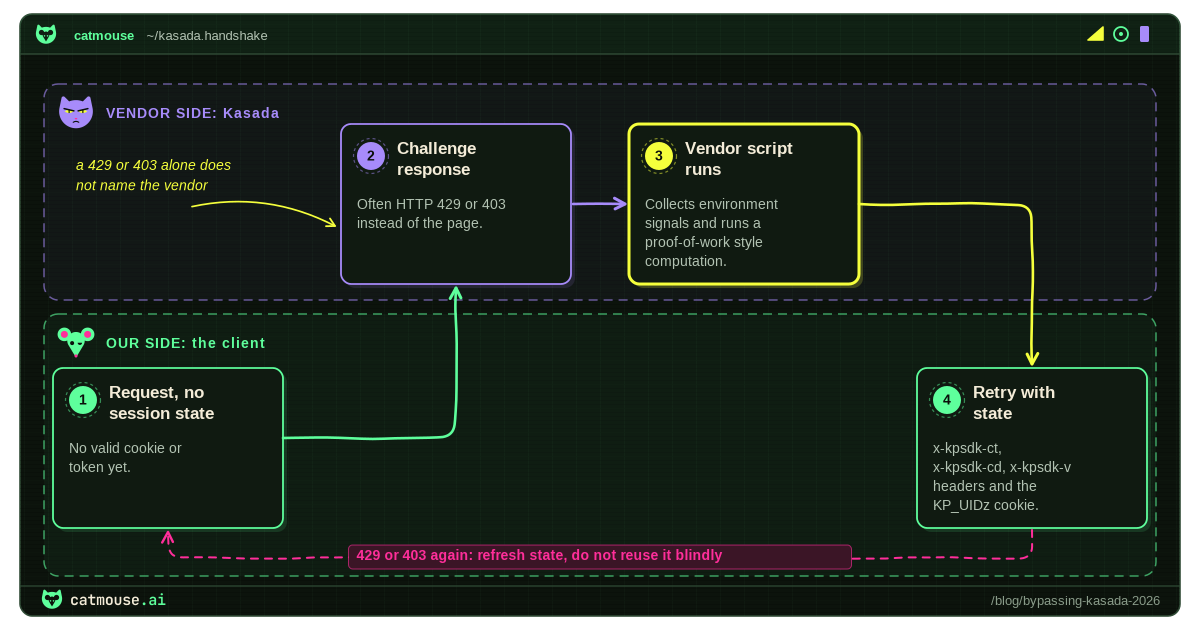
- Challenge bootstrap (kasada protected sites and retailers list)
- The initial HTTP challenge response on kasada protected sites and retailers list that delivers the vendor script or session seed to the client.
- Session state verification (kasada protected sites and retailers list)
- The header or cookie proof returned after telemetry evaluation on kasada protected sites and retailers list that authorizes subsequent API calls.
Frequently asked questions
Is this list complete?
No. It reflects hosts that Catmouse labels as Kasada on its targets page, and many other sites may use the product.
Is each label verified?
Not independently for this article. Confirm each one in your own network capture.
Does a listing mean a site can be automated?
No. Automating a site requires authorization from its owner and compliance with its terms and applicable law.
Why do some rows show two vendors?
The targets page records more than one product for those hosts. Check which one issues the token that a given request needs.